


The Euro (EUR) remains firmly on the defensive against a broadly ascendant US Dollar (USD) this Wednesday, signaling a challenging period for the single currency. As market participants conclude the month, the EUR/USD pair is on track to register a loss exceeding 2% for September, reflecting persistent bearish sentiment. Currently trading around 1.1337, the pair hovers perilously close to Tuesday’s low of 1.1312, a critical juncture that marks its weakest level observed since May 2025. This sustained downward pressure underscores a significant shift in currency dynamics, driven by a confluence of macroeconomic factors and technical indicators.
The Euro’s Tumultuous September: A Chronology of Decline
September has proven to be a particularly challenging month for the Euro. The currency pair began the month facing moderate pressure, but this gradually intensified as the weeks progressed. Early September saw the USD gather strength on the back of resilient US economic data, particularly robust employment figures and inflation reports that suggested the Federal Reserve might maintain its hawkish stance for longer than previously anticipated. This initial divergence in monetary policy expectations between the Federal Reserve and the European Central Bank (ECB) laid the groundwork for the Euro’s subsequent decline.
Mid-month, further upward revisions in US GDP growth and strong retail sales figures provided additional impetus to the Dollar, pushing EUR/USD below key psychological levels. Each breach of support – such as 1.1500, then 1.1450 – triggered further selling, as traders adjusted their positions to reflect the strengthening dollar narrative. Towards the end of the month, as central bank officials from both sides of the Atlantic reiterated their policy leanings, the market solidified its view of sustained US monetary tightening against a more cautious ECB. This culminated in the pair testing multi-year lows, with 1.1312 emerging as a pivotal point for current market sentiment. The consistent erosion of value over the month paints a clear picture of dominant dollar strength and inherent Euro weakness.
Drivers of Dollar Strength and Euro Vulnerability
The primary catalyst for the Euro’s defensive posture is the pervasive strength of the US Dollar. This strength is underpinned by several key factors:
-
Monetary Policy Divergence: The Federal Reserve has consistently signaled a "higher for longer" interest rate policy, driven by persistent inflation and a robust labor market. This contrasts with the European Central Bank (ECB), which, while having raised rates, faces a more complex economic landscape characterized by slower growth, potential recessionary pressures in some member states, and a more cautious approach to future tightening. The prospect of higher interest rate differentials in favor of the US makes dollar-denominated assets more attractive to global investors, increasing demand for the greenback.
-
Safe-Haven Appeal: In an environment of elevated global geopolitical tensions and economic uncertainty—including concerns over global growth slowdowns and commodity price volatility—the US Dollar often benefits from its traditional role as a safe-haven currency. Investors flock to assets perceived as secure during times of instability, and the sheer depth and liquidity of US financial markets make the Dollar an undeniable choice.
-
Resilient US Economic Data: Recent economic indicators from the United States have largely surprised on the upside. Strong employment reports, better-than-expected GDP growth, and relatively stable consumer spending figures suggest a more resilient US economy compared to its Eurozone counterpart. Conversely, the Eurozone has grappled with mixed economic signals, including manufacturing downturns in key economies like Germany and lingering energy concerns, which collectively dampen the Euro’s appeal.
-
Fiscal Policy and Debt Ceilings: While less direct, ongoing discussions surrounding US fiscal policy, including debt ceiling negotiations and government spending, can also intermittently influence dollar sentiment, though the current strength is more fundamentally driven by monetary policy and economic performance.
Technical Landscape: A Deeper Dive into Price Action
The technical analysis of EUR/USD provides a layered perspective, revealing both underlying support and immediate bearish pressure.

Monthly Chart Perspective:
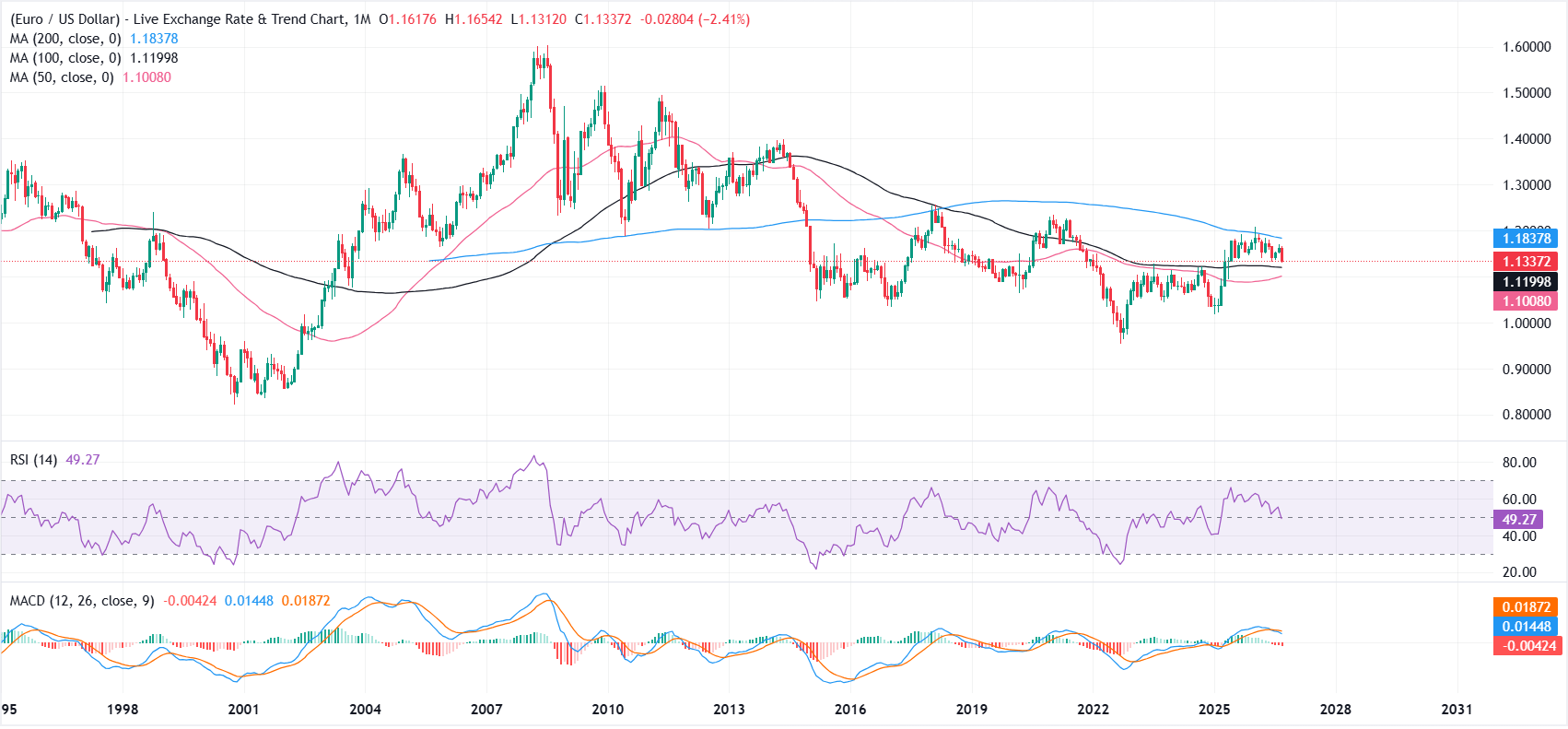
On the broader monthly chart, the technical picture appears mixed, indicating a long-term battle between bulls and bears. The EUR/USD pair currently trades above its 50-period Simple Moving Average (SMA) at 1.1008 and the 100-period SMA at 1.1200. This positioning typically suggests that the long-term trend retains a degree of support, preventing a complete collapse. However, the pair remains significantly capped well below the crucial 200-period SMA, which currently resides near 1.1838. The inability to reclaim this longer-term average implies that while major structural support may exist further down, the overarching bullish momentum has been absent for an extended period.
Momentum indicators on the monthly timeframe offer little decisive directional conviction. The Relative Strength Index (RSI), a popular oscillator measuring the speed and change of price movements, hovers around the neutral 50 level. An RSI at 50 neither confirms overbought nor oversold conditions, reflecting the market’s indecision on a monthly scale. Similarly, the Moving Average Convergence Divergence (MACD) indicator, which identifies changes in the strength, direction, momentum, and duration of a trend, has slipped slightly into negative territory. This subtle shift suggests that while the broader structure might still hold some support from historical levels, the upward momentum that would typically drive the pair higher has distinctly weakened, reinforcing the narrative of a market in search of a clear direction beyond its current range.
Daily Chart Bearishness:
In stark contrast to the monthly perspective, the daily chart paints a decidedly more bearish picture, underscoring the immediate selling pressure on EUR/USD. The pair is trading well below all three key daily Simple Moving Averages: the 50-day, 100-day, and 200-day SMAs. These averages are tightly clustered between 1.1521 and 1.1614, forming a significant overhead resistance zone that the pair has struggled to breach for some time. Trading below these averages is a classic bearish signal, indicating that short-to-medium term trends are firmly downward.
The momentum indicators on the daily chart further reinforce this bearish outlook. The Relative Strength Index (RSI) has plunged deep into oversold territory, registering a reading near 23. While an oversold RSI typically suggests that a reversal or short-covering bounce might be imminent, it primarily highlights the intensity of the recent selling pressure. Concurrently, the MACD remains firmly below zero and continues to trend downward, indicating strong bearish momentum and persistent selling interest. The combination of price action below key moving averages and deeply oversold momentum indicators suggests that selling pressure remains dominant, although the extreme oversold conditions do leave the pair vulnerable to a potential, albeit likely corrective, short-covering bounce if any positive catalysts emerge or selling fatigue sets in.
Key Resistance and Support Levels:
For traders, understanding the critical price levels is paramount. On the topside, initial resistance for EUR/USD is identified at the psychological mark of 1.1400. A move above this level would be the first sign of a potential recovery. Should a stronger rebound materialize, the next significant hurdle lies at 1.1470. Beyond these immediate barriers, the confluence of the 100-day SMA at 1.1521 and the 50-day SMA at 1.1532 will come into sharp focus, acting as robust resistance points. A sustained breach above these levels would be required to signal a more meaningful shift in the short-term trend. Further up, the 200-day SMA at 1.1614, coupled with a horizontal barrier near 1.1700, forms an even broader and more formidable resistance zone.
On the downside, immediate support is critically positioned at Tuesday’s low of 1.1312. This level is highly significant as a decisive break below it would unequivocally reinforce the existing bearish trend, opening the door to further substantial losses and potentially targeting lower psychological levels not seen in an even longer timeframe. However, the ability for the pair to hold above 1.1312, especially given the deeply oversold RSI, could provide the necessary springboard for oversold conditions to trigger a corrective recovery toward the aforementioned nearby resistance levels. The battle around 1.1312 is thus crucial for the near-term trajectory of EUR/USD.
Performance Against Other Major Currencies: A Relative Weakness Analysis
The provided data on the Euro’s performance against other major currencies during the month further illuminates its relative weakness. The Euro recorded a notable decline against several key counterparts:
- Against the US Dollar (USD): -2.49%
- Against the Japanese Yen (JPY): -3.89% (Weakest performance)
- Against the Canadian Dollar (CAD): -0.18%
- Against the Australian Dollar (AUD): -0.63%
- Against the New Zealand Dollar (NZD): -2.48%
- Against the Swiss Franc (CHF): -0.83%
- Against the British Pound (GBP): -0.33%
The most pronounced weakness for the Euro was observed against the Japanese Yen, where it depreciated by a substantial 3.89%. This significant movement can be attributed not only to Euro weakness but also to specific dynamics impacting the JPY, which, despite its own challenges, might have seen some intermittent safe-haven demand or a slight re-evaluation by the Bank of Japan, causing it to outperform. Similarly, the significant depreciation against the US Dollar (-2.49%) and New Zealand Dollar (-2.48%) highlights broad-based challenges for the Euro. While the Euro also lost ground against the British Pound, Canadian Dollar, Australian Dollar, and Swiss Franc, these declines were comparatively modest, suggesting a more nuanced interplay of economic factors influencing these cross-currency pairs. The consistent negative performance against a basket of major currencies underscores the pervasive bearish sentiment surrounding the Euro during this period.
Central Bank Stances and Market Expectations
The current EUR/USD dynamics are heavily influenced by the differing postures of the European Central Bank (ECB) and the Federal Reserve (Fed).
European Central Bank (ECB): Under the leadership of President Christine Lagarde, the ECB has been navigating a delicate balance. While it has aggressively raised interest rates to combat inflation, which remains above its 2% target, concerns about an impending economic slowdown or recession in the Eurozone have led to a more cautious tone regarding future hikes. Recent communications from ECB Governing Council members have hinted at a potential pause or a slower pace of tightening, particularly as economic data suggests weakening demand. This perceived dovish tilt, relative to the Fed, puts downward pressure on the Euro, as it reduces the attractiveness of Euro-denominated assets. The market is closely watching upcoming inflation data (Harmonized Index of Consumer Prices – HICP) and GDP figures for any signs that might force the ECB’s hand towards either further tightening or a more extended pause.
Federal Reserve (Fed): The Federal Reserve, on the other hand, has maintained a resolutely hawkish stance. With US inflation proving sticky and the labor market remaining remarkably tight, Fed officials, including Chairman Jerome Powell, have consistently signaled a willingness to keep interest rates elevated for an extended period, potentially even countenancing further hikes if necessary. The "higher for longer" narrative from the Fed has bolstered the US Dollar, as it implies a continued yield advantage for dollar assets. The market largely anticipates that the Fed will prioritize inflation control, even if it entails some economic cooling, thereby sustaining demand for the Dollar.
Analyst Consensus: Market analysts largely agree that the path of least resistance for EUR/USD remains to the downside in the immediate term, given the entrenched monetary policy divergence and the Dollar’s safe-haven appeal. While many acknowledge the possibility of a short-covering bounce due to oversold conditions on daily charts, few foresee a sustained reversal without a significant shift in either central bank rhetoric or macroeconomic data trends. Most forecasts suggest that the pair will likely consolidate around current lows, with potential for further depreciation if US economic resilience continues to outpace that of the Eurozone.
Broader Economic Implications
The sustained weakness of the Euro against the Dollar carries significant implications for both the Eurozone and global economies.
For the Eurozone Economy: A weaker Euro can be a double-edged sword. On one hand, it makes Eurozone exports more competitive on the global market, potentially boosting economic growth in export-oriented nations like Germany. This could offer some relief to industries grappling with high energy costs and slowing demand. On the other hand, a depreciating Euro makes imports, particularly critical energy resources and raw materials priced in Dollars, significantly more expensive. This exacerbates inflationary pressures within the Eurozone, making the ECB’s job of achieving price stability even more challenging and potentially necessitating further monetary tightening down the line, despite growth concerns. It also reduces the purchasing power of Eurozone consumers abroad.
For the US Economy: A strengthening Dollar, while reflecting US economic robustness, can also present challenges. It makes US exports more expensive for foreign buyers, potentially dampening export volumes and impacting the earnings of multinational corporations that derive a significant portion of their revenue from overseas. This could lead to a widening trade deficit. However, a strong Dollar also makes imports cheaper for US consumers and businesses, helping to mitigate domestic inflation and increasing consumer purchasing power for imported goods.
Global Trade and Investment: The EUR/USD exchange rate is the most heavily traded currency pair globally, making its movements influential across international markets. A volatile or depreciating Euro can introduce uncertainty into global trade flows and investment decisions. Companies engaged in cross-border transactions face increased currency risk, potentially impacting their profitability and hedging strategies. For global investors, the relative strength of the Dollar can influence capital allocation, drawing funds towards US markets and away from other regions, including the Eurozone.
Future Outlook: Key Factors to Watch
Looking ahead, several factors will be crucial in determining the future trajectory of EUR/USD. These include:
- Upcoming Economic Data: Key releases such as Eurozone inflation (HICP), GDP figures, and Purchasing Managers’ Index (PMI) data will provide insights into the health of the Eurozone economy. Similarly, US inflation (CPI), employment reports, and retail sales will continue to shape expectations for Federal Reserve policy.
- Central Bank Communications: Any shifts in rhetoric from ECB President Christine Lagarde or Fed Chairman Jerome Powell, or minutes from their respective policy meetings, will be closely scrutinized for clues on future interest rate paths.
- Geopolitical Developments: Ongoing geopolitical events, particularly those impacting energy markets or global trade, could trigger further safe-haven flows into the Dollar.
- Technical Breaches: Whether EUR/USD can hold above the critical 1.1312 support level or break through key resistance zones will be paramount for short-term trading strategies.
The Euro: A Cornerstone of the Global Economy
Despite its recent challenges, the Euro remains a cornerstone of the global financial system. It serves as the official currency for the 20 European Union countries belonging to the Eurozone and is the second most heavily traded currency in the world, trailing only the US Dollar. In 2022, the Euro accounted for 31% of all foreign exchange transactions, with an average daily turnover exceeding $2.2 trillion. The EUR/USD pair alone constitutes an estimated 30% of all global currency transactions, underscoring its immense importance. Other significant Euro pairs include EUR/JPY (4%), EUR/GBP (3%), and EUR/AUD (2%). The European Central Bank (ECB), based in Frankfurt, Germany, is the reserve bank for the Eurozone, responsible for setting interest rates and managing monetary policy with a primary mandate to maintain price stability. Key economic indicators, including inflation data (HICP), GDP, manufacturing and services PMIs, employment figures, consumer sentiment surveys, and the trade balance, are all vital gauges of the Eurozone’s economic health and directly influence the Euro’s value. Economic data from the four largest Eurozone economies—Germany, France, Italy, and Spain—are particularly significant, as they collectively account for 75% of the Eurozone’s economic output.
(The technical analysis section of this story was written with the assistance of an AI tool. To understand how FXStreet utilizes AI, please refer to our information page.)
