

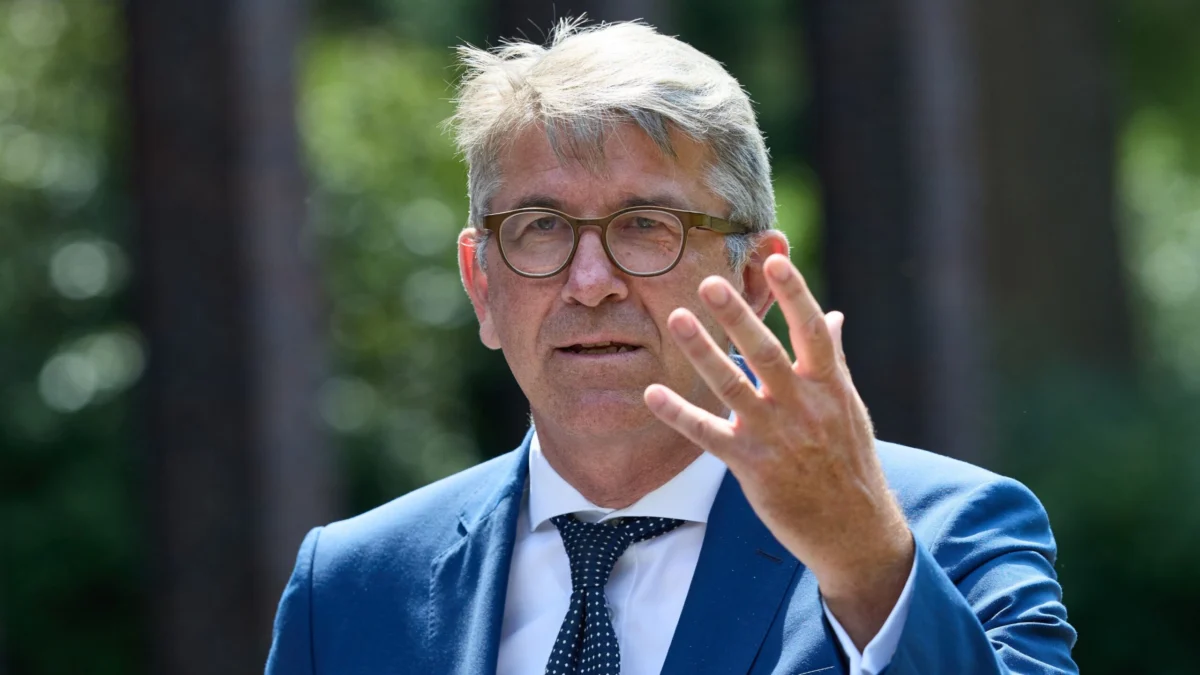
The German media landscape is currently abuzz with a contentious debate ignited by Culture State Minister Wolfram Weimer’s proposals for a radical reform of the public broadcasting system. These suggestions, which question the necessity of the existing structure of ARD and ZDF, have drawn sharp criticism from within the Social Democratic Party (SPD), with accusations of inadvertently aiding the far-right Alternative for Germany (AfD) party.
Heike Raab, chairwoman of the SPD’s media commission, has voiced strong disapproval of Weimer’s statements, asserting that echoing the rhetoric of the AfD on public broadcasting grants the party additional momentum. "Whoever adopts the rhetoric of the AfD without reflection provides them with additional impetus," Raab stated, directly referencing Weimer’s proposals. She questioned the timing and intent behind such pronouncements, particularly "four days before important state elections." According to Raab, Weimer is initiating a "wrong debate at the wrong time with the wrong phrasing."
Background: A Long-Standing Debate on Public Broadcasting
The discussion around the future of Germany’s public service broadcasters, ARD and ZDF, is not new. For years, various political factions and media observers have debated their scope, funding, and relevance in an increasingly digitalized media environment. The AfD, in particular, has consistently positioned itself as a staunch critic, advocating for significant reductions or even the dismantling of the current system.
In recent election campaigns, the AfD has made the reform or abolition of public broadcasting a central tenet of its platform. For instance, in Saxony-Anhalt, the party’s lead candidate, Ulrich Siegmund, declared that if elected Minister-President, his first action would be to terminate broadcasting contracts and transform the regional broadcaster MDR into a minimal "basic broadcast" service. Similar stances have been adopted in the AfD’s election manifestos for Mecklenburg-Vorpommern and Berlin, signaling a consistent and forceful agenda to reshape the media landscape.

Weimer’s Proposals: A Catalyst for Controversy
Wolfram Weimer’s recent considerations, outlined at a conference hosted by the Konrad Adenauer Foundation in Berlin, have injected a new urgency into this ongoing debate. While speaking in his capacity as Culture State Minister, Weimer reportedly questioned whether the current system, comprising ARD and ZDF, is still necessary in its present form. He specifically raised the possibility of merging ARD’s regional broadcasting stations, suggesting a reduction to a mere four or five public broadcasting entities nationwide. He cited the perceived burden on private media due to the public broadcasters’ financing through the broadcasting contribution (Rundfunkbeitrag). Weimer articulated that "the RTLs of this world" are facing immense pressure, and he views the current media market as a "duopoly" dominated by Big Tech and public broadcasters.
These statements are politically significant because they align, at least in part, with long-standing demands within conservative parties like the Christian Democratic Union (CDU) and the Christian Social Union (CSU) for a fundamental overhaul of the public broadcasting system. However, it is crucial to note that media and broadcasting policy in Germany falls under the purview of the federal states (Bundesländer), not the federal government. This constitutional division of powers means that any significant reform would require extensive cooperation and agreement among the sixteen state governments.

AfD’s Reaction: A Strategic Alignment
The AfD has welcomed Weimer’s suggestions, interpreting them as validation of their own long-held positions. Martin Renner, the AfD parliamentary group’s spokesperson for media policy, stated, "Better late than never: Wolfram Weimer is beginning to ask the right questions." He suggested that Weimer had "not only read but also understood" an AfD motion to establish a commission of inquiry into the "information and communication order of the 21st century." Renner further argued that the Culture State Minister’s considerations demonstrate a growing recognition that Germany’s "outdated media order no longer meets the realities of the digital information and communication space."
However, the AfD’s enthusiasm is tempered by their perception that Weimer’s proposals do not go far enough. Renner criticized the idea of consolidating nine ARD stations into four or five, and even contemplating the privatization of ZDF, as insufficient. "The entire information and communication order needs to be put to the test," he declared. The AfD’s stance underscores their ambition for a more radical transformation of the public broadcasting landscape, potentially including its complete abolition.

Journalists’ Union Responds: A Call for Caution
In contrast to the AfD’s embrace, the German Journalists’ Union (DJV) has firmly rejected Weimer’s "thought experiment." Mika Beuster, the federal chairman of the DJV, defended the established public broadcasting system, emphasizing its proven track record. "We have only known ideas for reconstruction with a wrecking ball from the AfD so far. The federal government should not blow the same horn," Beuster stated. He argued that, particularly in an era of disinformation and the dominance of large tech platforms, democracy requires a robust and independent public broadcasting service.
Beuster also highlighted the jurisdictional realities, reminding that media policy is primarily the responsibility of the federal states. He cautioned Weimer against creating the impression that he has the authority to dictate the future of ARD and ZDF, given that the final decisions lie with the sixteen state parliaments. The current monthly broadcasting contribution stands at 18.36 Euros per household, a fee that funds the operations of ARD, ZDF, and Deutschlandradio.

Analysis of Implications and Future Outlook
The controversy surrounding Weimer’s statements underscores a fundamental tension in German media policy. On one hand, there is a recognized need to adapt public broadcasting to the evolving digital landscape, addressing challenges such as declining viewership among younger demographics, the proliferation of online disinformation, and the competitive pressure from global tech giants. Weimer’s proposals can be seen as an attempt to initiate this necessary adaptation.
On the other hand, the timing and framing of these proposals have inadvertently amplified the narrative of parties like the AfD, which seek to dismantle the public broadcasting system for political reasons. The SPD’s criticism reflects a concern that any perceived weakening of public broadcasting could create a vacuum that the AfD aims to fill with its own agenda, potentially undermining democratic discourse and media pluralism.

The fact that media policy is decentralized in Germany presents a significant hurdle for any federal initiative. While the federal government can set broader policy directions, the implementation and detailed regulation of public broadcasting are state matters. This means that any substantial reform would require complex negotiations and consensus-building among a diverse array of state governments, each with its own political priorities and media landscapes.
The debate also brings into sharp focus the essential role of public broadcasting in a democratic society. Proponents argue that it provides essential public service journalism, fosters cultural diversity, and serves as a crucial bulwark against misinformation and the unchecked influence of private media conglomerates. Critics, however, question its efficiency, its reach, and its perceived bias.
As the discussion unfolds, the key questions remain: Can public broadcasting adapt to the digital age while maintaining its core principles of independence and public service? How can reforms be implemented without inadvertently empowering anti-democratic forces? And can the federal and state governments find common ground to ensure a robust and relevant public broadcasting system for the future? The current political climate suggests that these questions will continue to dominate the media policy agenda in Germany for the foreseeable future. The interplay between political opportunism, genuine reformist impulses, and the constitutional framework will shape the future of German public broadcasting.

Related Topics and Further Reading
The ongoing debate touches upon several critical areas within German politics and media. For those interested in delving deeper, the following topics are particularly relevant:
- The AfD’s Media Policy: Understanding the specific proposals and ideological underpinnings of the AfD’s stance on public broadcasting is crucial. Their agenda often centers on themes of national identity, criticism of perceived "elite media," and calls for deregulation.
- The Role of ARD and ZDF: Examining the mandates, funding mechanisms, and programming of Germany’s public broadcasters provides essential context. Their historical development and societal role are key to understanding the current discourse.
- Federalism and Media Regulation in Germany: The constitutional division of powers between the federal government and the states regarding media policy is a fundamental aspect of the German system. Understanding this structure is vital for grasping the limitations and possibilities of reform.
- The Impact of Digitalization on Media: The broader trends of digitalization, the rise of social media, and the challenges of online disinformation are driving forces behind the calls for media reform across Europe.
Further investigation into these areas will offer a comprehensive understanding of the complex dynamics at play in the German public broadcasting debate. The recent proposals by Culture State Minister Weimer have undeniably served as a catalyst, forcing a critical re-evaluation of a cornerstone of Germany’s media landscape.
