

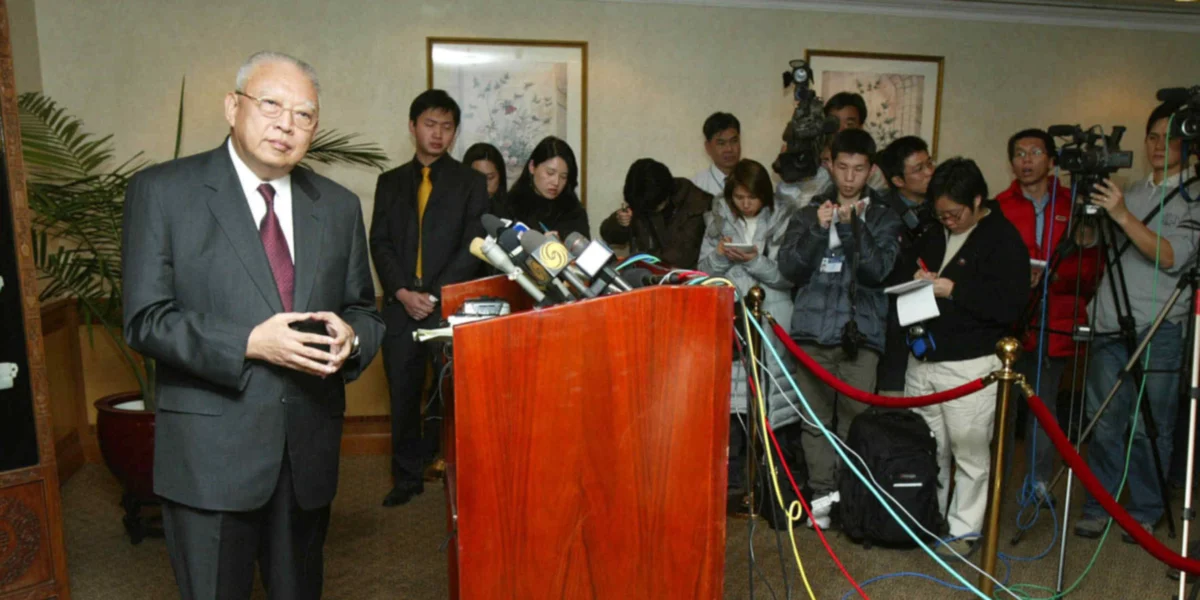
Hong Kong’s first chief executive after its handover from British to Chinese rule, Tung Chee-hwa, a prominent businessman whose career spanned global shipping and high-stakes politics, died on Tuesday at the age of 89. His office confirmed his passing, marking the end of an era for the city and its complex relationship with mainland China. Tung, often referred to as C.H. Tung, emerged from a distinguished shipping dynasty to assume leadership in 1997, a period of immense transition and anticipation for Hong Kong. His tenure, however, became inextricably linked to a significant political storm stirred by a controversial national security law, an event that foreshadowed deeper shifts in the city’s autonomy and freedoms in the years that followed.
From Shipping Tycoon to Chief Executive
Born in Shanghai on July 7, 1937, Tung Chee-hwa’s early life was shaped by the tumultuous events of 20th-century China. His father, Tung Chao-yung, a visionary shipping magnate, founded Orient Overseas, a company that would ascend to become one of the world’s largest shipping conglomerates. The family relocated to Hong Kong in 1948 as the Chinese Communist Party consolidated its power on the mainland. This migration placed the Tung family within Hong Kong’s burgeoning capitalist landscape, a stark contrast to the political changes occurring across the border.
The Tung family’s business maintained significant connections with the Kuomintang regime, which established its base in Taiwan after the Chinese Civil War. This historical link is subtly reflected in the Orient Overseas logo, which features a plum blossom, Taiwan’s national flower. This intricate web of familial, business, and political connections would later play a role in Tung’s ascent.
Tung received his tertiary education in the United Kingdom, earning a bachelor’s degree in marine engineering from the University of Liverpool in 1960. His time in Liverpool also fostered a lifelong passion for the city’s iconic football club. In recognition of his achievements, the University of Liverpool bestowed upon him an honorary doctorate in law in 1997, the same year he assumed leadership of Hong Kong.
Following his graduation, Tung spent nearly a decade in the United States, gaining valuable experience, including a period working for General Electric. He eventually returned to Hong Kong to contribute to the family business. He officially took the helm of Orient Overseas in 1979, three years before his father’s death. For a considerable time, he operated in his father’s formidable shadow, often referred to by the press and business circles as merely "C.Y. Tung’s son."
A pivotal moment in Tung’s business career, and arguably a turning point that significantly influenced his political trajectory, occurred in the mid-1980s. Orient Overseas faced a severe financial crisis. The company’s survival was secured through a complex rescue package orchestrated by a consortium of major Japanese financial institutions, with crucial involvement from the Bank of China and the Hong Kong-based state-owned conglomerate China Merchants Group, which also had extensive shipping interests. This critical intervention, facilitated by entities closely aligned with Beijing, is widely seen as having forged a closer relationship between Tung and the Chinese leadership, paving the way for his eventual appointment as Hong Kong’s chief executive.
The Article 23 Crisis and Its Aftermath
In 1997, as Hong Kong transitioned from British colonial rule to Chinese sovereignty, Tung Chee-hwa was selected as the first Chief Executive, succeeding Chris Patten, the last British governor. His appointment was a clear signal of Beijing’s preference for a leader with strong ties to the mainland and a commitment to the "one country, two systems" framework.
Tung’s first term was largely defined by the controversial attempt to enact a national security law under Article 23 of the Basic Law, Hong Kong’s mini-constitution. The proposed legislation aimed to criminalize acts of treason, secession, sedition, and subversion against the Central People’s Government. However, the broad scope and perceived implications for civil liberties and freedom of expression ignited widespread public opposition.
On July 1, 2003, the sixth anniversary of the handover, an unprecedented mass protest saw an estimated half a million people take to the streets of Hong Kong. This demonstration, one of the largest in the city’s history, sent a powerful message of dissent and concern. The sheer scale of the public outcry forced Beijing to reconsider the legislation. Facing immense pressure, the government shelved the Article 23 bill, a significant political setback for Tung and a victory for civil society.
The fallout from the Article 23 crisis contributed to a decline in Tung’s public approval ratings. He resigned from his position as Chief Executive in March 2005, citing health reasons, during his second term. His resignation was immediately followed by his appointment as vice chairman of the Chinese People’s Political Consultative Conference (CPPCC), China’s top political advisory body, underscoring his continued importance within the mainland’s political structure.
Legacy and Shifting Political Landscape
In the years following his resignation, Tung Chee-hwa remained a prominent pro-Beijing figure, albeit largely out of the direct spotlight. He held influential positions, including chairman of the Our Hong Kong Foundation, a pro-Beijing think tank that actively shapes public discourse on policy and governance. He also served as an independent director for Alibaba Group Holding, a role he held from September 2014 until his departure, during which Alibaba’s board lauded his contributions, stating they exemplified "the highest standards of care and committed service."
His family’s shipping business continued to evolve. In 2018, Orient Overseas was acquired by China’s COSCO Shipping Holdings in a landmark deal valued at $6.3 billion. Tung and his younger brother, Tung Chee-chen, divested their combined 68.7% stake, a transaction that propelled COSCO Shipping into becoming the world’s third-largest shipping entity. At the time, Tung’s son, Alan Tung Lieh-sing, described the sale as "solely a commercial decision."
In recent years, reports indicated that Tung’s health was deteriorating. He experienced a fall during the opening session of the National People’s Congress in March 2021. He subsequently missed the annual National Day celebrations in Hong Kong in October 2021, later revealed to have undergone surgery for an undisclosed ailment. He also abstained from attending the official 25th handover anniversary ceremony in July 2022, which was attended by President Xi Jinping.
Tung officially stepped down as vice chairman of the CPPCC in March 2023, marking his formal exit from significant public office. One of his last publicly noted transactions occurred in September 2022, when land registry records revealed he purchased a Mid-Levels apartment for HK$160 million (approximately $20.4 million USD). He had been renting this property since becoming Chief Executive, and the purchase made him a first-time homeowner at the age of 84.
The legacy of Tung Chee-hwa’s tenure is complex and continues to be debated. His administration grappled with the delicate balance of Hong Kong’s semi-autonomous status within China. The failed attempt to implement the Article 23 national security law serves as a stark historical marker, highlighting the deep-seated desire for protected freedoms among the Hong Kong populace.
Echoes of Article 23 and Evolving Governance
The political climate in Hong Kong has undergone profound transformations since Tung’s premiership. Beijing ultimately imposed its own national security law in June 2020, following widespread anti-government protests in 2019. This national legislation dramatically reshaped the city’s political and social landscape, significantly curtailing dissent and opposition.
More recently, in March 2024, Hong Kong’s government, under current Chief Executive John Lee, successfully enacted its own domestic national security law, also based on Article 23 of the Basic Law. This new legislation, the Safeguarding National Security Ordinance, was passed unanimously by the Legislative Council, a body now composed exclusively of members vetted and approved by Beijing. Unlike the protests of 2003, the passage of this latest security law was met with a notably subdued public response, reflecting the altered environment and the perceived diminishment of avenues for organized opposition.
Tung Chee-hwa’s life and career encapsulate a critical period of Hong Kong’s history – the initial years of its return to Chinese sovereignty, marked by aspirations, anxieties, and profound political negotiation. His passing closes a significant chapter, leaving behind a legacy that is both tied to the city’s economic prowess and its evolving political identity under Beijing’s increasing influence. His role as the first chief executive remains a crucial reference point for understanding the trajectory of Hong Kong’s governance and its ongoing journey within the "one country, two systems" framework.
