

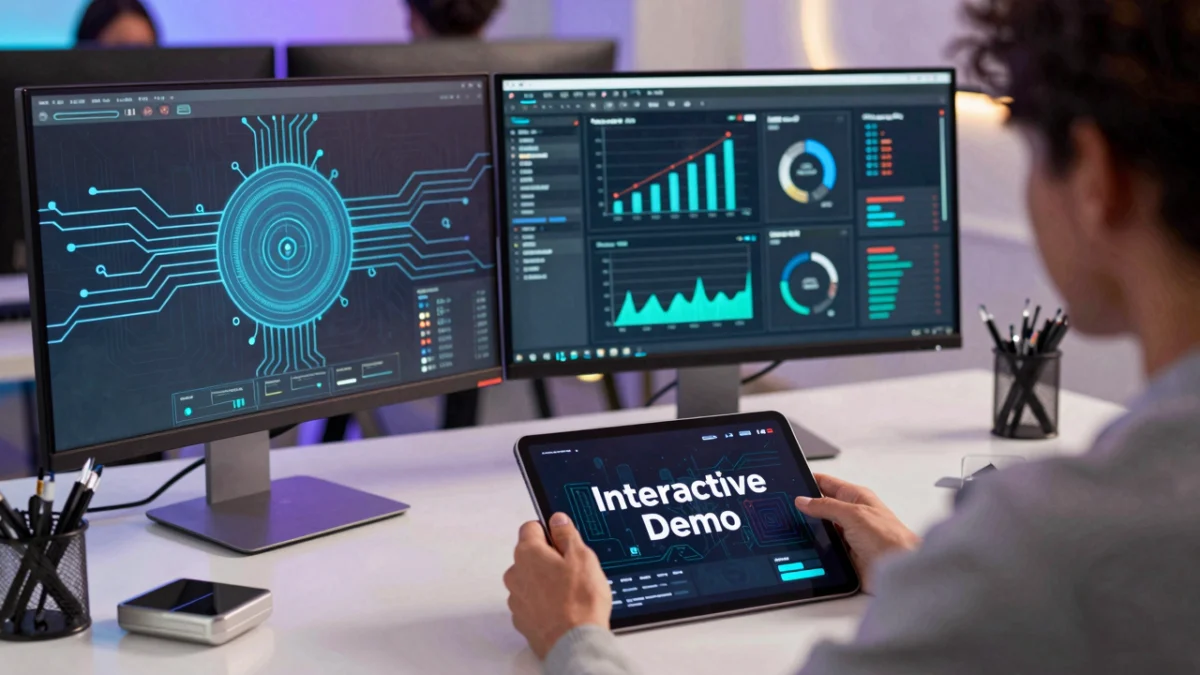
The global Software-as-a-Service (SaaS) industry is currently undergoing a fundamental shift in how products are marketed and sold, moving away from traditional "gatekept" sales models toward a more transparent, user-centric approach. At the heart of this transformation is the emergence of interactive demos—sophisticated tools that allow potential customers to experience a product’s core functionality in a browser-based environment without the friction of creating an account or scheduling a discovery call. Industry data suggests that this shift is not merely a trend but a response to changing buyer behaviors, where modern B2B consumers increasingly demand self-service options and immediate proof of value. By providing hands-on experiences early in the buyer journey, companies are seeing significant improvements in engagement metrics and conversion rates, fundamentally altering the standard sales funnel.

The Evolution of Software Demonstrations: A Chronology
To understand the current dominance of interactive demos, one must look at the history of software sales. In the early 2000s, software sales relied heavily on "on-premise" installations and physical meetings where sales engineers would perform live demonstrations. This era was characterized by high friction and long sales cycles.
By 2010, the rise of cloud computing introduced the era of recorded video tutorials and webinars. While more scalable, these formats were passive; they allowed prospects to watch a product in action but offered no agency. The mid-2010s saw the rise of the "freemium" model and "free trials," which allowed users to explore software on their own. However, many users found these trials overwhelming, often landing in an empty dashboard without knowing how to proceed, leading to high "churn" before a single feature was ever used.

The year 2020 served as a catalyst for the current "Interactive Era." With the global shift to remote work, the demand for digital-first sales tools skyrocketed. This period saw the birth and rapid scaling of platforms like Walnut, Navattic, and Storylane. These tools introduced "HTML capture" technology, which allows marketing teams to take a "snapshot" of their software and create a guided, interactive tour that feels like the real product but remains a controlled, frictionless environment. Today, these tools have integrated artificial intelligence to personalize experiences for every individual viewer, marking the latest chapter in this technological evolution.
Critical Features and Technological Architectures
When evaluating the current landscape of interactive demo tools, several key technological features define the market leaders. The primary distinction lies in how the demo is captured and delivered.

HTML Capture vs. Screen Recording
Unlike traditional screen recording software that creates static video files, top-tier tools like Navattic and Walnut utilize HTML capture. This technology records the actual code of the application’s front end. This allows the demo to remain responsive, meaning text can be edited for personalization, and buttons can remain clickable, providing a high-fidelity experience that is indistinguishable from the live software.
AI-Driven Personalization and Voiceovers
The integration of Artificial Intelligence has revolutionized the speed of demo production. Platforms like Supademo now offer AI-generated voiceovers and text descriptions. This allows a product marketer to record a series of clicks and have the AI automatically generate a professional narrative, significantly reducing the time-to-market for new sales collateral.

Analytics and Lead Scoring
Perhaps the most significant advantage for sales teams is the depth of user analytics. Interactive demos track exactly where a user clicks, how much time they spend on specific features, and where they drop off. This data provides a "heat map" of interest, allowing sales representatives to follow up with prospects with specific knowledge of what features resonated most, effectively turning a cold lead into a warm, qualified opportunity.
Comparative Analysis of Market Leaders
As the market matures, different platforms have carved out specific niches based on the needs of various organizational sizes and technical requirements.

Walnut: The Enterprise Personalization Engine
Walnut has positioned itself as the premier choice for enterprise-level sales teams. With a G2 rating of 4.8/5, its focus is on "Demo Experience Automation." Walnut’s strength lies in its ability to allow sales reps to personalize demos at scale—changing logos, names, and data points within the demo to match the prospect’s industry without needing help from the engineering department. Data from Walnut users indicates a 67% demo completion rate and a 32% increase in overall conversion.
Storylane: Speed and Accessibility for Sales Teams
For teams looking for rapid deployment, Storylane offers a user-friendly drag-and-drop editor. It is particularly popular among mid-market companies that need to create "demo hubs"—centralized libraries where prospects can choose their own adventure based on their role or industry. Starting at approximately $40 per month, it has lowered the barrier to entry for smaller startups.

Navattic: The Technical Precision Standard
Navattic is frequently cited as the best option for technical products. Because it relies heavily on HTML capture, it can handle complex, data-heavy dashboards that might break in simpler tools. While it requires a slightly steeper learning curve, it provides the most "realistic" sandbox environment, making it a favorite for DevOps and cybersecurity firms.
Supademo and Demostack: From Quick Wins to High-Fidelity Sandboxes
Supademo caters to the need for speed, allowing users to create basic interactive tours in under 15 minutes using screenshot-based workflows. Conversely, Demostack offers a "sandbox" approach, which clones the entire backend of a product to create a fully functional environment that does not touch live data. This is ideal for deep-dive technical proofs-of-concept.

Statistical Impact on the Sales Funnel
The adoption of interactive demos is driven by measurable ROI. A cross-industry analysis reveals that companies implementing these tools see a 20% to 40% increase in trial-to-paid conversion rates. The psychological impact of "doing" rather than "watching" cannot be overstated; users who interact with a product are significantly more likely to remember its value proposition.
Case studies from major tech players highlight this impact. Zapier, a leader in workflow automation, integrated interactive demos into the launch of their "Tables" product. By allowing users to see how the product worked before signing up, they realized a 14% increase in new sign-ups. Furthermore, because the demos answered common "how-to" questions upfront, companies reported a significant decrease in the number of support tickets filed during the initial onboarding phase, leading to higher customer satisfaction scores (CSAT).

Industry Reactions and Expert Analysis
Market analysts suggest that the rise of interactive demos is a death knell for the "Request a Demo" gate. "The modern buyer is 70% of the way through their journey before they ever talk to a salesperson," notes one industry report. "If you don’t let them see the product until they book a call, you’ve already lost them to a competitor who is more transparent."
Inferred reactions from sales leadership suggest a shift in the role of the Sales Engineer (SE). Traditionally, SEs spent their days performing repetitive "introductory" demos. With interactive demos handling the top-of-funnel education, SEs are now free to focus on complex technical integrations and high-value architectural discussions, making the entire sales organization more efficient.

Broader Implications and Future Outlook
The implications of this technology extend beyond the sales department. Marketing teams are now using interactive demos in email campaigns and social media ads, seeing higher click-through rates than static images or standard video. Customer Success teams are utilizing them to create "interactive documentation," where a user can learn how to use a new feature by actually clicking through it within the help center.
Looking forward, the next frontier for interactive demos is "Dynamic Data Population." Future iterations of these tools will likely pull real-time data from a prospect’s LinkedIn profile or company website to automatically populate the demo with their actual business information the moment they click "Play."

In conclusion, interactive demos have moved from a "nice-to-have" marketing asset to a mission-critical component of the B2B tech stack. By reducing friction, providing deep behavioral insights, and catering to the self-service preferences of the modern buyer, these tools are set to remain the standard for software engagement for the foreseeable future. Organizations that fail to adopt these transparent, hands-on sales methods risk obsolescence in an increasingly competitive and fast-moving digital economy.
