

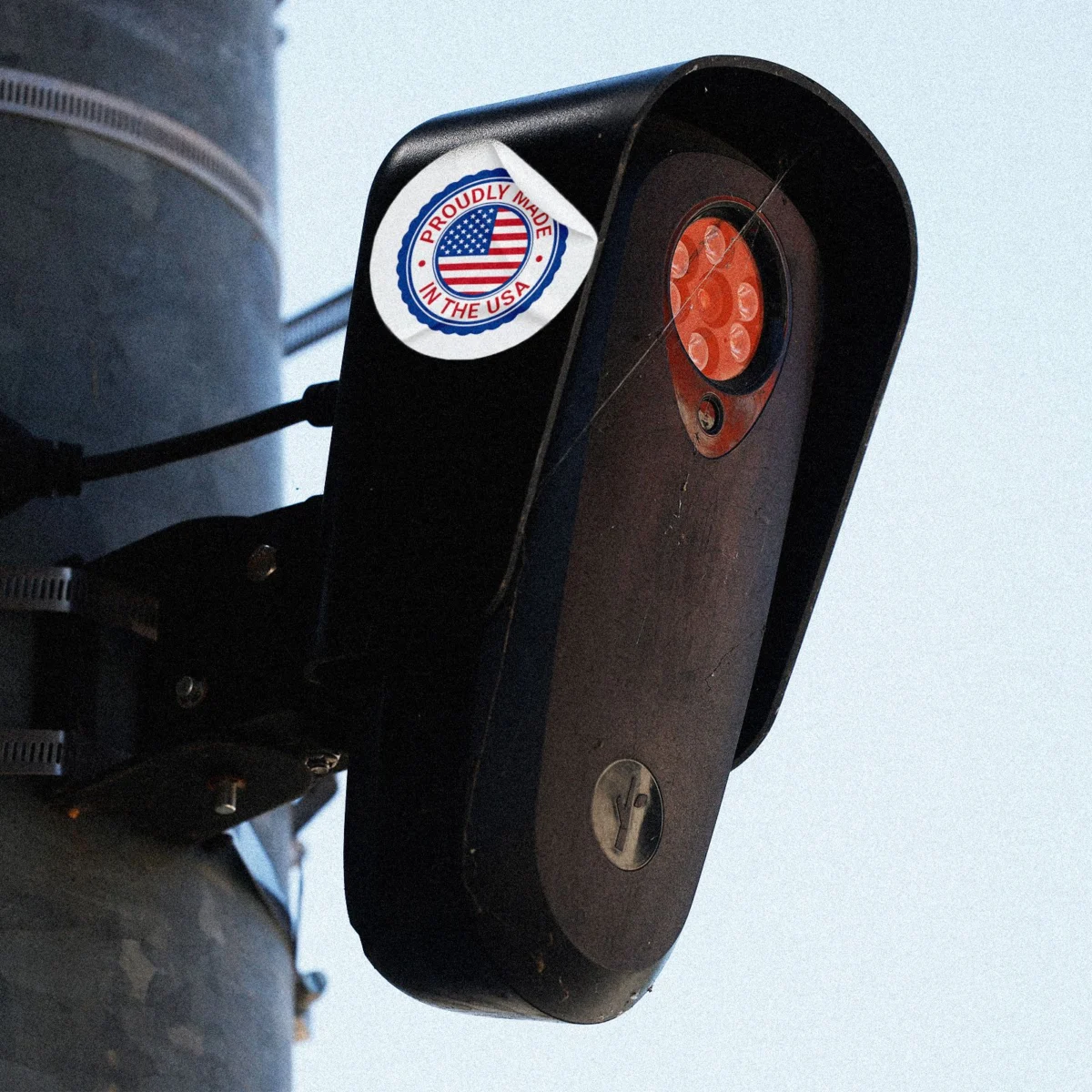
Flock CEO Garrett Langley’s journey with the company began unconventionally, with the first license plate cameras being assembled in his Atlanta home, a process that left permanent drill marks on his dining table. A decade later, the physical location where Flock assembles its signature — and fiercely debated — product has become a more guarded secret. Once a point of pride, the company’s manufacturing origins, once publicly proclaimed as domestic, have become increasingly vague in its marketing materials. This shift in transparency coincides with growing public backlash and legislative scrutiny surrounding Flock’s pervasive surveillance technology.
For years, Flock Safety actively promoted its devices as being manufactured in the United States. However, recent marketing materials reviewed by WIRED no longer specify the origin of its cameras. This change in messaging appears to be linked to the growing controversy surrounding the company’s widespread deployment of Automatic License Plate Readers (ALPRs). The pressure has mounted to a degree that a US manufacturer, which had previously identified Flock as a client, quietly removed any mention of the company from its website earlier this year.
The startup has found itself at the epicenter of a nationwide protest movement. This public outcry has led dozens of local governments to abruptly suspend or terminate their contracts with Flock. At the federal level, Congress is actively considering legislation that could cut off federal funding to states that fail to implement limitations on the use of Flock cameras and other ALPR systems. While law enforcement agencies champion these cameras as indispensable tools for crime deterrence and resolution, civil liberties advocates and concerned citizens have raised alarm over their potential for misuse. Allegations range from officers tracking personal vehicles of ex-partners to the sharing of sensitive footage with immigration authorities, and the broad surveillance of pedestrian movements.
Despite the intense focus on the deployment and use of Flock’s technology, the intricacies of its manufacturing supply chain have received comparatively little attention. This is a significant oversight, as the origin of its hardware could have substantial implications for US national security. By examining current and former Flock employees, supply chain analysts, US import records, and historical marketing videos featuring CEO Garrett Langley, WIRED has pieced together the most comprehensive account to date of how Flock’s hardware pipeline has evolved.
Flock’s cameras primarily rely on a global network of suppliers for non-customized components that are also utilized in a wide array of other electronic products. As CEO Langley articulated in a 2021 marketing video, "Our value is in the aggregation and the packaging of all of these things… in a nice waterproof, consumer-friendly device." This philosophy highlights Flock’s business model: sourcing readily available components and integrating them into a specialized surveillance product.
Data from US import records, compiled by ImportGenius, indicates a growing trend of Flock sourcing "commodity" cameras, radar systems, and other essential components from Primax Electronics. Primax, a company headquartered in Taiwan, operates manufacturing facilities in China, Thailand, and other locations. Lynn Hughes, an analyst at ImportGenius, notes that while these appear to be components, "Primax manufactures whole security camera solutions." She further points out that "Quite a few shipments include ‘Radar’ in the product description which might be related to the radar sensor pods they’re attaching to their cameras." This suggests that Flock is likely sourcing integrated sub-assemblies rather than individual raw materials.
Flock did not provide detailed responses to most of WIRED’s specific inquiries for this report, offering only general statements. A spokesperson for Flock, Paris Lewbel, stated via email that, "All products that Flock builds are National Defense Authorization Act compliant." This refers to a US law that imposes restrictions on government contractors regarding the use of parts manufactured by certain Chinese technology companies, ostensibly due to national security concerns.
Cris van Pelt, the driving force behind the anti-Flock advocacy project "Have I Been Flocked," argues that while the precise location of camera manufacturing might have a relatively minor direct impact on US communities, the lack of transparency regarding their origins points to a more systemic issue. "It all speaks to the fact that there is no real oversight, and that tens of thousands of literal and figurative black boxes are being installed on American roads," van Pelt stated. "If any part of the supply chain is compromised, we would never know. That’s a much bigger problem than where the final product is assembled."
The Evolution of "Aggregation"
The genesis of Flock’s hardware development can be traced back to Langley’s early tinkering. In a past marketing video, he recounted how the initial prototypes were constructed using cameras salvaged from Android phones purchased on Alibaba. These were then coupled with batteries and soldered onto solar panels. The objective was to demonstrate that a functional device could be assembled from components costing between $200 and $300. This early reliance on readily available, often consumer-grade parts foreshadowed the company’s ongoing supply chain strategy. It is worth noting that WIRED previously reported that Flock’s cameras continue to utilize smartphone-style processors and transmit significant amounts of data in an unencrypted format, raising further security concerns.
As Flock began to secure contracts with homeowners associations, the operation moved from Langley’s home to a corporate office that also functioned as an impromptu assembly line. Langley described this period as an exciting but also challenging and unprofessional phase. Pallets of parts, shipped from China, had to be manually transported considerable distances within the building multiple times a week. This hands-on, albeit rudimentary, assembly process allowed for direct oversight and rapid iteration.
Around 2020, Flock relocated its assembly operations to a facility in Atlanta that was described as a WeWork-style warehouse, according to a marketing video produced by the facility’s operator. A small team of Flock employees was tasked with assembling cameras, with engineers focusing on the core device and less technical staff handling the integration of solar panels and mounting hardware. This marked a significant step up from the earlier home-based operations.
In lieu of establishing dedicated warehouses for finished products, former employees revealed that Flock stored cameras in self-storage units scattered across the country. Installation crews would then retrieve these units as needed. One former employee characterized this system as "janky," suggesting it may have rendered the cameras more susceptible to tampering than if they had been stored in more secure, company-controlled facilities. This decentralized storage strategy, while potentially cost-effective, introduced an additional layer of logistical complexity and security risk.
Shifting Claims of Domestic Manufacturing
Flock’s marketing narrative around its manufacturing origins underwent a noticeable evolution. In marketing materials from 2019, the company explicitly stated its cameras were "manufactured in the United States." By the following year, this claim had been refined to "made in the USA." In 2021, Flock provided even greater specificity, informing potential customers that assembly was performed by "Flock Safety in Atlanta, GA." This consistent emphasis on domestic production aimed to assuage consumer concerns and differentiate Flock from competitors who might rely more heavily on overseas manufacturing.
However, over the subsequent two years, Flock began to shift its final assembly processes to contract manufacturing facilities located in North Carolina and Wisconsin. These facilities were operated by East West Manufacturing and Plexus, respectively, according to an individual familiar with the matter. Concurrently, the company also began establishing its own dedicated warehouses. The primary motivation for keeping assembly within North America, according to this source, was twofold: to address security concerns, particularly those related to potential Chinese surveillance, and to maintain proximity to factories that could facilitate rapid product customization in response to evolving customer demands.
A Flock marketing brochure from 2023 described its cameras as "designed & manufactured in the U.S." By 2024, Flock’s manufacturing partners were reportedly capable of producing up to 500 cameras per day, a tenfold increase from just a few years prior. Despite these advancements in assembly capacity, the sourcing of component parts largely continued from Asia.
In mid-May of this year, as public backlash against Flock intensified, East West Manufacturing quietly removed any reference to Flock from its case studies section on its website. Archived versions of the site, accessed via the Wayback Machine, confirm this removal. While a video from East West promoting its work for Flock, shared on LinkedIn in late 2021, remains accessible, the removal of the case study suggests a strategic distancing by the manufacturing partner. East West and Plexus did not respond to requests for comment.
WIRED’s investigation was unable to definitively determine the current assembly location for Flock’s license plate cameras. A recent Flock marketing presentation from 2024 omits any mention of an assembly site.
Workplace Safety and Unanswered Questions
Adding another layer of complexity to Flock’s operational transparency, the US Occupational Safety and Health Administration (OSHA) cited Flock in July for allegedly failing to promptly report a June incident. In this incident, an employee was hospitalized following a leg amputation. Records from the workplace regulator indicate that the injury occurred at a Flock "audio and video equipment manufacturing" site in Houston, Texas. It is possible that this location is actually a site for camera assembly or maintenance, and the injury resulted from an installation or repair procedure. Neither Flock nor OSHA provided clarification regarding the exact nature of the Houston site or the work performed there. Flock is currently contesting a proposed penalty of approximately $9,500, asserting that the injury was reported promptly after they became aware of it.
Even if Flock were to re-establish its manufacturing supply chain entirely within the United States, it is unlikely to quell the bipartisan backlash the company is currently facing. Matthew Guariglia, a senior policy analyst at the Electronic Frontier Foundation, a civil liberties advocacy group, stated, "Domestic manufacturing is no substitute for accountability over how these systems are built, sold, and used. The multi-billion dollar industry churning out mass surveillance technology is not safer or more acceptable based on where it is assembled."
Flock’s primary competitors offer varying degrees of transparency regarding their manufacturing processes. Motorola Solutions, for instance, has publicly stated that its license plate cameras are assembled at its own facility in Richardson, Texas. Axon, while less forthcoming about the specific production location of its Outpost cameras, has indicated that it assembles other products in Scottsdale, Arizona. Neither Motorola nor Axon responded to requests for comment.
A US-Made Drone Signals a New Direction
In contrast to the opaque origins of its license plate cameras, Flock has been more upfront about the manufacturing of its new surveillance drone. Last October, the company announced the establishment of its own facility in Smyrna, Georgia, dedicated to assembling drones, solar panels, and refurbishing various other products. This move aligns with evolving US regulations that largely restrict the use of foreign-made drones, particularly those manufactured by Chinese companies like DJI, which Flock has previously deployed. No similar federal regulations currently apply to license plate cameras.
The operational status and success of the Smyrna facility remain somewhat unclear. Flock has repeatedly postponed the launch timeline for its first so-called "Alpha" drone. The drone finally began field deployment in May, according to a company executive. This year, Flock informed officials in Berkeley, California, that it intended to replace its DJI drones with the US-made Alpha model "within two years." Lewbel, the Flock spokesperson, confirmed that the company continues to "bring more Alpha drones online." This strategic shift towards domestic drone manufacturing, driven by regulatory pressures, highlights a potential future direction for Flock’s product development and supply chain management.
The persistent questions surrounding the manufacturing origins of Flock’s widely deployed license plate cameras, coupled with ongoing controversies over their use, underscore a broader debate about transparency, accountability, and the national security implications of pervasive surveillance technologies. As the company navigates increasing public scrutiny and legislative action, its manufacturing footprint remains a critical, albeit increasingly elusive, piece of the puzzle.
Additional reporting by Caroline Haskins.
