

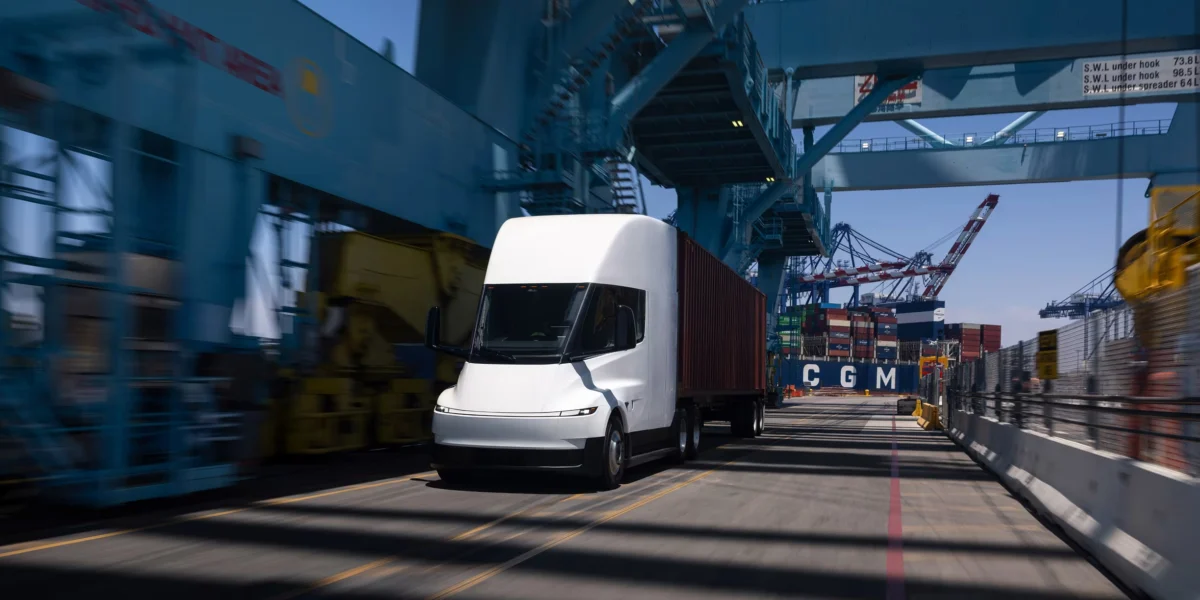
The highly anticipated Tesla Semi, an all-electric Class 8 truck, has finally begun customer deliveries, signaling a pivotal moment for the electrification of heavy-duty commercial transportation. After nearly a decade of development and significant delays since its initial unveiling in 2017, the first units are now reaching fleet operators, setting the stage for a potential paradigm shift in the logistics industry. The long-awaited handover commenced at a dedicated event in Reno, Nevada, on Thursday night, attended by a gathering of customers, employees, and industry influencers. Conspicuously absent from the proceedings was Tesla CEO Elon Musk, who was reportedly attending a state dinner with President Trump and Chinese Premier Xi Jinping, leaving company executives to detail the vehicle’s capabilities and the journey to its production.
A Long Road to Production: The Semi’s Chronology
The journey of the Tesla Semi has been marked by ambitious promises and considerable challenges. First introduced to the world in November 2017 at a high-profile event, the Semi captivated audiences with its futuristic design, central driving position, and bold performance claims. At the time, Musk projected an impressive range of 500 miles on a single charge while hauling an 80,000-pound load, along with significant fuel cost savings compared to traditional diesel trucks. Initial production was optimistically slated for 2019, fueling excitement among potential customers and investors eager to see Tesla disrupt yet another segment of the automotive market. Major companies like PepsiCo, Walmart, Anheuser-Busch, and UPS placed early pre-orders, eager to integrate electric trucks into their sustainability initiatives and reduce operational costs.
However, the path from concept to commercialization proved far more arduous than initially envisioned. The 2019 production target came and went, followed by a series of revised timelines. The primary culprits for these protracted delays were manifold. The global COVID-19 pandemic severely disrupted supply chains worldwide, impacting everything from raw materials to critical electronic components, particularly semiconductors. Tesla, like many automakers, grappled with these shortages. Furthermore, the development and scaling of Tesla’s next-generation 4680 battery cells, crucial for achieving the Semi’s promised range and payload capacity, presented significant engineering and manufacturing hurdles. Internal refinements based on pilot customer feedback also necessitated design changes, further extending the development cycle. These combined factors pushed the Semi’s launch back by several years, testing the patience of early reservation holders and drawing skepticism from industry analysts and competitors alike.
Unpacking the Event: Features, Pricing, and Infrastructure
The Reno event served as the official launch pad for the Semi, offering an in-depth look at the refined production model. While the final sticker price was not explicitly revealed during the presentation, company executives reiterated the truck’s projected cost-efficiency. The most capable version, offering a range of 500 miles or more depending on the load, is expected to cost just under $300,000 before federal and state incentives. Shorter-range variants will also be available, likely at a lower price point, catering to different operational needs.
A cornerstone of the Semi’s appeal is its promise to significantly lower the total cost of ownership (TCO) for fleet operators. This reduction stems primarily from two factors: the lower cost of electricity compared to diesel fuel, and reduced maintenance requirements inherent in electric powertrains. Electric vehicles have fewer moving parts than internal combustion engine (ICE) vehicles, leading to less wear and tear and simpler servicing. Estimates from various industry analyses suggest that electric trucks could offer savings of 20-40% on fuel and maintenance costs over their lifespan, although the high upfront capital expenditure remains a significant barrier for some. Government incentives, such as the federal clean commercial vehicle tax credit in the U.S., which can cover a substantial portion of the incremental cost of an electric truck, are crucial in making the Semi an economically viable option for early adopters.
One of the most pressing challenges highlighted during the event, and acknowledged by sources familiar with the matter, remains the charging infrastructure. The Semi requires powerful "megawatt charging" stations to rapidly replenish its large battery packs, enabling quick turnarounds essential for commercial operations. During the 30-minute presentation, Tesla demonstrated a Semi charging from 3% to 60% battery capacity at one of these specialized stations, showcasing the technology’s potential. Tesla is actively developing and deploying a network of these megawatt chargers, strategically located along key freight corridors and at customer depots. However, the widespread availability of such high-power charging remains nascent, requiring substantial investment and time to build out. This infrastructure development is critical for the Semi’s scalability and broad adoption, as fleet owners will need reliable and accessible charging solutions to maximize uptime and operational efficiency.
Manufacturing Ambitions and Economic Impact
The delivery event itself was held at a newly constructed factory in Reno, Nevada, specifically dedicated to the production of the Tesla Semi. This facility is strategically located adjacent to Tesla’s pioneering Gigafactory 1, leveraging existing infrastructure and expertise. Tesla’s ambitious plans for this plant include scaling production to as many as 50,000 trucks per year, translating to approximately 1,000 units per week once fully operational. This level of production would not only establish Tesla as a major player in the heavy-duty truck market but also create an estimated 3,000 jobs for the local economy in Nevada, providing a significant boost to regional employment and manufacturing. The state of Nevada has been a key partner in Tesla’s growth, offering various incentives to attract and retain the company’s manufacturing operations. The success of the Semi plant will further solidify this relationship and potentially spur additional economic development in the region.
Evolving Mission and Environmental Imperatives
The Semi’s launch arrives at a fascinating juncture for Tesla, a company whose self-proclaimed mission has undergone a notable evolution under Elon Musk’s leadership. When the Semi was first unveiled in 2017, Tesla’s stated mission was "to accelerate the world’s transition to sustainable energy." This mission clearly aligned with the introduction of an electric truck aimed at reducing fossil fuel consumption in a high-emissions sector. However, in recent years, Musk has increasingly repositioned Tesla as a "robotics and AI company," and its broader mission has shifted to "build a world of amazing abundance." While nearly all of Tesla’s current revenue still derives from vehicle sales, this reorientation suggests a broader ambition beyond just electric transportation.
Despite this shift in corporate narrative, the environmental benefits of electric trucking remained a central theme of the Reno event. Dan Priestly, the head of Tesla’s Semi program, underscored the significant impact heavy trucks have on global emissions. He noted that while these vehicles constitute merely 1% of vehicles on the road, they are responsible for a disproportionate 16% of transportation-related emissions. This statistic highlights the immense potential for electric trucks like the Semi to contribute to global climate goals and improve air quality, particularly in urban areas where diesel trucks often operate. Priestly emphasized that deploying the Semi into commercial operations directly fulfills the company’s original mission of accelerating the transition to sustainable energy, suggesting that the core environmental drive behind the Semi remains strong, irrespective of broader corporate mission statements.
Engineering Triumphs and Lessons Learned from Delays
The years of delay were not without purpose, as Tesla engineers used the time to refine the Semi’s design and address critical feedback. Priestly and Lars Moravy, who leads many of Tesla’s engineering efforts, detailed several key improvements during the event. One significant change was a reduction of approximately 1,000 pounds from the vehicle’s original design, a considerable feat that directly impacts payload capacity and energy efficiency. This weight saving was likely achieved through advancements in battery packaging, chassis design, and material selection, all crucial for maximizing the range and utility of a heavy-duty truck.
Another area of refinement involved the Semi’s drive axle. Moravy admitted that the previous design, which required three different types of oil, had "always frustrated" him, highlighting Tesla’s tendency towards "super bespoke" engineering solutions. Priestly explained that advancements in motor design and contributions from Tesla’s lubricants team allowed them to simplify this to just one type of oil, improving maintenance simplicity and potentially reliability. This anecdote illustrates a maturing engineering approach at Tesla, where practical considerations for fleet operation are gaining prominence alongside innovative design.
Perhaps the most candid admission of error concerned the Semi’s side windows. In its initial concept, the truck featured unconventional pop-out windows that did not fully open. This design choice drew considerable criticism from actual truck drivers and automotive bloggers, who pointed out the impracticality for common trucking tasks like interacting with toll booths, badge readers, or drive-thru windows. Priestly openly acknowledged this oversight, calling the original design "not sufficient." He revealed that the production Semi now features standard roll-down windows, a pragmatic change based directly on user feedback. "We fully admit we were wrong about the windows," Priestly stated, adding that "it’s okay to be wrong, Dan," as Moravy chimed in. This willingness to admit and rectify design flaws demonstrates a responsiveness to real-world operational needs, a critical factor for success in the demanding commercial trucking sector.
Vindication and a Jab at Skeptics
A central tenet of the Semi’s original announcement in 2017 was the promise of a 500-mile range on a single charge while fully loaded. This claim was met with significant skepticism from various corners, most notably from figures like Bill Gates, who in a 2020 blog post, expressed doubts about the practicality of electric big rigs, citing the "big and heavy" nature of batteries.
During the Reno event, Moravy and Priestly subtly but pointedly addressed these "naysayers" without naming them directly. Priestly explained Tesla’s relentless pursuit of efficiency: "We’re kind of ruthless about every watt-hour that we chase in these things, because there’s this wonderful compounding effect, [which] is that if you make the vehicle more efficient, that means it’s less battery you need to do the same amount of work, which means that you can take battery out of the vehicle, which is lower cost and lower mass." Moravy then added, "We had some naysayers, names shall not be mentioned," to which Priestly playfully responded, "But, pretty well-known names." Moravy concluded with a statement that encapsulates Tesla’s ethos: "And at Tesla, we love when people tell us something’s impossible. So we took that challenge." This segment served as a clear vindication of Tesla’s engineering capabilities in achieving a seemingly insurmountable range target for a heavy-duty electric vehicle.
Musk’s Vision and Broader Implications
Although absent from the live event, Elon Musk’s presence was felt through a pre-taped segment that preceded the presentation. In the video, Musk declared the Semi would be the "funnest truck to drive," emphasizing the performance characteristics often associated with Tesla’s passenger vehicles. He also promised that Tesla’s partial automation features, conspicuously missing from the Semi’s initial rollout despite the years of delays, would be added in the "near future." This suggests that advanced driver-assistance systems (ADAS) like Autopilot or even elements of Full Self-Driving (FSD) capabilities are planned for the Semi, which could further enhance safety and operational efficiency for fleet operators in the long run.
Musk also reiterated the economic rationale for the truck, stating that it "makes a ton of sense economically, because the cost of electricity per mile is much less than the cost of diesel, especially in these crazy times." While the economic argument for EVs generally holds true, the latter clause carries a subtle political undertone, implicitly linking high diesel prices to geopolitical events, an area Musk has often commented on.
The launch of the Tesla Semi has profound implications for the commercial trucking industry, environmental sustainability, and Tesla’s own strategic direction. For the logistics sector, the Semi represents a viable pathway to decarbonization and potentially significant operational savings, albeit with the initial hurdle of charging infrastructure and high upfront costs. It challenges incumbent truck manufacturers, who have also been developing electric heavy-duty trucks, to accelerate their own timelines and innovations. Companies like Daimler Truck, Volvo, and Freightliner have already introduced their own electric truck models, creating a competitive landscape where Tesla, despite its first-mover advantage in public perception, must now prove its execution capabilities.
Environmentally, the widespread adoption of electric trucks could be transformative. Reducing emissions from heavy-duty transport is crucial for meeting global climate targets and improving public health. The Semi’s entry into the market provides a powerful impetus for this transition. For Tesla, the Semi could open up a massive new revenue stream beyond passenger vehicles, reinforcing its position as a diversified energy and transportation company. Its success will be a critical test of Tesla’s ability to scale manufacturing, manage complex supply chains, and adapt its consumer-centric approach to the rigorous demands of commercial trucking. The road ahead for the Tesla Semi, while now officially started, promises to be as challenging and impactful as its long development journey.
