

The landscape of small business recruitment has reached a critical inflection point in 2026, where the traditional methods of talent acquisition are no longer sufficient to sustain growth in a tightening labor market. While aggregate economic indicators suggest a cooling of the broader labor market, small business owners are reporting a starkly different reality on the ground. According to Robert Half’s 2026 research, 47% of small business leaders find that securing skilled professionals is significantly more challenging than it was just twelve months ago. This discrepancy between macro-level statistics and micro-level operational hurdles highlights a systemic issue within the Small and Medium Enterprise (SME) sector: a widening gap between the need for specialized talent and the outdated processes used to acquire it.
Data released in April 2026 by the National Federation of Independent Business (NFIB) provides further clarity on this struggle, revealing that 34% of small business owners have open positions they are currently unable to fill. This figure sits more than ten points above the historical average, suggesting that the "labor shortage" often discussed in economic circles is, for small businesses, a persistent structural barrier rather than a temporary cyclical trend. For a small enterprise looking for a specific professional with a niche skill set, the theoretical cooling of the economy offers no reprieve.
The Evolution of the Small Business Hiring Crisis: A Five-Year Chronology
To understand the current state of recruitment in 2026, it is necessary to examine the trajectory of the labor market over the last several years. Following the volatility of the early 2020s, the period between 2023 and 2025 saw a rapid shift toward digital transformation across various industries. However, many small businesses lagged in the modernization of their human resources and recruitment infrastructure.
By 2024, the "Great Resignation" had transitioned into what economists called the "Great Realignment," where workers prioritized stability and specific cultural fits. Small businesses, which often lack the brand recognition of larger corporations, began to feel the pressure of competing for a limited pool of highly skilled labor. In 2025, the rise of specialized AI tools in the workplace increased the demand for workers who possess not just technical proficiency, but high-level "soft" skills such as complex problem-solving and ethical judgment.
Entering 2026, the situation has crystallized into a "process crisis." A recent SME hiring analysis found that a mere 12% of small businesses are fully staffed, while 46% continue to report extreme difficulty in identifying qualified applicants. The timeline of the past five years suggests that while the candidates are present in the market, the mechanisms for reaching, vetting, and onboarding them have failed to evolve at the same pace as the technology they are expected to use.
The Structural Deficit: Moving Beyond the "Scramble" Method
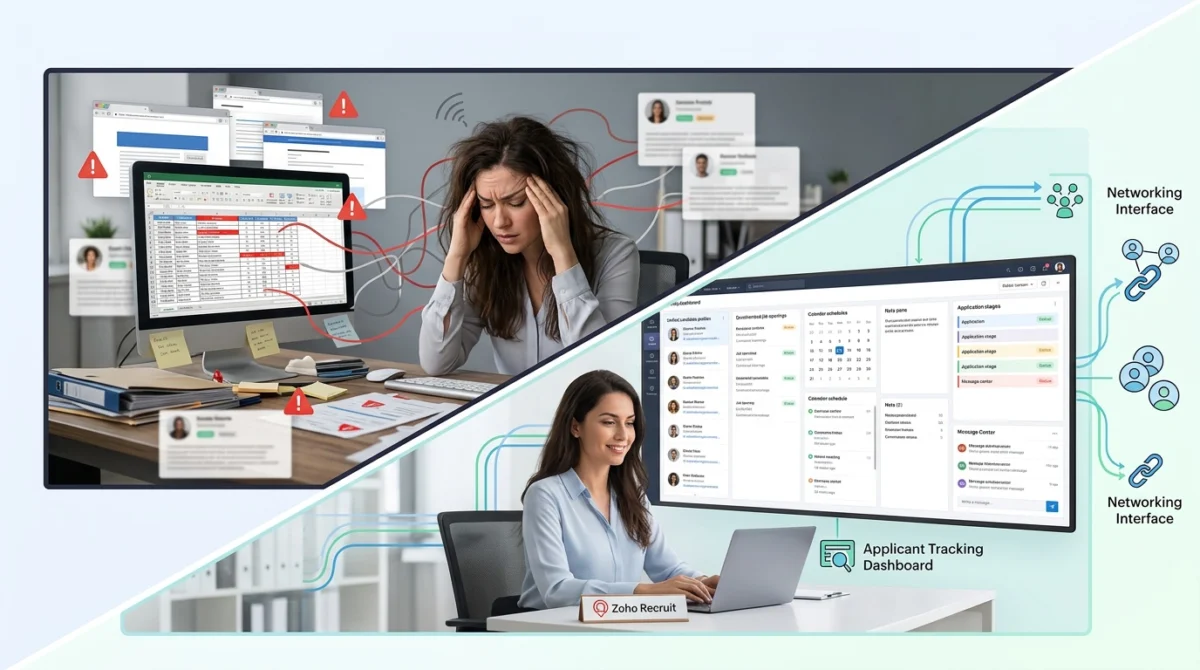
The primary obstacle for most small business owners is not necessarily a lack of interest from the workforce, but a lack of a formalized recruitment system. In many firms with fewer than 50 employees, hiring is still treated as an ad hoc administrative task rather than a strategic business function. The "scramble" method—characterized by posting a single job ad, manually reviewing resumes late at night, and conducting hurried interviews between client meetings—often leads to poor outcomes.
Research indicates that when a role remains open for more than six weeks, the pressure to fill the position often results in a "compromise hire." This is a decision made out of necessity rather than alignment. Recruiting software and automated systems are designed to alleviate this pressure by introducing structure. By automating the distribution of job postings to multiple platforms and centralizing candidate data, these systems prevent "candidate leakage," where high-quality applicants are lost because a hiring manager failed to follow up during a busy week.
For an owner managing every facet of their business, the implementation of a structured process is the difference between a six-week hiring cycle and a sixteen-week ordeal. The efficiency gained through technology allows the business to maintain its operational momentum while simultaneously building its future capacity.
Analyzing the 2026 Skills Gap: The Premium on Judgment
One of the most significant findings in the SHRM 2026 Talent Trends Report is the nature of the skills currently in highest demand. Approximately 80% of HR professionals identify judgment, decision-making, and complex problem-solving as the most difficult capabilities to find in the current candidate pool. These are "non-linear" skills that are notoriously difficult to quantify through traditional resume screening.
In a small business environment, these skills are amplified in importance. In a company of nine people, every individual’s decision-making directly impacts the bottom line. Unlike a corporation with nine thousand employees, there is no middle-management buffer to absorb the shock of a poor judgment call. This reality makes the "gut-check" method of hiring particularly dangerous for SMEs.
Modern recruiting platforms address this by utilizing structured screening questions and objective skills assessments. By forcing an "apples-to-apples" comparison through standardized scorecards, software helps owners move past the superficial quality of an interview and into a data-driven evaluation of a candidate’s actual capabilities. This reduces the risk of being swayed by a charismatic but under-qualified applicant.
The Financial Reality: The High Cost of Recruitment Errors
The economic stakes of hiring have never been higher for small businesses. Data from Gallup research highlights the staggering cost of employee turnover. Replacing a frontline worker can cost approximately 40% of their annual salary, while replacing a leadership-level employee can cost up to 200% of their salary when recruiting fees, training time, and lost productivity are accounted for.
For a small business operating on thin margins, a single bad hire can effectively erase a quarter’s worth of profit. The "hidden costs" of a failed hire include:
- Recruitment Advertising: The direct cost of job board placements and premium listings.
- Onboarding and Training: The time diverted from senior staff to bring a new hire up to speed.
- Opportunity Cost: The revenue lost because a role remained unfilled or was filled by an unproductive individual.
- Cultural Impact: The negative effect on existing staff morale when a new team member is a poor fit.
A structured, software-supported process is not merely a convenience; it is a financial safeguard. By ensuring the right candidate is identified the first time, small businesses can turn recruitment from a recurring expense into a long-term investment.
Industry Perspectives and Official Responses
Industry analysts, including experts from Zoho Corporation—a leading provider of business software—emphasize that the democratization of recruitment technology has leveled the playing field. In a statement regarding the 2026 hiring climate, technology consultants have noted that the barrier to entry for high-end recruitment tools has dropped, making it feasible for even the smallest firms to utilize AI-driven screening and automated scheduling.
The consensus among HR tech specialists is that software should not replace human judgment but should instead "clean the lens" through which that judgment is applied. By removing the administrative burden of scheduling and status updates, business owners can focus on the qualitative aspects of hiring, such as cultural alignment and long-term vision.
Economic analysts also point out that the small businesses currently thriving are those that treat talent acquisition as a "genuine growth lever." These firms do not wait for a crisis to begin looking for talent; they maintain a continuous, system-driven pipeline that allows them to scale rapidly when market opportunities arise.
Broader Implications for the SME Sector
The shift toward system-driven hiring has broader implications for the resilience of the small business sector. As the labor market continues to evolve, the ability to rapidly identify and integrate skilled professionals will become a primary competitive advantage. Small businesses that fail to adopt these processes risk falling into a cycle of "permanent understaffing," where existing employees are overworked, leading to further turnover and stunted growth.
Furthermore, the emphasis on judgment and problem-solving skills suggests a shift in how small businesses will be structured in the future. With AI handling more routine administrative tasks, the human element of a small business will be defined by its ability to navigate complexity. Consequently, the "process" of finding these people is no longer a back-office function—it is the foundation of the business’s strategic plan.
In conclusion, the data from 2026 makes it clear that the "hiring headache" reported by nearly half of small business leaders is a solvable problem. By transitioning from a "scramble" mindset to a system-based approach, small business owners can mitigate the risks of the skills gap, reduce the financial burden of turnover, and ensure that their team has the capacity to meet the demands of a complex economic environment. In a world where the most valuable candidates are also the hardest to find, the process is the prize.
