

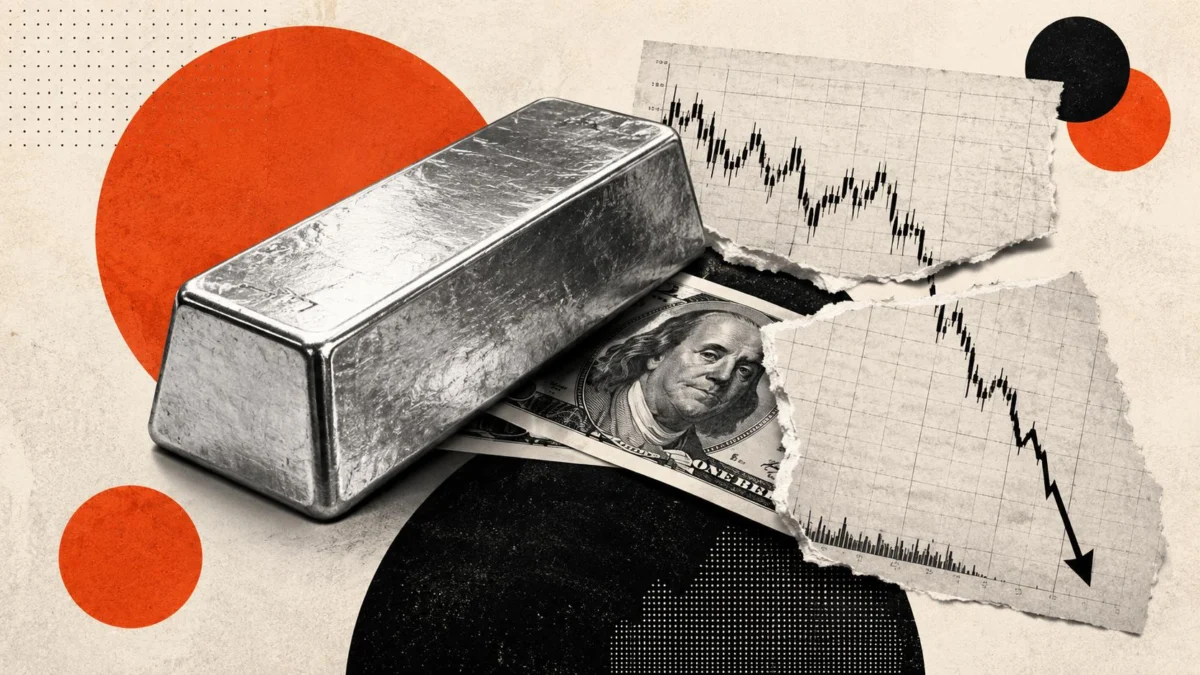
Silver (XAG/USD) experienced a sharp reversal on Friday, erasing significant gains after reaching a two-month high of $71.12. The precious metal, often seen as a barometer of market sentiment and a hedge against economic uncertainty, subsequently dove below the critical $69.00 threshold, settling at $66.76. This represented a substantial decline of 3.60% by the close of the trading day. The dramatic U-turn was primarily triggered by comments from Federal Reserve Chair Kevin Warsh, who delivered a decidedly hawkish speech at the highly anticipated Jackson Hole Economic Symposium, sending ripples through global financial markets and pushing US Treasury yields higher.
The Catalyst: Jackson Hole and Warsh’s Hawkish Stance
The annual Jackson Hole Economic Symposium, hosted by the Federal Reserve Bank of Kansas City, is a pivotal event in the central banking calendar. It brings together central bankers, finance ministers, academics, and financial market participants from around the world to discuss long-term policy issues. Speeches delivered at Jackson Hole are often closely scrutinized for clues regarding future monetary policy direction.
On Friday, Kevin Warsh, a former Federal Reserve Governor known for his influential economic commentary, took the podium. His remarks, widely interpreted as leaning hawkish, signaled a heightened concern over inflationary pressures and a potential readiness for the Federal Reserve to maintain or even adopt a more restrictive monetary policy stance for an extended period. A "hawkish" posture typically implies a central bank’s inclination to raise interest rates or reduce liquidity to curb inflation, even if it risks slowing economic growth.
The immediate consequence of Warsh’s comments was a discernible upward surge in US Treasury yields. Treasury yields represent the return an investor receives on a government bond. When yields rise, it increases the opportunity cost of holding non-yielding assets such as precious metals like silver and gold. Investors are enticed by the prospect of higher, risk-free returns from government bonds, making non-interest-bearing commodities less attractive. This direct relationship—hawkish Fed rhetoric leading to higher yields and subsequently pressuring precious metals—is a well-established dynamic in financial markets.
Chronology of a Volatile Trading Day
The trading day for silver began with a sense of optimism, building on recent momentum that had propelled XAG/USD to its highest point in two months. The white metal touched an intraday peak of $71.12, signaling strong bullish sentiment among traders. However, this upward trajectory proved fleeting. As news and analysis of Kevin Warsh’s Jackson Hole speech disseminated through the markets, the bullish momentum quickly dissipated.
The initial reaction was a cautious retreat from the peak, but as the implications of a potentially more aggressive Fed monetary policy began to sink in, selling pressure intensified. By mid-day, silver had surrendered its earlier gains, breaching the psychological $70.00 level. The descent continued, with XAG/USD plummeting below $69.00 and ultimately finding temporary support around the $66.76 mark. The speed and magnitude of the reversal underscored the market’s sensitivity to central bank communication and the profound impact of interest rate expectations on commodity valuations.
This rapid correction can be viewed as a classic example of "buy the rumor, sell the news," or in this case, a swift re-evaluation based on unexpected hawkish commentary. The market’s anticipation of the Jackson Hole symposium had likely factored in some degree of uncertainty, but Warsh’s explicit leanings towards tighter policy surprised many, leading to aggressive profit-taking and a shift in sentiment.
Technical Outlook: A Battle for Direction
From a technical analysis perspective, Friday’s price action delivered a significant blow to silver’s short-term bullish aspirations. The "false breakout" above the $70.00 level is a critical development, often signaling a potential reversal or a deeper correction. While XAG/USD had maintained a short-term upward bias prior to Friday, the failure to sustain gains above this key psychological and technical resistance level suggests that bulls may struggle to regain control immediately.
Key Resistance Levels:
For a bullish resumption, silver must decisively clear several formidable resistance levels. The immediate hurdle is the $70.00 mark, which now acts as a strong psychological and technical barrier. A sustained breach above this level would instill confidence among buyers and could pave the way for a retest of the day’s high at $71.12. Beyond that, the $72.00 milestone presents the next significant target. Further upward movement would then bring the 200-day Simple Moving Average (SMA) at $72.48 into focus. The 200-day SMA is a widely watched long-term indicator, and a break above it would signal a more robust and sustainable bullish trend.
Key Support Levels:
Conversely, the path of least resistance in the near term appears to be downwards. Should the selling pressure persist, a break below the immediate support at $66.00 could open the door to a test of $65.00. A more significant support level lies at the 50-day SMA, currently positioned at $61.44. The 50-day SMA is a key short-term trend indicator, and a break below it would confirm a shift in the short-term trend from bullish to bearish. Should this level fail to hold, the psychological $60.00 level would be the next critical area of support.
Momentum Indicators:
The Relative Strength Index (RSI), a momentum oscillator that measures the speed and change of price movements, offers mixed signals. While the RSI had previously indicated that buyers were in control, reflecting the short-term upward bias, its recent dip over the last two days suggests that bullish momentum is waning. Although not yet in oversold territory, the declining RSI warns that bulls are "not out of the woods" and could face further challenges in defending current price levels. A continued decline in the RSI, especially if it crosses below the 50-mark, would signal a shift in momentum to the bearish side.
Broader Economic Context: Silver’s Multifaceted Role
Silver’s price dynamics are influenced by a complex interplay of factors, including monetary policy, industrial demand, and its role as a safe-haven asset. Understanding these broader contexts is crucial for comprehending its recent volatility and potential future trajectory.
Monetary Policy and the US Dollar:
As a yieldless asset, silver typically has an inverse relationship with interest rates. When central banks, like the Federal Reserve, raise interest rates or signal a hawkish stance, the cost of holding non-yielding assets increases. This makes interest-bearing assets, such as government bonds or savings accounts, more attractive, drawing capital away from precious metals. Furthermore, silver is priced in US Dollars (XAG/USD). A stronger US Dollar, often a consequence of higher interest rates or a hawkish Fed, tends to make dollar-denominated commodities more expensive for holders of other currencies, thereby dampening demand and pushing prices lower. Conversely, a weaker dollar typically supports higher silver prices.
Inflation Hedge Status:
Silver, much like gold, is often touted as an inflation hedge. During periods of high inflation, investors seek assets that can preserve purchasing power, and precious metals historically have fulfilled this role. However, the effectiveness of silver as an inflation hedge can vary. While it may rise during periods of perceived inflation risk, a hawkish Fed actively combating inflation can paradoxically suppress precious metal prices by pushing real interest rates higher. The market’s interpretation of whether the Fed is succeeding in its inflation fight, or if inflation will prove persistent despite tightening, heavily influences this dynamic.
Industrial Demand: The Backbone of Silver’s Value:
Unlike gold, which is primarily a monetary and jewelry metal, silver boasts significant industrial utility. It possesses the highest electrical conductivity of all metals, making it indispensable in a wide array of applications, particularly in electronics, solar energy, and medical devices.
- Electronics: Silver is used in switches, contacts, conductors, and various components due to its superior conductivity.
- Solar Energy: The rapidly expanding solar power sector is a major consumer of silver, utilizing it in photovoltaic cells.
- Medical Applications: Silver’s antimicrobial properties make it valuable in medical instruments, wound dressings, and antibacterial coatings.
- Other Industries: It also finds use in photography (though declining), automotive applications, and specialized alloys.
Therefore, the health of the global economy, particularly the industrial sectors of major economies like the US, China, and India, profoundly impacts silver demand. A robust manufacturing sector typically translates to higher industrial demand for silver, supporting its price. Conversely, an economic slowdown or recession can dampen industrial activity, leading to reduced demand and downward pressure on silver prices. India, in particular, plays a significant role in consumer demand for silver jewelry and decorative items, adding another layer to its price sensitivity.
Supply Dynamics:
Silver is significantly more abundant than gold, which contributes to its lower per-ounce price. Supply comes from mining operations (often as a byproduct of lead, zinc, copper, or gold mining) and recycling. Fluctuations in mining output, driven by exploration success, technological advancements, or geopolitical stability in mining regions, can influence global supply. Recycling rates also play a role, with higher prices generally incentivizing more recycling.
Silver’s Safe-Haven Status and the Gold/Silver Ratio:
While silver shares gold’s status as a safe-haven asset, it typically exhibits greater volatility and is considered a "lesser" safe haven compared to gold. During periods of extreme geopolitical instability or deep recession fears, investors often flock to gold first. However, silver still benefits from risk-off sentiment, albeit often with a more pronounced price swing.
The Gold/Silver ratio, which indicates how many ounces of silver are needed to buy one ounce of gold, is a widely watched metric by investors. A high ratio often suggests that silver is undervalued relative to gold, or that gold is overvalued. Conversely, a low ratio might imply that gold is undervalued compared to silver. This ratio can provide insights into the relative strength or weakness of the two precious metals and inform investment decisions, with some traders using it to identify potential arbitrage opportunities or rotational strategies between the two metals.
Investment Landscape for Silver:
Investors can gain exposure to silver through various avenues:
- Physical Silver: Purchasing coins or bars offers direct ownership, though it comes with storage and insurance costs.
- Exchange Traded Funds (ETFs): These funds track the price of silver and are traded on stock exchanges, providing a liquid and convenient way to invest without physical ownership.
- Futures Contracts: For more sophisticated traders, futures contracts allow speculation on future silver prices, offering leverage but also higher risk.
- Mining Stocks: Investing in companies that mine silver provides indirect exposure, though these investments also carry company-specific risks.
Many investors use silver to diversify their portfolios, recognizing its potential to act as a hedge during high-inflation periods or as a play on industrial growth. Its lower price point compared to gold also makes it more accessible to a broader range of investors.
Future Outlook and Implications
The recent hawkish rhetoric from Federal Reserve officials, exemplified by Kevin Warsh’s Jackson Hole speech, casts a shadow of uncertainty over the short-term outlook for precious metals, including silver. The implications are multi-faceted:
- Persistent Monetary Tightening: If the Fed continues to signal a hawkish stance or indeed proceeds with further interest rate hikes, the opportunity cost of holding silver will remain elevated, likely capping any significant upward moves.
- Dollar Strength: A stronger US Dollar, driven by tighter monetary policy, will continue to exert downward pressure on silver prices.
- Industrial Demand Resilience: The crucial factor for silver’s long-term performance will be the resilience of global industrial demand. If major economies manage to avoid a severe recession and industrial activity remains robust, it could provide a fundamental floor for silver prices.
- Inflation vs. Disinflation: The ongoing battle against inflation will be key. If inflation proves more stubborn than anticipated, silver’s role as an inflation hedge might regain prominence, but only if real interest rates remain suppressed. If the Fed successfully brings inflation under control, disinflationary pressures could reduce the appeal of inflation hedges.
- Geopolitical Factors: Unforeseen geopolitical events or escalating global tensions could trigger a flight to safety, benefiting precious metals. However, the current narrative is dominated by monetary policy.
In conclusion, silver finds itself at a critical juncture. While its intrinsic value, industrial utility, and historical role as a safe-haven asset provide long-term appeal, its short-term trajectory is highly susceptible to the Federal Reserve’s monetary policy decisions and the resultant impact on US Treasury yields and the US Dollar. The dramatic price reversal witnessed on Friday serves as a stark reminder of the market’s sensitivity to central bank communication and the complex interplay of factors that drive precious metal valuations. Investors will be closely watching upcoming economic data and further Fed commentary for clearer signals on silver’s path forward.
