

Silver (XAG/USD) demonstrated resilience on Monday, trading on the front foot as buyers successfully defended the critical $55.00 support level after the precious metal briefly dipped below it on Friday, reaching its lowest valuation since December 2025. At the time of reporting, XAG/USD was observed around $56.85, marking a nearly 1.50% gain for the day. Despite this immediate rebound, the broader market sentiment indicates a lack of robust upside momentum, primarily due to persistent Middle East tensions bolstering the US Dollar and energy-driven inflation risks keeping expectations for a hawkish Federal Reserve firmly in play. Concurrently, the technical outlook for silver largely remains bearish, although momentum indicators have begun to signal a potential slowdown in the intense selling pressure that characterized recent trading sessions.
Current Market Dynamics and Price Action
The precious metal’s modest recovery on Monday saw it climb from the previous week’s lows, yet it struggles to overcome significant overhead resistance. The brief breach of the $55.00 mark on Friday underscored the prevailing bearish sentiment, pushing silver to a valuation not seen in over six months. This low point recalled market conditions from December 2025, a period marked by similar macroeconomic uncertainties and strong US dollar performance. The current trading range around $56.85 suggests a tug-of-war between short-term buying interest, possibly driven by bargain hunting, and fundamental headwinds that limit sustained upward movement.
The market’s immediate focus remains on the interplay between global geopolitical stability and monetary policy expectations. While silver typically benefits from safe-haven demand during times of uncertainty, the current landscape presents a complex scenario where Middle East tensions paradoxically strengthen the US Dollar. As the world’s primary reserve currency, the Dollar often attracts capital during crises, diminishing the relative appeal of other safe-haven assets like silver, especially for international investors.
Geopolitical Undercurrents and USD Strength
Escalating geopolitical tensions in the Middle East continue to be a dominant factor influencing global financial markets. Renewed conflicts or heightened political instability in the region often trigger a flight to safety, with the US Dollar being a primary beneficiary. This phenomenon occurs as investors seek refuge in highly liquid assets perceived to be backed by the stable economic and political framework of the United States. A stronger US Dollar makes dollar-denominated commodities, including silver, more expensive for holders of other currencies, thereby dampening international demand and exerting downward pressure on prices.
Moreover, these tensions frequently lead to spikes in energy prices, particularly crude oil. The fear of supply disruptions from major oil-producing regions contributes to higher energy costs, which in turn fuel inflationary pressures worldwide. This creates a challenging environment for central banks, especially the Federal Reserve, which must balance inflation control with economic growth objectives. The persistent threat of energy-driven inflation solidifies the market’s expectation that the Fed will maintain a hawkish stance, potentially keeping interest rates higher for longer.
Federal Reserve Policy and Inflationary Pressures
The specter of a hawkish Federal Reserve looms large over the silver market. A "hawkish" Fed implies a central bank more inclined to raise interest rates or maintain them at elevated levels to combat inflation, even if it risks slowing economic growth. Higher interest rates increase the opportunity cost of holding non-yielding assets like silver, as investors can earn better returns from interest-bearing alternatives such as bonds or savings accounts. This dynamic makes silver less attractive as an investment, especially for those seeking yield.
Current hawkish expectations are deeply rooted in ongoing inflationary risks, particularly those stemming from energy prices. While broader inflation metrics might show some moderation, the volatility in global energy markets due to geopolitical events creates persistent upward pressure on consumer prices. The Fed’s dual mandate includes achieving maximum employment and price stability. With the labor market often showing resilience, the central bank’s primary focus frequently shifts to reining in inflation. Should the Fed signal further rate hikes or commit to a prolonged period of high rates, silver prices are likely to face continued headwinds. Conversely, any indications of a dovish pivot, such as anticipated rate cuts, would typically provide a significant boost to silver, as lower rates reduce the opportunity cost of holding the metal.
Shifting Market Positioning and Demand Signals
A key insight into silver’s recent struggles comes from market positioning data. According to analysis from TD Securities, speculative appetite for the metal has continued to wane. The investment bank noted that "money managers have also reduced their long silver exposure, which will apply downward pressure on prices due to weakening industrial and investment demand." This reduction in long positions by money managers signifies a broader retreat from bullish bets on silver, indicating a more cautious, if not outright bearish, stance among institutional investors.
This retrenchment is a direct reflection of softening demand signals from two critical sectors: industrial usage and investment interest. Silver is unique among precious metals due to its significant industrial applications, particularly in electronics, solar energy, and medical technologies. A slowdown in global economic growth, or specific sectors like manufacturing and technology, can directly translate into reduced industrial demand for silver. For instance, if global supply chains remain disrupted or manufacturing output contracts, the need for silver as a component material decreases.
From an investment perspective, weakening interest can stem from various factors, including the aforementioned higher opportunity costs due to rising interest rates, a stronger US Dollar, and a general shift in investor sentiment towards riskier assets or other perceived safe havens. When investors pull back from buying physical silver, silver-backed Exchange Traded Funds (ETFs), or futures contracts, the overall demand picture deteriorates, contributing to downward price pressure. This weakening of both industrial and investment pillars creates a dual challenge for silver’s valuation.
Technical Analysis: A Bearish Outlook Persists
Despite Monday’s minor gains, the technical outlook for XAG/USD remains predominantly bearish across multiple timeframes, though signs of stabilization are emerging.
Daily Chart Analysis:
Silver continues to trade well below its key long-term moving averages, specifically the 200-day and 100-day Simple Moving Averages (SMAs). The 200-day SMA, currently around $70.58, and the 100-day SMA, at $72.24, represent significant resistance levels that the metal would need to overcome to signal a reversal in its long-term downtrend.
The Relative Strength Index (RSI), hovering around 38, remains below the neutral 50-line, indicating that sellers still hold an advantage, albeit with modest downside momentum. However, the slightly positive Moving Average Convergence Divergence (MACD) histogram hints at tentative attempts by the market to stabilize after the recent sharp slide. This suggests that while the overall trend is down, the immediate selling pressure might be exhausting itself, paving the way for a potential consolidation or minor corrective rally.
On the upside, initial resistance is identified at a horizontal barrier near $60.00. A more formidable cap is expected around $65.00, which aligns with previous support turned resistance. A sustained breach above these levels would be crucial to ease selling pressure and open the path towards the more significant hurdles posed by the 200-day and 100-day SMAs.
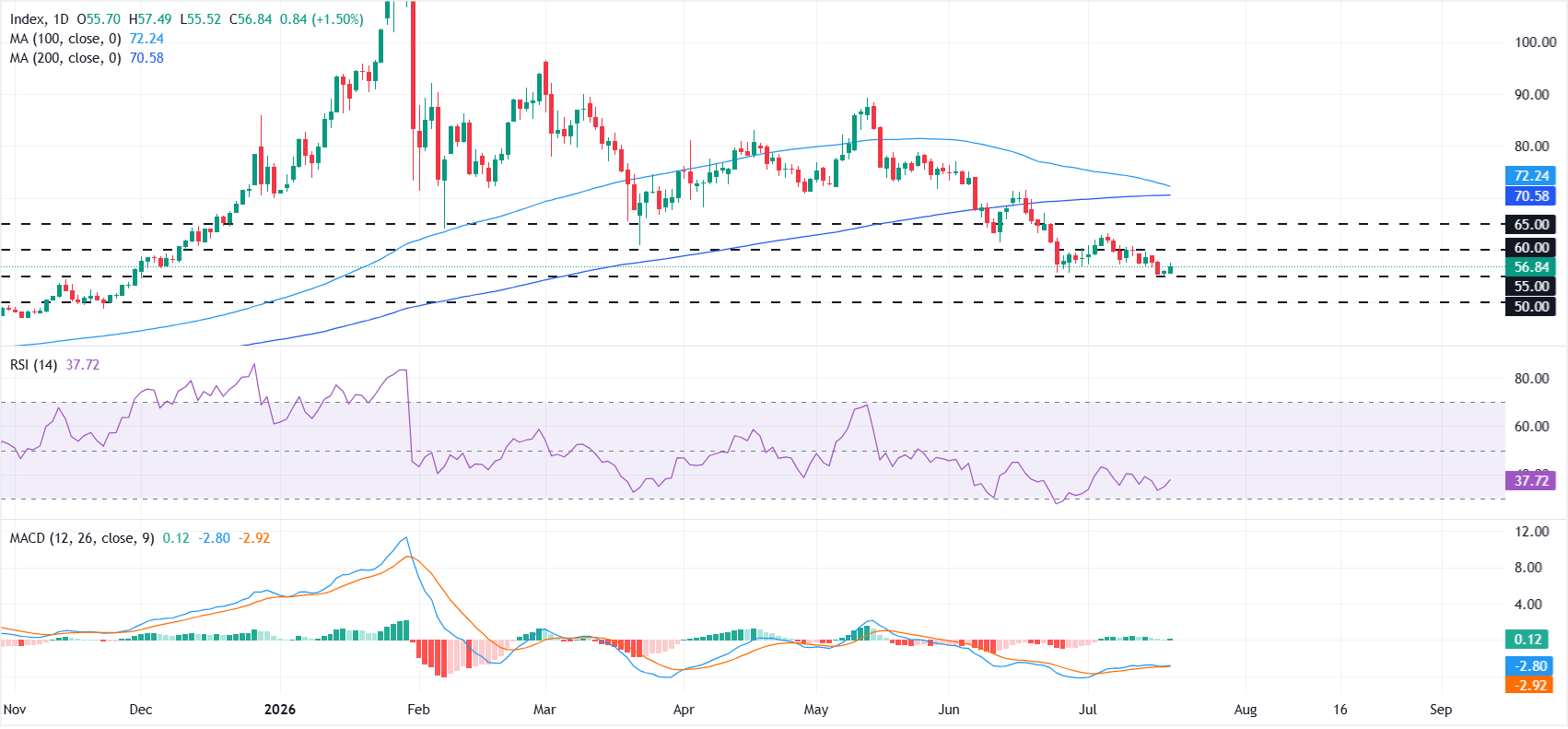
Conversely, immediate support is robustly placed at $55.00. A decisive loss of this floor would expose silver to deeper losses, with the next significant psychological and technical support zone anticipated around $50.00. Buyers are likely to mount a strong defense in this area to prevent further declines.
Four-Hour Chart Analysis:
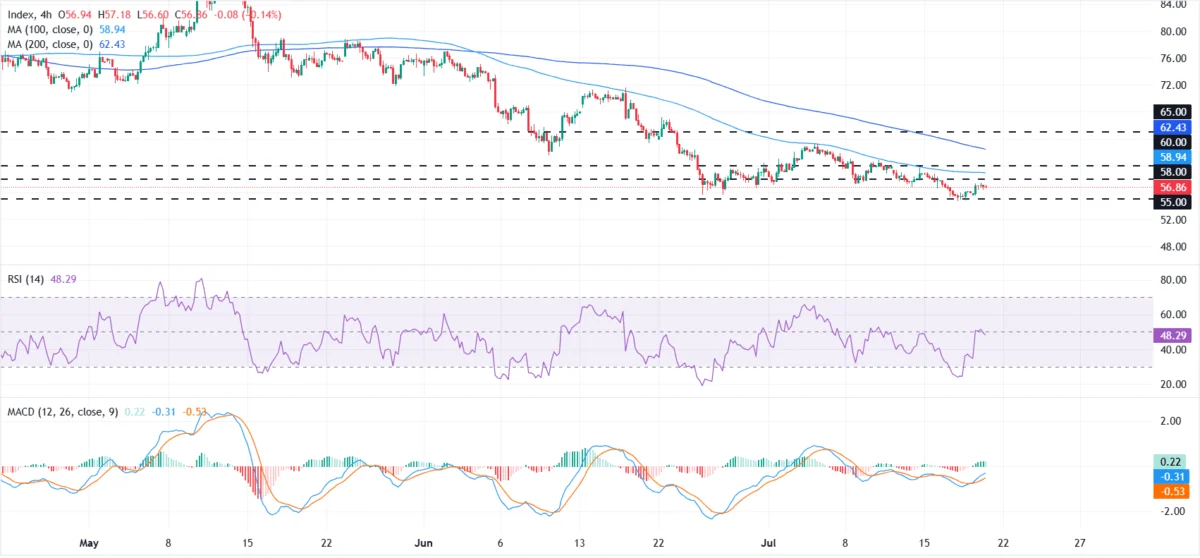
The near-term bias for XAG/USD also remains bearish, with the metal trading below both the 100-period Simple Moving Average (SMA) at $58.94 and the 200-period SMA at $62.43. These short-term moving averages act as dynamic resistance levels, confirming the prevailing downtrend in the immediate timeframe.
While silver has bounced off its recent lows, its recovery appears to be capped by a nearby horizontal barrier at $58.00. The Relative Strength Index (RSI) at 47 is near neutral, indicating a lack of strong directional conviction in the very short term. The Moving Average Convergence Divergence (MACD) has turned mildly positive, which typically suggests a build-up in bullish momentum. However, in this context, it is more likely indicative of a corrective bounce within a larger bearish trend rather than a clear trend reversal.
For the short-term bulls, immediate resistance is seen at $58.00, followed by the 100-period SMA near $58.94, and then the psychological level of $60.00. Further challenges lie at the 200-period SMA at $62.43 and a prior horizontal cap at $65.00, which together reinforce a broader supply zone overhead.
On the downside, initial support remains at the horizontal level of $55.00. A breach below this critical floor would likely expose the metal to further losses within the prevailing bearish structure, potentially retesting Friday’s lows and beyond.
Historical Context and Broader Implications
The current market conditions for silver are reminiscent of past periods where a strong US Dollar, rising interest rates, and subdued industrial demand converged. Silver’s dual identity as both a precious metal and an industrial commodity means its price dynamics are influenced by a wider array of factors than gold, which primarily acts as a safe haven and store of value. When industrial demand softens, silver loses one of its key pillars of support.
Historically, silver prices tend to follow gold’s trajectory, albeit with higher volatility. The Gold/Silver ratio, which measures how many ounces of silver are needed to equal one ounce of gold, is a key metric for investors. A high ratio often suggests silver is undervalued relative to gold, potentially indicating a future buying opportunity for silver. The current environment, with gold maintaining a stronger safe-haven appeal, could see this ratio widen, signaling that silver remains relatively cheaper.
The industrial uses of silver are extensive and diverse. Its exceptional electrical conductivity makes it indispensable in electronics, including smartphones, computers, and electric vehicles. The rapidly expanding solar energy sector is another major consumer of silver, using it in photovoltaic cells. Medical technologies, photography (though less so now), and even water purification systems also rely on silver’s unique properties. Therefore, the long-term outlook for industrial demand is tied to global economic growth, technological innovation, and the pace of the green energy transition. Any significant shifts in these areas could dramatically alter silver’s demand profile.
For investors, silver offers a way to diversify a portfolio and potentially hedge against inflation, similar to gold, though its industrial component adds a layer of economic sensitivity. While less popular than gold, its lower price point often makes it more accessible for individual investors seeking exposure to precious metals. However, the present confluence of a strong dollar, hawkish central bank policy, and geopolitical uncertainty creates a challenging environment that requires careful monitoring of both fundamental and technical indicators. The defense of the $55.00 level on Monday provides a temporary reprieve, but the path forward for silver remains fraught with significant headwinds.
