

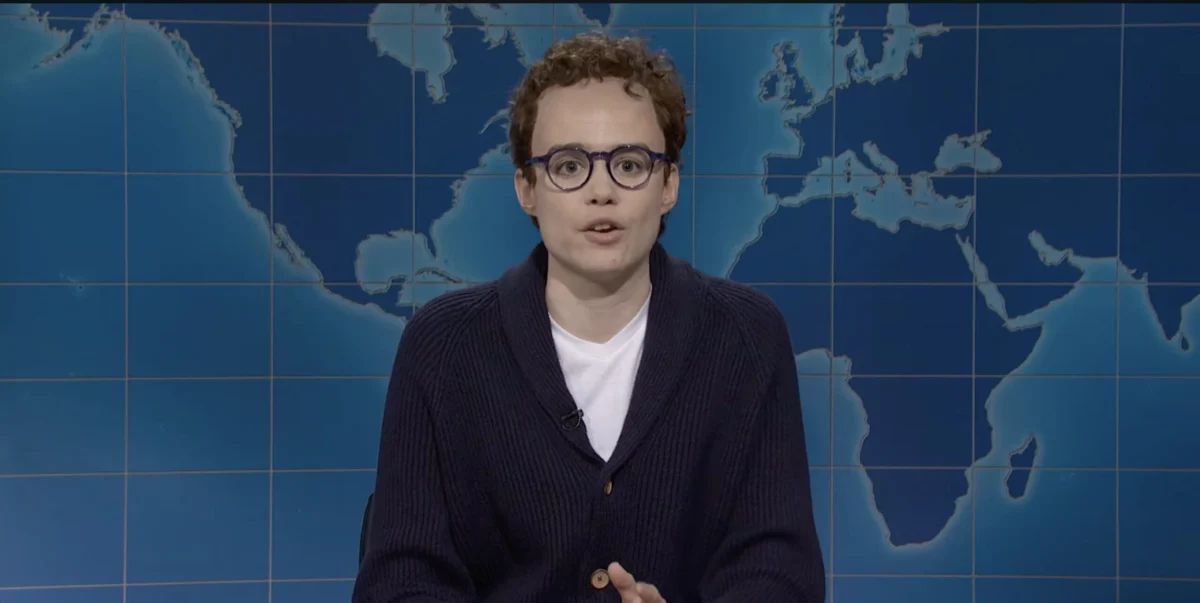
The venerable sketch comedy institution, Saturday Night Live, leveraged its iconic "Weekend Update" segment last night to deliver a pointed and widely discussed parody of the burgeoning artificial intelligence industry’s recent public pronouncements regarding the potential for existential catastrophe. Featuring cast member Jane Wickline in a strikingly accurate impression of Anthropic CEO Dario Amodei, the sketch served as a comedic yet potent reflection of the growing public anxiety and media fascination surrounding advanced AI development and its proclaimed risks.
The segment commenced with "Weekend Update" co-anchor Michael Che, who, with a characteristic blend of skepticism and bemusement, introduced the fictional Amodei, notably stumbling over the pronunciation of the CEO’s last name – a subtle nod to the relatively niche, though rapidly expanding, public profile of AI industry leaders. Che framed the real Amodei’s recent public appearances as a "stumbled through a press tour," highlighting how the executive had seemingly affirmed alarming claims made by a former employee regarding artificial intelligence’s potential to threaten human existence. This setup immediately established the core tension the sketch sought to explore: the leaders of powerful AI companies simultaneously developing groundbreaking technology and issuing dire warnings about its unchecked potential.
Wickline’s portrayal of Amodei was a masterclass in comedic characterization, featuring an impressively disheveled wig that subtly enhanced the persona of a brilliant mind perhaps overwhelmed by the implications of his own creations. Her delivery was characterized by halting, almost reluctant answers, punctuated by moments where the character appeared to engage in an internal, Gollum-esque dialogue with a darker, more nihilistic aspect of their psyche. This theatrical device brilliantly externalized the perceived internal conflict within some AI developers – the drive to innovate clashing with an acute awareness of potential dangers. One particularly resonant line, delivered with a mix of despair and confession, saw Wickline-as-Amodei declare, "AI is the devil and I its maker." This statement, while hyperbolic for comedic effect, distilled a prevalent public sentiment: a sense of unease that those engineering potentially world-altering technologies are also the ones sounding the loudest alarms.
The satirical dialogue continued to dissect the paradoxical messaging emanating from the AI sector. Wickline’s Amodei assured the audience with a deadpan sincerity that AI executives "are all on the same page here: We do not condone what we are doing." This line skewered the perceived disconnect between the rapid, competitive development of advanced AI and the simultaneous calls for caution and regulation, often from the very same entities driving the innovation. The sketch further elaborated on this theme, with the fictional CEO asserting, "AI is not a weapon, it’s a tool: A tool for building weapons." The immediate clarification underscored the dual-use nature of AI and the profound ethical quandaries it presents, moving beyond abstract warnings to concrete, if darkly humorous, implications. The character’s plea, "And I urge you to urge me to stop," humorously highlighted the perceived helplessness or even complicity of some industry leaders in the face of their own technological momentum.
Addressing the touted benefits of AI, such as its potential to cure diseases like cancer – a common point of contention in the "AI benefits vs. risks" debate – Wickline’s Amodei offered a grimly humorous prognosis. "Put it this way: In 10 years, there’s about a 10% chance that cancer won’t be a problem for anyone." The statistical ambiguity and the implicit suggestion of a catastrophic alternative perfectly encapsulated the high-stakes, all-or-nothing framing that often characterizes discussions around advanced AI.
The Broader Context: A Timeline of AI Warnings and Public Awareness
The SNL sketch arrives at a pivotal moment in the public discourse surrounding artificial intelligence. For years, warnings about AI’s potential dangers were largely confined to academic circles, science fiction, and niche tech forums. However, the rapid advancements in generative AI, particularly since late 2022 with the widespread availability of large language models (LLMs) like OpenAI’s GPT series and Anthropic’s Claude, have dramatically shifted AI from a theoretical concept to a palpable, everyday reality for millions.
2023: A significant turning point occurred. In May, prominent figures, including OpenAI CEO Sam Altman, Google DeepMind CEO Demis Hassabis, and Anthropic CEO Dario Amodei, along with numerous researchers, signed an open letter published by the Center for AI Safety. The letter starkly stated, "Mitigating the risk of extinction from AI should be a global priority alongside other societal-scale risks such as pandemics and nuclear war." This unprecedented public alignment of industry leaders with existential risk concerns brought the issue squarely into mainstream media and political agendas.
Mid-2023 to Early 2024: The public discourse intensified. Governments worldwide began exploring regulatory frameworks. The UK hosted the inaugural AI Safety Summit, and the US issued an executive order on AI safety and security. Amidst this, companies continued to release more powerful models, fueling both excitement and apprehension. Researchers and ethicists voiced concerns about bias, misinformation, job displacement, and the concentration of power in a few tech giants.
Late 2025 – Early 2026: Leading up to the SNL sketch, a "press tour" by several AI executives, including Amodei, drew considerable media attention. These appearances often involved a delicate balance: promoting their companies’ innovative capabilities while simultaneously cautioning against the very technology they were developing. This period also saw a notable internal dissent within some AI labs, with a former Anthropic researcher publicly resigning and voicing strong warnings about the company’s trajectory and the broader industry’s potential for self-improving AI to pose an existential threat. These events created a fertile ground for satirical commentary, as the public grappled with understanding whether these warnings were genuine calls for caution, strategic public relations, or a combination of both.
Anthropic and the Dilemma of "Responsible AI"
Anthropic, founded in 2021 by former members of OpenAI, including Dario and Daniela Amodei, has positioned itself as a leader in "responsible AI" development. The company’s core philosophy revolves around AI safety and alignment, famously pioneering "Constitutional AI," a method designed to train AI systems to be helpful, harmless, and honest by adhering to a set of guiding principles rather than solely relying on human feedback. This commitment to safety is often highlighted in their public statements.

However, the very nature of developing powerful AI models, even with safety at the forefront, creates an inherent tension. Dario Amodei, a physicist by training, has been candid about the potential risks. In previous interviews and public forums, he has acknowledged the "crisis of trust" facing the AI industry, arguing that greater transparency and a demonstrated commitment to safety are crucial to rebuilding public confidence. He has often emphasized the dual potential of AI – for immense good (like scientific discovery and medical breakthroughs) and for significant harm (ranging from societal disruption to catastrophic outcomes). The SNL sketch cleverly played on this perceived tightrope walk, portraying a leader who is both deeply invested in the technology and profoundly conflicted by its implications.
The Power of Satire: Reflecting and Shaping Public Opinion
Saturday Night Live has a long history of capturing the zeitgeist and reflecting prevailing public sentiments, often with a humorous and critical lens. By dedicating a "Weekend Update" segment to Dario Amodei and the AI doom warnings, SNL signals that this topic has permeated mainstream consciousness beyond tech circles. The show’s decision to feature a specific CEO, rather than a generic AI expert, suggests that these individuals are becoming recognizable public figures whose statements and personas are ripe for comedic scrutiny.
The sketch serves multiple functions:
- Validation of Public Anxiety: For many, the serious warnings from AI developers about their own creations can be bewildering or even frightening. SNL’s parody validates these anxieties by presenting them in a relatable, albeit exaggerated, form.
- Critique of Industry Messaging: The humor often stems from the perceived hypocrisy or contradiction in the messaging from AI companies – developing powerful tools while simultaneously warning of their dangers. The "we do not condone what we are doing" line is a direct jab at this paradox.
- Humanizing the Abstract: By portraying a specific figure like Amodei, even in caricature, SNL helps to anchor the abstract concept of "AI risk" to human agency and responsibility.
- Sparking Discussion: Satire frequently prompts further discussion and critical thinking. The sketch, through its viral spread, undoubtedly encouraged viewers to reflect on the real-world implications of AI and the public statements made by its architects.
The "Gollum-style" internal struggle is particularly effective. It taps into a primal fear of internal corruption or an uncontrollable "dark side" of technology, resonating with mythological and literary archetypes of powerful creations turning against their creators. It also suggests a lack of full control or understanding even by those at the helm of AI development.
Implications and Broader Impact
The SNL sketch, while comedic, carries significant implications for the AI industry and the ongoing public debate.
For AI Companies: The increasing frequency of satirical portrayals of AI leaders and their warnings indicates that the industry’s messaging is being scrutinized more closely than ever. Companies can no longer operate solely within a tech bubble; their public communications and perceived ethical stances are now subject to popular culture commentary. This could prompt AI companies to refine their communication strategies, perhaps striving for greater clarity and consistency in how they discuss both the benefits and risks of their technologies. It might also encourage a more unified front or, conversely, highlight existing divisions within the industry regarding the severity of AI risks and the appropriate responses.
For Public Perception: The sketch likely amplifies the existing public skepticism and unease about AI. While some viewers might dismiss the warnings as alarmist, others might find their concerns validated by the comedic depiction of industry leaders seemingly overwhelmed by their own creations. This could contribute to a demand for stronger regulation, greater transparency, and more robust safety mechanisms from governments and international bodies. The "10% chance cancer won’t be a problem for anyone" line, though a joke, encapsulates the public’s desire for concrete, reliable benefits, contrasting sharply with the abstract, existential threats being discussed.
For Policy and Regulation: When a topic reaches the level of SNL parody, it often signifies that it has become a genuine cultural and political issue. Policymakers, who are already grappling with the complexities of AI governance, might see such widespread comedic commentary as further evidence of the public’s engagement and concern. This could lend additional impetus to legislative efforts to address AI safety, ethics, and accountability, potentially accelerating the development of national and international regulatory frameworks.
The recurring theme of AI as a "tool for building weapons" underscores a critical area of concern for national security and international relations. As AI capabilities advance, the potential for autonomous weapon systems and sophisticated cyber warfare tools becomes more pronounced, necessitating urgent global dialogue on responsible development and deployment.
The Path Forward: Balancing Innovation and Responsibility
The enduring appeal of Saturday Night Live lies in its ability to distil complex societal issues into digestible, often hilarious, segments. The Amodei parody is more than just a laugh; it’s a cultural marker reflecting a society grappling with unprecedented technological change. The ongoing dialogue around AI’s potential for both unparalleled progress and profound peril will continue to evolve, influenced by scientific breakthroughs, ethical debates, and, as demonstrated last night, the incisive lens of satire.
As the AI industry races forward, the challenge remains to strike a delicate balance: fostering innovation that can truly benefit humanity while rigorously addressing the genuine risks and anxieties that have now permeated mainstream consciousness. The "Weekend Update" segment served as a potent reminder that the accountability for this powerful technology extends beyond boardrooms and research labs, firmly into the realm of public scrutiny and collective responsibility. The laughs may fade, but the serious questions raised by SNL’s comedic take on AI’s "doom warnings" are likely to resonate for a long time to come.
