

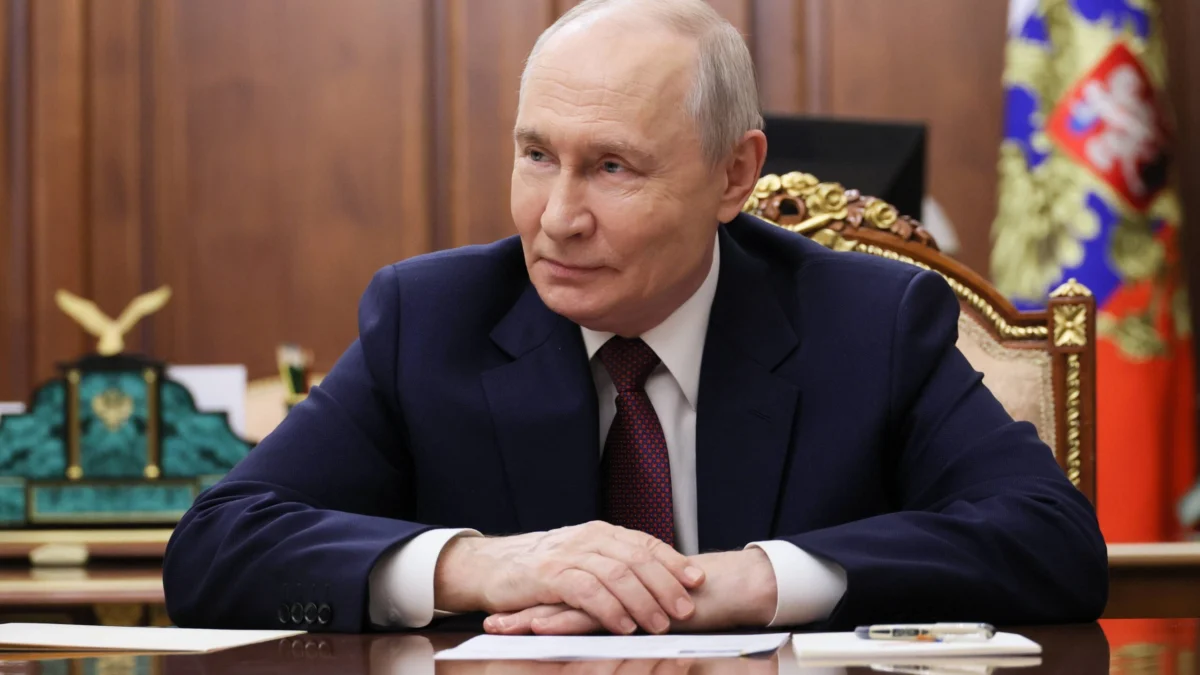
New York – Russian President Vladimir Putin has indicated a willingness to resume trilateral negotiations aimed at resolving the conflict in Ukraine, following a discussion with U.S. envoy Steve Witkoff. Putin stated that Russia is prepared to re-engage in these contacts, which previously involved representatives from the United States and Ukraine. The Kremlin chief’s remarks, made to state television correspondent Pavel Sarubin, suggest a potential shift in Russia’s approach to finding a resolution, albeit with a clear emphasis on long-term security arrangements.
This development comes after a series of diplomatic engagements. U.S. envoy Steve Witkoff reportedly met with Ukrainian President Volodymyr Zelenskyy and European officials before proceeding to St. Petersburg for a meeting with Putin. Following this encounter, Kremlin advisor Yuri Ushakov hinted at the possibility of new negotiations involving Moscow, Kyiv, and Washington, tentatively scheduled for mid-November. Putin’s latest statement appears to confirm this intention and elaborate on the specific objectives of such talks.
H2: Core Objectives: A Definitive Peace, Not a Truce
President Putin articulated that the primary goal of these prospective negotiations would be to address the crucial question of security guarantees for both Ukraine and Russia in the aftermath of a peace agreement. He stressed that the aim is to establish a "definitive variant," as opposed to a temporary cessation of hostilities. This distinction is significant, as it signals Russia’s continued rejection of a mere ceasefire as a standalone solution. The Kremlin appears to be seeking a comprehensive and enduring peace settlement that addresses fundamental security concerns, rather than an interim pause that could allow for the resumption of conflict.
This stance underscores Russia’s long-held demands regarding its security interests, particularly concerning the eastward expansion of NATO and the perceived threat posed by Ukraine’s potential alignment with Western military alliances. For months, Moscow has insisted that any lasting peace must include robust security guarantees that prevent hostile military infrastructure from being deployed near its borders.
H2: The Diplomatic Path: A Recapped Timeline and Key Players
The recent diplomatic overtures began with U.S. envoy Steve Witkoff’s engagement with Ukrainian leadership. Witkoff, known for his role in international real estate and his connections within U.S. political circles, has been involved in discreet diplomatic efforts. His meeting with President Zelenskyy, while details remain scarce, likely focused on exploring avenues for de-escalation and potential negotiation frameworks. Following this, Witkoff’s journey to St. Petersburg for a meeting with President Putin marked a significant step in bridging communication gaps between the two nations.
The subsequent announcement by Yuri Ushakov, Putin’s foreign policy advisor, regarding the potential mid-November talks, provided a concrete timeline. Ushakov indicated that the proposed discussions would be tripartite, involving Russia, Ukraine, and the United States. This inclusion of the U.S. is critical, given its substantial military and financial support for Ukraine and its influential role in international diplomacy.
Putin’s recent statement directly references "three-way contacts," suggesting a continuation or revival of previous dialogue formats. While the specifics of these earlier discussions are not fully detailed in the provided text, their mention implies a pre-existing, albeit perhaps stalled, framework for multilateral engagement on the conflict.
H3: European Security on the Agenda
President Putin also highlighted that discussions regarding future security for Ukraine and Russia would necessitate a broader conversation about European security. He noted that Witkoff had conveyed the importance of including European security in these talks, a proposition to which Putin stated he is "fundamentally" agreeable. This suggests that Russia views the Ukraine conflict not in isolation, but as an integral part of the wider European security architecture.
This linkage to broader European security aligns with Russia’s long-standing grievances regarding the post-Cold War security order, which it perceives as having been disadvantageous to its interests. Putin’s willingness to discuss European security implies a desire to revisit and potentially reshape the continent’s security arrangements to accommodate Russian concerns. This could involve discussions on arms control, military deployments, and the roles of various international security organizations.
H2: Supporting Data and Context
The conflict in Ukraine, which began with Russia’s full-scale invasion in February 2022, has resulted in immense human suffering and widespread destruction. According to United Nations estimates, millions of Ukrainians have been displaced internally and externally, and thousands of civilians have been killed or injured. The economic impact has been devastating, not only for Ukraine but also for the global economy, with significant disruptions to energy and food markets.
Diplomatic efforts to resolve the conflict have been ongoing since its inception, but have faced numerous obstacles. While initial negotiations between Russia and Ukraine in the early stages of the war showed some promise, they ultimately faltered. The involvement of international mediators, including Turkey and the United Nations, has also yielded limited breakthroughs. The current diplomatic push, involving the U.S. envoy, appears to be an attempt to re-energize these efforts by bringing key stakeholders to the table with a clearer agenda.
H3: Russia’s Security Demands: A Historical Perspective
Russia’s emphasis on security guarantees is rooted in its historical experiences and its perception of its geopolitical position. Following the dissolution of the Soviet Union, Russia has viewed the eastward expansion of NATO as a direct threat to its security. Russian officials have repeatedly expressed concerns about NATO military infrastructure being positioned closer to its borders, particularly in countries that were formerly part of the Soviet bloc or the Warsaw Pact.
The conflict in Ukraine has been framed by Russia, in part, as a response to what it considers unfulfilled security assurances and a perceived Western encroachment on its sphere of influence. Therefore, any sustainable peace agreement, from Moscow’s perspective, must address these deep-seated security concerns. This includes the status of Ukraine’s potential NATO membership and the deployment of foreign military assets on its territory.
H2: Potential Implications and Analysis
Putin’s statement, while signaling a willingness to talk, also sets a high bar for any potential peace agreement. The emphasis on a "definitive variant" and the inclusion of broader European security issues suggests that Russia is seeking a fundamental restructuring of the current security order, rather than a simple resolution of the territorial disputes in Ukraine.
The inclusion of European security in the discussions could open a Pandora’s Box of complex issues, potentially involving NATO, the Organization for Security and Co-operation in Europe (OSCE), and other regional security frameworks. It remains to be seen how these discussions would be structured and who would represent the broader European security interests beyond the direct parties to the conflict.
The U.S. role in these negotiations will be critical. Washington has consistently supported Ukraine’s sovereignty and territorial integrity while also maintaining lines of communication with Moscow. The success of these talks will likely depend on the ability of the U.S. and its allies to find common ground with Russia on core security issues, while also upholding the principles of international law and Ukrainian self-determination.
H3: Reactions from Other Parties (Inferred)
While direct statements from Ukrainian and U.S. officials regarding Putin’s latest remarks are not immediately available in the provided text, it can be inferred that Ukraine would welcome any genuine willingness from Russia to negotiate a peaceful resolution, provided it respects Ukraine’s sovereignty and territorial integrity. President Zelenskyy has consistently advocated for a diplomatic solution that restores Ukraine’s full territorial integrity and ensures accountability for the aggressor.
The United States, under the Biden administration, has maintained a dual approach of providing robust support to Ukraine while also keeping channels of communication open with Russia for de-escalation and potential diplomatic pathways. U.S. officials have previously indicated that any resolution to the conflict must be determined by Ukraine itself and must adhere to international principles. The U.S. envoy’s engagement suggests a continued U.S. commitment to facilitating dialogue.
H2: The Path Forward: Uncertainty and Caution
President Putin’s statement offers a glimmer of hope for a diplomatic resolution to the protracted conflict in Ukraine. However, the path forward remains fraught with challenges and uncertainties. The stated Russian objectives, particularly the demand for a "definitive variant" and the inclusion of broader European security, indicate that any negotiations will be complex and demanding.
The effectiveness of these potential talks will hinge on the willingness of all parties to engage in good faith, to compromise, and to find solutions that address the legitimate security concerns of all involved while respecting international law and the sovereignty of nations. The international community will be closely watching these developments, hoping for a de-escalation of violence and a lasting peace that upholds fundamental principles of global security. The coming days and weeks will likely reveal the true depth of commitment to negotiation and the potential for substantive progress.
