

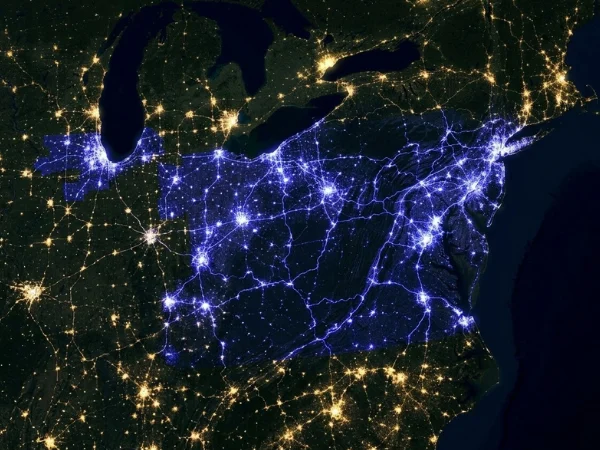
PJM Interconnection, the organization responsible for managing the largest wholesale electricity market and power grid in the United States, currently finds itself at a critical juncture that could redefine the future of American energy infrastructure. Serving more than 65 million people across 13 states and the District of Columbia, the regional transmission organization (RTO) is grappling with a convergence of pressures: a massive spike in demand driven by the rapid expansion of artificial intelligence (AI) data centers, the accelerated retirement of traditional fossil fuel power plants, and a systemic bottleneck in the process of connecting new, primarily renewable, energy sources to the grid. The situation has become so dire that PJM officials and industry experts are now warning of a looming "capacity cliff" that could manifest as early as 2028, potentially leading to rolling blackouts and sustained price volatility for millions of residential and industrial consumers.
The scale of the challenge is underscored by PJM’s own projections, which forecast a 6.8 gigawatt (GW) capacity shortfall within the next four years. This deficit is not merely a theoretical concern for grid operators; it is already manifesting in the marketplace. Recent capacity auctions—the mechanism through which PJM secures commitments from power plants to be available for future needs—saw prices skyrocket to unprecedented levels. In the most recent Base Residual Auction for the 2025/2026 delivery year, prices surged from approximately $28.92 per megawatt-day to $269.92 per megawatt-day. This nearly tenfold increase forced PJM to seek federal approval to implement emergency caps to prevent total market collapse, yet the underlying causes of the price spike remain unresolved.
The Chronology of a Growing Energy Crisis
To understand the current emergency, it is necessary to trace the timeline of PJM’s evolving operational landscape. For much of the last decade, the RTO enjoyed a period of relative stability characterized by low natural gas prices and a steady transition from coal-fired generation to gas-fired plants. However, the trajectory began to shift sharply around 2022, following the global explosion in generative AI technologies.
In early 2023, PJM began revising its long-term load forecasts upward at a rate seldom seen in the utility industry. The primary driver was the concentration of data center development in Northern Virginia—often referred to as "Data Center Alley"—and increasingly in Ohio and Pennsylvania. By mid-2024, the reality of the "interconnection queue" crisis became undeniable. Over 250,000 megawatts of proposed generation, mostly wind, solar, and battery storage, remained stuck in a multi-year administrative backlog.
Simultaneously, environmental regulations and economic shifts have accelerated the retirement of older coal and oil-fired generators. According to Advanced Energy United, a clean energy trade group, these retirements are occurring faster than the grid can replace them, creating a dangerous gap in "firm" capacity—power that can be dispatched at any time, regardless of weather conditions. As of late 2024, PJM is caught between the mandates of state-level clean energy goals and the immediate, physical necessity of maintaining grid reliability.
The AI Factor: A New Class of Energy Consumer
The emergence of AI data centers has introduced a variable that PJM’s market models were not originally designed to handle. Unlike traditional industrial loads, which may fluctuate based on shifts or seasonal cycles, AI data centers require massive amounts of "always-on" power. A single large-scale data center campus can consume as much electricity as a small city, and the growth shows no signs of slowing.
Jon Gordon, a senior director at Advanced Energy United and a noted PJM expert, emphasizes that the grid operator is struggling with how to categorize these massive new loads. "We’ve never isolated a customer class, like large load data centers, to be interrupted," Gordon noted during a recent industry forum. Traditionally, when the grid faces a shortage, all customers share the burden of conservation or rolling outages. However, the sheer size and critical nature of AI infrastructure are forcing PJM to consider "interruptible service" contracts specifically for data centers—a prospect that developers find unacceptable.
Data center operators generally demand "firm service," meaning they require a 99.999% guarantee of power availability to prevent data loss or hardware damage. This conflict between what the grid can realistically provide and what the newest, most lucrative customers demand is at the heart of PJM’s current governance debate.
The Interconnection Bottleneck and Cost Discovery
While the demand side of the equation is surging, the supply side remains constrained by what developers call a "notorious" interconnection process. Adam Stern, a representative from clean energy developer Clearway Energy, points to a fundamental flaw in how PJM manages new projects. Currently, developers entering the "queue" to connect to the grid often do not know the full cost of the necessary infrastructure upgrades until they are years into the process.
"The queue becomes somewhat of a cost discovery tool," Stern explained. This uncertainty leads to a high "drop-out" rate, where developers abandon projects late in the game after discovering that the grid upgrades required to support their project are financially unfeasible. This cycle wastes administrative resources and delays the deployment of the very renewables needed to bridge the 6.8 GW gap. Stern argues that PJM must shift toward providing cost certainty ahead of time, allowing developers to make informed investment decisions and accelerating the "speed-to-power" for projects that are actually viable.
Innovative Solutions: Virtual Power Plants and Distributed Energy
As PJM searches for ways to modernize its operations, some are looking toward the "load side" of the grid for solutions. Kimaya Abreu of Voltus, a leading virtual power plant (VPP) operator, suggests that the answer lies in utilizing distributed energy resources (DERs)—such as smart thermostats, industrial batteries, and backup generators—to create a more flexible grid.
VPPs aggregate thousands of small-scale energy resources to act as a single, large-scale power plant. Unlike massive utility-scale solar farms or gas plants, VPPs do not require years of interconnection studies because they are located behind the meter on the customer’s property. Recently, Voltus signed a landmark deal with Google to provide 100 megawatts of distributed capacity to the PJM market.
Abreu highlights a new "bring your own capacity" pathway that PJM is exploring. Under this model, large loads like data centers are incentivized to fund their own distributed energy solutions. This allows the data center to "carry its own capacity costs" while reducing the overall strain on the collective grid. "If we can use what we already have as efficiently as possible and add less, avoid some of those network upgrades, that has long-term affordability benefits for all ratepayers," Abreu stated.
Broader Economic and Regulatory Implications
The crisis at PJM has far-reaching implications for the American economy and the national transition to clean energy. If PJM cannot resolve its capacity shortfall, the economic consequences for the 13 states in its footprint could be severe. High electricity prices act as a regressive tax on residents and can deter manufacturers from expanding in the region.
Furthermore, the tension between PJM’s market rules and state-level policy is reaching a boiling point. States like Maryland, Illinois, and New Jersey have passed ambitious laws requiring a transition to 100% clean energy. However, if PJM’s markets continue to favor existing fossil fuel units to maintain reliability, these states may find their policy goals at odds with the RTO’s operational reality.
Federal regulators at the Federal Energy Regulatory Commission (FERC) are watching PJM closely. There is increasing pressure for PJM to reform its governance structure to allow states more input into how the market is run. Currently, PJM operates as a membership-based organization where utilities and generators hold significant sway. Critics argue that this structure is too slow to react to the fast-moving "energy emergency" currently unfolding.
Conclusion: A Race Against the 2028 Deadline
As PJM Interconnection looks toward the 2028 horizon, the margin for error is disappearing. The 6.8 GW shortfall represents a significant threat to the reliability of the Eastern Interconnection, the massive power grid that covers much of the eastern U.S. and Canada. To avoid a capacity cliff, PJM must successfully navigate a trifecta of reforms: streamlining the interconnection queue to bring renewables online faster, integrating distributed energy resources like VPPs to manage load growth, and creating a stable market environment that can accommodate the unique needs of AI data centers without unfairly burdening residential ratepayers.
The coming months will be decisive. PJM’s ability to modernize its 20th-century processes for a 21st-century energy landscape will determine whether it remains a model for wholesale electricity markets or becomes a cautionary tale of how administrative inertia can lead to a systemic energy crisis. For the 67 million people living under PJM’s purview, the stakes—ranging from the monthly utility bill to the reliability of the lights in their homes—could not be higher.
