

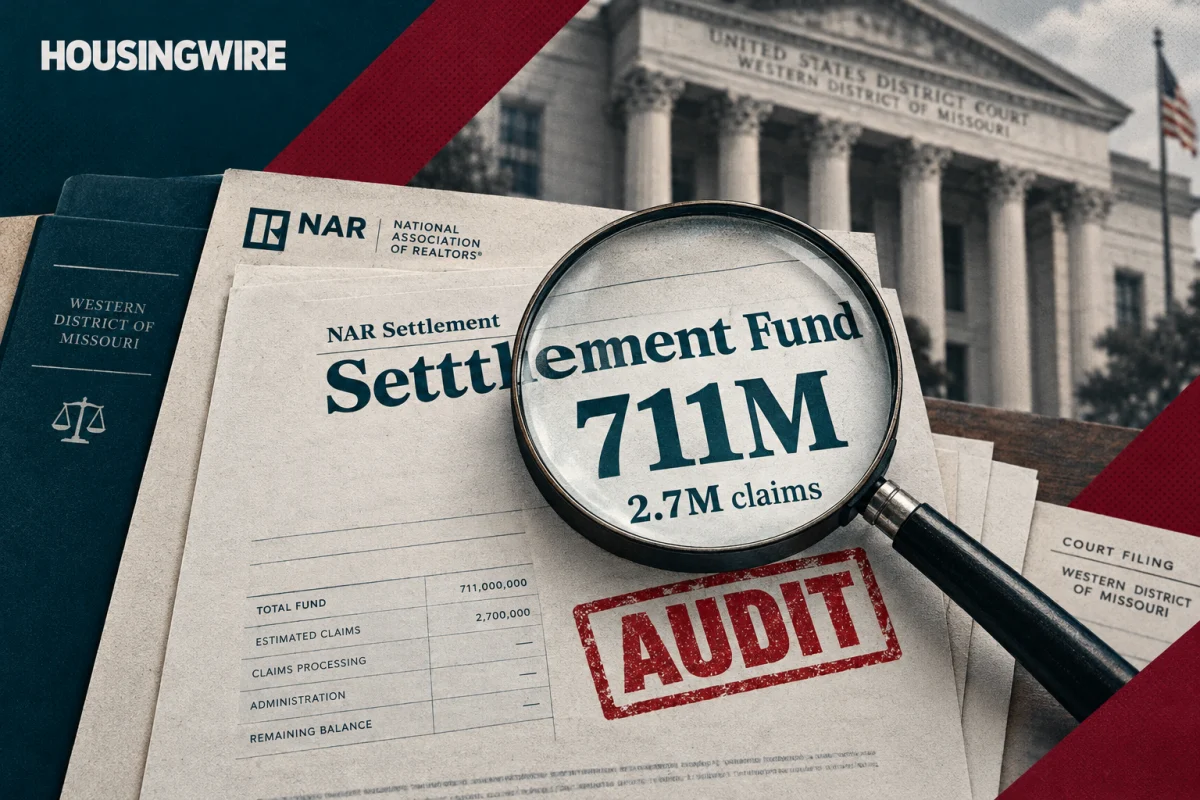
According to recent filings in the U.S. District Court for the Western District of Missouri, the consolidated settlement fund established to resolve nationwide antitrust litigation against the National Association of Realtors (NAR) and several major brokerages reached a balance of $711,263,551 as of September 30, 2026. This financial milestone comes nearly three years after a Missouri jury found the real estate industry liable for conspiring to artificially inflate agent commissions, a landmark verdict that fundamentally altered the landscape of American residential real estate. Despite the accumulation of hundreds of millions of dollars and the processing of millions of claims, the timeline for distributing these funds to eligible home sellers remains obscured by a combination of mandatory financial audits and the lingering possibility of a final challenge in the U.S. Supreme Court.
The litigation, which began with the Sitzer/Burnett class-action suit, alleged that NAR’s long-standing "Participation Rule" required listing brokers to offer a set commission to buyer agents in exchange for listing a home on a Multiple Listing Service (MLS). This practice, plaintiffs argued, stifled competition and forced sellers to pay for services they did not receive, leading to billions of dollars in excess costs. Following the October 2023 jury verdict, which initially awarded $1.8 billion in damages (subject to trebling), NAR and several large-scale brokerages, including Keller Williams, Anywhere Real Estate, and RE/MAX, entered into a series of settlement agreements to mitigate further financial exposure and provide a path forward for the industry.
Financial Growth and Administrative Oversight
The most recent quarterly status report indicates that the settlement fund is currently being managed by Morgan Stanley. The funds were transitioned to the institution from Huntington Bank in October 2025 at the direction of lead class counsel to optimize the security and yield of the assets. The move appears to have been financially productive; during the first nine months of 2026, the accounts holding the settlement proceeds generated approximately $17.1 million in interest income.
However, the filings also highlight significant outflows from the fund. Between January and September 2026, roughly $5.8 million was transferred out of the accounts. While the court documents do not provide a granular itemization of these transfers, they typically cover legal fees, administrative costs, and miscellaneous expenses related to the management of the class-action infrastructure. To date, there is no evidence in the public record suggesting that any direct payments have been distributed to the millions of home sellers who comprise the settlement class.
JND Legal Administration, the firm appointed to oversee the claims process, reported that it has successfully processed approximately 2.7 million claim submissions. The sheer volume of the class necessitated one of the largest notification campaigns in legal history. According to JND, the outreach effort included six distinct notification phases, resulting in the distribution of 138 million emails and 44 million physical postcards. The postage costs alone for this massive communication effort exceeded $18 million.
The Cost of Complexity and the Audit Phase
Managing a class of this magnitude carries a substantial administrative price tag. As of June 2025, JND had invoiced the settlement fund nearly $33 million for its work in identifying class members, managing the claims portal, and verifying documentation. More recent invoices from the third quarter of 2026 show an additional $156,000 in administrative work, with roughly $494,294 in outstanding invoices currently pending.
The distribution of funds is currently being delayed by a court-ordered audit of JND’s processes. This audit is a standard but rigorous procedure in high-value class-action settlements, intended to ensure that claims have been verified accurately and that the proposed distribution plan adheres to the court’s directives. The audit is designed to prevent fraudulent claims and to ensure that the "pro-rata" distribution—where each claimant receives a portion of the fund based on the commission they paid—is calculated fairly. Given the 2.7 million claims processed, even a minor calculation error could result in millions of dollars being misallocated.
Legal Hurdles and the Supreme Court Variable
While the settlement received final approval from Judge Stephen R. Bough in early 2025, the legal path has not been entirely cleared. Throughout the fall of 2026, various appellate courts, including the Eighth Circuit, have consistently rejected appeals from "objectors"—individuals or entities within the class who argue that the settlement terms are inadequate or that the legal fees awarded to class counsel are excessive.
Despite these rejections, the legal window remains open for these objectors to petition the U.S. Supreme Court for a writ of certiorari. If the Supreme Court were to agree to hear an appeal, the distribution of the $711 million fund could be delayed by another year or more. Legal analysts suggest that while the likelihood of the Supreme Court intervening is statistically low, the high-stakes nature of the antitrust allegations and the significant impact on the national economy make it a possibility that class counsel must account for before releasing funds.
Industry Evolution Post-Settlement
While the financial payout remains in limbo, the structural changes mandated by the NAR settlement have already taken hold across the United States. As of August 2024, two major changes were implemented across all NAR-affiliated MLS platforms:
- The Removal of Commission Offers: Brokers are no longer permitted to include offers of compensation for buyer agents on the MLS. While commissions can still be negotiated and paid, they must be handled through off-MLS communication.
- Mandatory Buyer Agreements: Real estate professionals working with buyers must enter into a written agreement before touring a home. These agreements must clearly state the amount of compensation the agent will receive and specify that this compensation cannot be "open-ended."
These changes were intended to decouple commissions, theoretically allowing buyers to negotiate their own agent’s fees and sellers to avoid paying for the opposing party’s representation. However, the market impact has been a subject of intense debate. Early data from 2025 and 2026 suggest that while some commissions have compressed, the overall cost of buying a home remains high due to inventory shortages and interest rate fluctuations.
Broader Implications and Stakeholder Reactions
The real estate industry continues to grapple with the long-term implications of the $711 million fund and the rules that created it. For many agents, the settlement represented a "reset" of the profession, forcing a greater emphasis on value proposition and transparent pricing. For consumers, the settlement promised lower costs, though many are still waiting to see the tangible benefits in their bank accounts.
"The size of the fund is a testament to the scale of the alleged harm," said a consumer advocacy spokesperson. "But for the millions of families who feel they overpaid for a home sale over the last decade, $711 million is a figure on a ledger. Until the audit is complete and the Supreme Court options are exhausted, the ‘justice’ promised by this verdict remains theoretical."
Industry leaders, meanwhile, have focused on compliance and stability. NAR has repeatedly stated that the settlement was the best available option to preserve the American model of independent brokerage while resolving "existential" legal threats. The association has spent millions on education and training to help its members navigate the new regulatory environment, even as its membership numbers have seen slight fluctuations in response to the increased administrative burden of the new rules.
Timeline of Key Events
- October 2023: A Missouri jury finds NAR and major brokerages liable in the Sitzer/Burnett case, awarding $1.8 billion in damages.
- March 2024: NAR announces a landmark $418 million settlement agreement to resolve most pending commission-related litigation.
- August 2024: New industry rules regarding MLS listings and buyer agreements go into effect nationwide.
- May 2025: The court grants final approval to the NAR settlement, despite several formal objections.
- October 2025: Settlement funds are moved to Morgan Stanley for long-term management.
- September 2026: Court filings reveal the fund has grown to over $711 million, fueled by interest and additional brokerage settlements.
- Late 2026 (Projected): Completion of the court-ordered audit of JND Legal Administration’s claims processing.
As the 2026 calendar year draws to a close, the Western District of Missouri remains the focal point for millions of Americans waiting for their share of the settlement. While the financial infrastructure is in place and the fund continues to grow through interest, the final hurdle of the American legal process—the exhaustion of all possible appeals—stands between the class members and their payouts. For now, the $711 million remains a dormant fortune, waiting for the final gavel to fall.
