

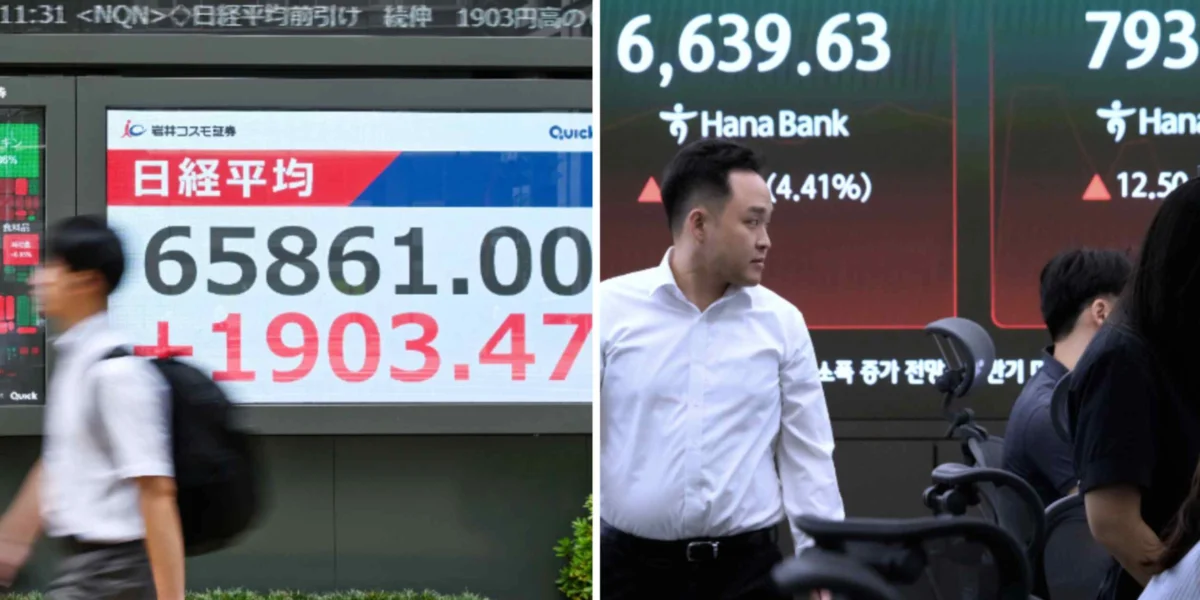
TOKYO – Japan’s Nikkei Stock Average experienced a dramatic surge on Wednesday, August 5, 2026, climbing more than 2,000 points. However, the jubilant market performance is tempered by a growing apprehension among many investors regarding the increasing correlation between Japanese equities and the historically volatile South Korean stock market, as exemplified by the concurrent sharp gains on South Korea’s KOSPI index. This significant upward movement, while seemingly positive, has ignited a debate about the underlying drivers and sustainability of such gains, particularly in light of perceived systemic risks emanating from Seoul.
A Day of Unprecedented Gains, Yet Lingering Unease
The Nikkei 225, a benchmark index representing 225 large-cap Japanese stocks, closed at a new high, marking one of the largest single-day point gains in its history. The index’s advance, exceeding 2,000 points, translated to a substantial percentage increase, injecting a significant boost to investor confidence on the surface. Simultaneously, South Korea’s Korea Composite Stock Price Index (KOSPI) also registered a robust performance, further highlighting the synchronized movements observed on this particular trading day.
While market participants typically welcome such substantial gains, the accompanying news from South Korea has cast a shadow of caution over the jubilant mood. Analysts and fund managers are increasingly pointing to a discernible pattern of co-movement between the Nikkei and the KOSPI, suggesting that developments in one market are having a disproportionately strong influence on the other. This interdependence, especially when driven by factors impacting the South Korean economy, raises concerns about the inherent stability and independent valuation of Japanese stocks.
Chronology of Market Movements and Emerging Trends
The heightened correlation between the Nikkei and KOSPI has been a developing narrative over the past several quarters, but the events of August 5th have brought it into sharp focus. Market observers have noted a gradual tightening of this linkage, particularly since early 2026. Several factors are believed to be contributing to this phenomenon:
- Increased Cross-Border Investment Flows: Growing institutional and retail investor interest in East Asian markets has led to more diversified portfolios that often include both Japanese and South Korean equities. This has amplified the impact of sector-specific or macroeconomic news from either country on the other.
- Sectoral Interdependencies: Key industries where both Japan and South Korea are global leaders, such as semiconductors, automotive manufacturing, and consumer electronics, exhibit strong supply chain linkages. Disruptions or significant advancements in one nation’s dominant players can have ripple effects across the region. For instance, a breakthrough in advanced semiconductor manufacturing in South Korea might lead to increased investment in related Japanese technology suppliers, and vice-versa.
- Global Macroeconomic Influences: As major export-oriented economies, both Japan and South Korea are highly sensitive to global economic trends, currency fluctuations, and geopolitical developments. Shared vulnerabilities and opportunities tend to manifest in synchronized market movements.
- Investor Sentiment and Risk Appetite: Regional market sentiment often dictates broader investment flows. A positive outlook on the East Asian economic bloc can drive capital into both markets, while negative sentiment can lead to simultaneous sell-offs.
The surge on August 5th appears to have been triggered by a confluence of factors, including positive economic data releases from South Korea and a perceived improvement in regional geopolitical stability. However, the magnitude of the gains, particularly when viewed against the backdrop of persistent underlying economic challenges in some Japanese sectors, has fueled skepticism.
Supporting Data and Market Indicators
To understand the depth of this interdependence, it is crucial to examine relevant market data. Over the past year, the correlation coefficient between the daily returns of the Nikkei 225 and the KOSPI has steadily increased, reaching levels that some analysts describe as “uncomfortably high.” For example, historical data from financial data providers indicates that the rolling 90-day correlation has moved from an average of 0.65 in early 2025 to above 0.85 by mid-2026, suggesting a near-unison movement in their price action.
Furthermore, sector-specific analysis reveals that technology stocks, particularly those involved in the semiconductor supply chain, have shown the most pronounced co-movement. The performance of major South Korean chipmakers like Samsung Electronics and SK Hynix has been closely mirrored by Japanese companies involved in semiconductor manufacturing equipment, materials, and components.
Data on foreign investor flows also provides insight. In recent months, a significant portion of foreign capital flowing into East Asian equities has been allocated broadly across Japan and South Korea, rather than being specifically targeted to one market over the other. This suggests a regional investment strategy, where the performance of one market acts as a key indicator for investment decisions in the other.
Official Responses and Market Commentary
Official responses from regulatory bodies and financial institutions have been measured. While acknowledging the strong market performance, there has been a consistent emphasis on maintaining market stability and transparency.
The Bank of Japan (BOJ), in its latest monetary policy statement, reiterated its commitment to supporting economic growth while remaining vigilant about potential asset price bubbles. While not directly commenting on the Nikkei-KOSPI correlation, the BOJ’s cautious tone suggests an awareness of external market influences. Similarly, the Financial Services Agency (FSA) of Japan has stated that it is closely monitoring market developments and ensuring robust regulatory oversight to prevent any undue volatility or manipulation.
South Korean financial authorities, while likely pleased with the KOSPI’s performance, have also been vocal about the need for structural reforms to enhance the resilience of their domestic stock market. Recent policy initiatives aimed at improving corporate governance and unlocking shareholder value in South Korean companies underscore this commitment.
Market analysts, while acknowledging the short-term gains, have largely echoed the sentiment of caution. "We are seeing a powerful upward momentum, but the question remains whether this is driven by fundamental improvements in the Japanese economy or is largely a reflection of positive sentiment in the broader East Asian tech sector, heavily influenced by South Korea," commented Kenji Tanaka, chief market strategist at a prominent Tokyo-based investment bank. "Investors need to be discerning and understand the risks associated with this increasing interdependence."
Another analyst, speaking on condition of anonymity due to internal policy, noted, "The market is effectively pricing in a regional economic bloc’s performance. When South Korea sneezes, Japan often catches a cold, and vice versa. This rally, while impressive, could be vulnerable to any sudden shifts in sentiment or economic headwinds originating from Seoul."
Broader Impact and Implications
The growing interdependence between the Nikkei and KOSPI has several significant implications for investors, policymakers, and the broader regional economy:
- Increased Systemic Risk: A synchronized downturn in both markets could have a more severe and widespread impact than if they were to move independently. This heightened systemic risk requires greater coordination in economic policy and financial regulation across the region.
- Challenges for Independent Valuation: It becomes increasingly difficult for investors to assess the intrinsic value of individual Japanese companies when their stock prices are heavily influenced by external factors, particularly those originating from a different economic and regulatory environment. This can lead to mispricing of assets and inefficient capital allocation.
- Policy Coordination Needs: Policymakers in both Japan and South Korea may need to consider greater dialogue and potential coordination on economic and financial policies to manage shared risks and opportunities effectively. This could include discussions on currency management, trade policies, and responses to global economic shocks.
- Investor Diversification Strategies: Investors will need to adapt their diversification strategies. Simply holding a basket of East Asian stocks might not provide the intended diversification benefits if these markets are moving in lockstep. A deeper understanding of sector-specific drivers and individual company fundamentals will be paramount.
- Impact on Global Capital Flows: The performance of these two major Asian markets significantly influences global capital allocation. A period of synchronized volatility could deter international investors, impacting the cost of capital for businesses in the region.
The surge in the Nikkei Stock Average on August 5, 2026, represents a significant event in the Japanese equity market. However, the underlying narrative of increasing interdependence with the South Korean market introduces a layer of complexity and caution that cannot be ignored. As investors navigate this evolving landscape, a nuanced understanding of the regional economic dynamics and the interconnectedness of these key Asian bourses will be crucial for making informed investment decisions and ensuring long-term market stability. The challenge ahead lies in harnessing the potential of regional growth while mitigating the amplified risks that arise from such close market ties.
