


Global financial markets witnessed a notable rally in Gold (XAU/USD) on Tuesday, with the precious metal advancing approximately 0.75% to touch a two-day peak of $4,106. This upward momentum was primarily fueled by a confluence of factors, including a significant drop in crude oil prices, a corresponding decline in US Treasury yields, and an overall improvement in global risk appetite. The US Dollar Index (DXY), a key measure of the dollar’s strength against a basket of major currencies, also registered a marginal decrease of 0.05%, further contributing to Gold’s appeal as a non-yielding asset.
Geopolitical De-escalation Drives Oil Price Decline
A major catalyst for the day’s market movements was the growing speculation surrounding a potential reopening of the Strait of Hormuz, a critical maritime chokepoint for global oil shipments. Reports from IRIB, citing an Iranian Foreign Ministry spokesperson, indicated ongoing talks between Iran and Oman regarding the strategic strait. Crucially, Tehran is reportedly considering allowing European nations to undertake mine-clearing operations within the waterway. This development signals a potential de-escalation of tensions in a region historically prone to geopolitical volatility, which has significant implications for global energy markets.
The Strait of Hormuz, connecting the Persian Gulf with the Gulf of Oman and the Arabian Sea, is the world’s most important oil transit chokepoint, through which approximately one-fifth of global oil consumption, and a quarter of the world’s liquefied natural gas (LNG), passes daily. Any threat to its free passage invariably triggers spikes in crude oil prices due to supply disruption fears. Therefore, news of potential diplomatic progress and a move towards ensuring safe passage has immediately translated into a substantial reduction in the geopolitical risk premium embedded in oil prices.
Further adding to the narrative of easing tensions, former US President Donald Trump reposted an article from August 2, titled "Trump: Deal is imminent as Iran talks restart Monday on denuclearisation." While the direct link between denuclearization talks and the Strait of Hormuz isn’t immediate, such reports collectively contribute to an overarching sentiment of diplomatic engagement and potential de-escalation between Iran and Western powers. This broader context helps alleviate market fears of military confrontation or blockades, which have historically sent shockwaves through energy markets and, by extension, global inflation expectations. The prospect of unhindered oil flow through Hormuz directly contributes to the expectation of stable or even lower energy costs, reducing inflationary pressures and, consequently, easing the need for aggressive monetary tightening by central banks.
Macroeconomic Data and Labor Market Insights
Beyond geopolitical developments, recent US economic data has provided a mixed, yet generally calming, picture for investors. The June Job Openings and Labor Turnover Survey (JOLTS) report revealed a decline in job openings from 7.537 million to 7.359 million, falling slightly short of the forecast of 7.4 million. While a decrease in job openings might typically signal a cooling labor market, the report also highlighted a low number of layoffs, indicating minimal firing and hiring activity. With roughly one vacancy per unemployed person, the JOLTS data suggests a labor market that is gradually moving towards a more balanced state, rather than one experiencing a sharp downturn. This ‘Goldilocks’ scenario – not too hot, not too cold – reduces immediate concerns about wage-driven inflation while also assuaging fears of an imminent recession, contributing to the improved risk appetite observed in markets.

Concurrently, the US Commerce Department reported a narrowing of the trade deficit for June, which decreased from -$77.6 billion to -$73.3 billion. This figure was slightly higher than the estimated -$73 billion but still represents an improvement. A shrinking trade deficit can be indicative of stronger domestic demand and potentially reduced reliance on imports, or increased exports, both of which are generally positive for a nation’s economic health.
Looking ahead, market participants are keenly awaiting further labor market indicators. The ADP Employment Change report for July is anticipated to show private companies having hired 70,000 people, a decrease from the 98,000 jobs created in June. Following this, Thursday’s jobless claims data will offer more insights into the pace of layoffs and hiring. The week culminates with the highly anticipated Nonfarm Payrolls report for July, with economists projecting an addition of 80,000 workers to the US workforce. These employment figures are critical for the Federal Reserve as it assesses the health of the economy and calibrates its monetary policy. Weaker-than-expected job growth could further bolster the case for a less aggressive stance on interest rate hikes, which is typically supportive of gold prices.
Disinflationary Pressures and Evolving Fed Expectations
The most direct impact on Gold’s rally on Tuesday came from the significant tumble in crude oil prices. West Texas Intermediate (WTI), the US oil benchmark, plummeted by nearly 5%, settling at $76.09 per barrel. This sharp decline in energy costs immediately translated into lower US Treasury yields, as markets began to price in expectations of reduced inflationary pressures. The yield on the benchmark US 10-year Treasury note collapsed by 10 basis points, dropping to 4.687%.
Lower crude prices are a key disinflationary force, as energy costs permeate almost every sector of the economy, from transportation to manufacturing. When oil prices fall, the cost of producing and transporting goods decreases, which can eventually lead to lower consumer prices. This dynamic fundamentally shifts the outlook for central bank policy. If inflation is expected to cool naturally due to external factors like falling energy costs, the Federal Reserve might feel less pressure to aggressively hike interest rates.
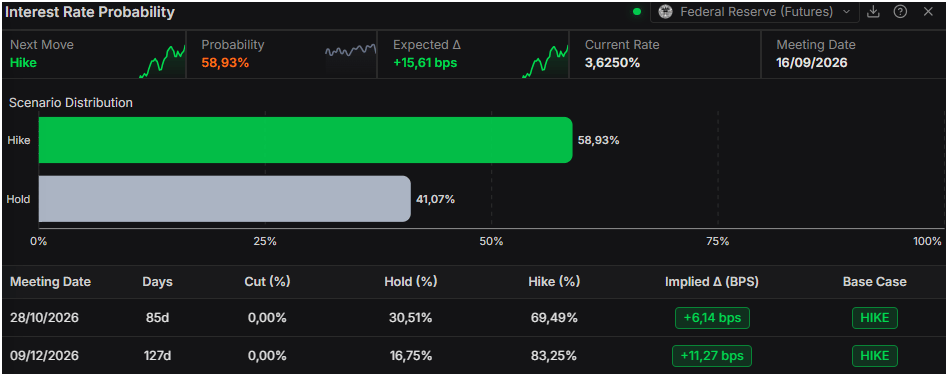
Indeed, money markets are already reflecting this recalibration of expectations. According to Prime Terminal data, there is now a nearly 59% chance that the Federal Reserve will raise rates at its September 16 meeting. However, for the December meeting, the odds for a rate hike climb to 83%, suggesting that while immediate pressures might be easing, the market still anticipates further tightening down the line to ensure inflation is brought firmly under control.
Reinforcing the Fed’s data-dependent approach, New York Fed President John Williams stated on Monday that he expects inflation pressures to decrease gradually. However, he also issued a cautionary note, emphasizing that the US central bank remains "prepared to respond with rate hikes" if inflation does not subside as hoped. This nuanced stance underscores the Fed’s commitment to its dual mandate of achieving maximum employment and price stability, highlighting that while disinflationary trends are welcome, vigilance remains paramount. The perceived shift towards a potentially less hawkish Fed, even if temporary, reduces the opportunity cost of holding non-yielding assets like gold, making it more attractive to investors.
Gold’s Technical Outlook: A Critical Juncture
From a technical perspective, Gold’s current performance places it at a critical juncture. The precious metal is consolidating but has been steadily approaching the $4,100 mark, a level not seen since last Friday. Momentum indicators are signaling a potential shift, with the Relative Strength Index (RSI) on the daily chart appearing poised to clear the 50-neutral level. For many technical traders, a break above the 50-mark in the RSI is often interpreted as a bullish signal, suggesting increasing buying pressure.
Despite this emerging bullish momentum, the broader market structure for XAU/USD continues to exhibit a series of successive lower highs and lower lows, which is a classic pattern indicative of a bearish trend. To decisively shift this outlook, Gold would need to clear significant resistance levels. The first key hurdle is the 50-day Simple Moving Average (SMA), currently situated at $4,156. A breach of this level would be a strong indication of renewed buying interest. Following that, the July 6 cycle high at $4,202 represents the next major resistance. A sustained move above both these levels would likely signal a shift in the market’s bias from bearish to neutral-upward, potentially paving the way for further gains.
Conversely, for the bearish continuation scenario to unfold, Gold prices must extend their losses below the August 3 daily low of $4,019. A decisive break below this support level would expose the psychological $4,000 mark as the next target. Should that fail to hold, the June 17 low of $3,959 would come into focus, signaling a deeper retracement for the yellow metal. Traders will be closely watching these key technical levels in conjunction with the ongoing macroeconomic and geopolitical developments to gauge Gold’s likely trajectory in the coming days.
Broader Market Implications and Gold’s Enduring Role
The current rally in gold, driven by a combination of easing geopolitical tensions and shifting monetary policy expectations, highlights the precious metal’s multifaceted role in investor portfolios. While often considered a safe-haven asset during times of extreme uncertainty or economic distress, gold also serves as a hedge against inflation and a beneficiary of lower real interest rates. The current environment, where disinflationary pressures are emerging from falling energy costs, coupled with a potentially less aggressive Federal Reserve, creates a favorable backdrop for gold, even as overall risk appetite improves.
The correlation between gold, the US Dollar, and US Treasury yields remains a cornerstone of its market dynamics. As the dollar weakens and bond yields fall, the opportunity cost of holding a non-yielding asset like gold decreases, making it more attractive. Conversely, a strong dollar makes gold more expensive for international buyers, and higher yields offer a more competitive return. The current market conditions align well with a positive outlook for gold, provided the trends of easing geopolitical risk and cooling inflation persist.
Central banks globally continue to be significant holders and buyers of gold, viewing it as a critical component of their reserve diversification strategy and a symbol of economic strength. In 2022, central banks added a record 1,136 tonnes of gold to their reserves, valued at approximately $70 billion, according to the World Gold Council. This trend, particularly among emerging economies like China, India, and Turkey, underscores gold’s enduring appeal as a long-term store of value and a hedge against currency depreciation and systemic risks. As the global economic landscape continues to evolve, shaped by geopolitical shifts, inflationary pressures, and central bank policies, gold’s role as a resilient and liquid asset is expected to remain prominent.
