

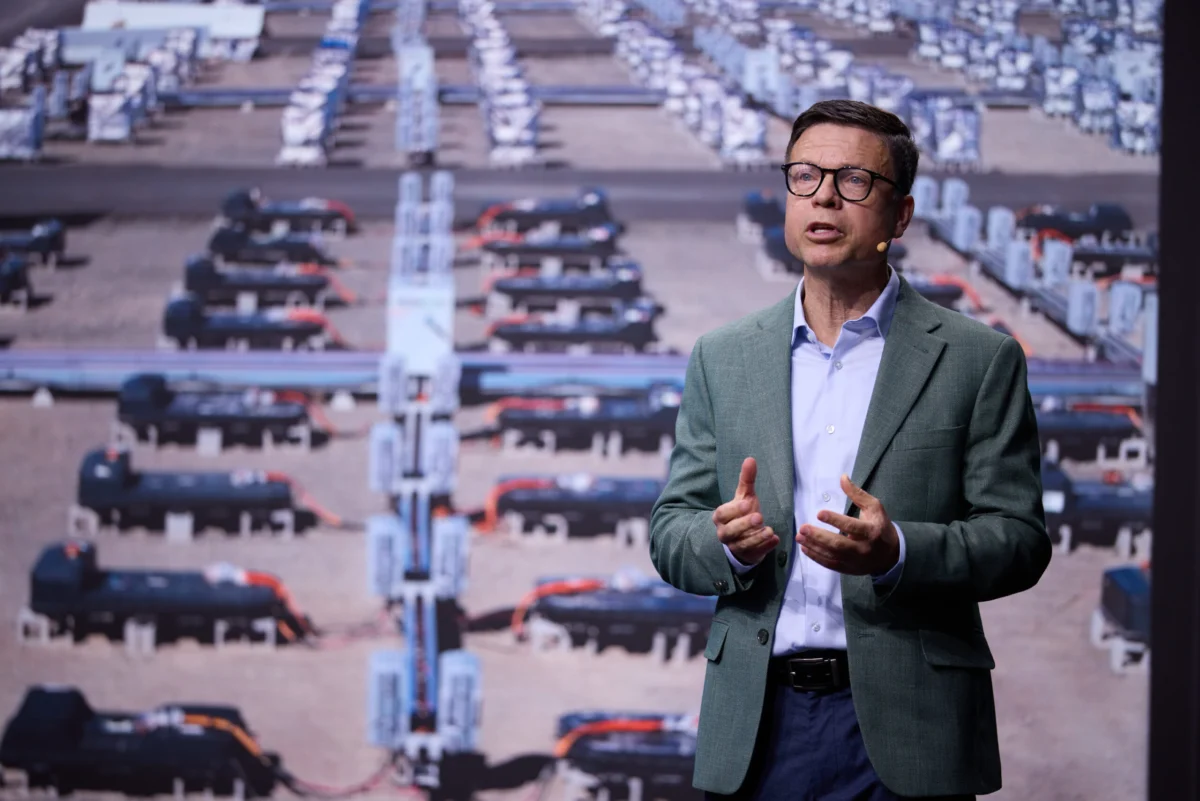
DETROIT – General Motors (GM) announced on June 9, 2026, a pivotal strategic shift in its battery development roadmap, unveiling ambitious plans to develop sodium-ion battery cells for energy storage systems (ESS) and eventually for its electric vehicle (EV) fleet. This initiative, highlighted during the automaker’s "Empower" event, marks a significant commitment to reducing the United States’ reliance on China for critical battery materials and fostering a robust, domestically sourced supply chain. Kurt Kelty, GM’s vice president of battery and sustainability, articulated a bold vision during an exclusive interview with CNBC, stating, "We’re developing a supply chain such that, two years from now, three years from now, it will be domestic. That’s what we’re aiming for – when we get into market, we’ve got a domestic source for that." This declaration underscores a broader industrial policy aiming for technological self-sufficiency amidst escalating geopolitical tensions and supply chain vulnerabilities.
The Genesis of a New Strategy: Countering Global Dependencies
GM’s move into sodium-ion technology is more than just an engineering endeavor; it is a strategic response to the precarious global landscape of battery material sourcing and manufacturing. The world’s battery supply chain is overwhelmingly dominated by China, which controls an estimated 85% of the global EV battery cathode active material production, over 90% of anode active material, and commands an 80% share of overall battery manufacturing, according to reports from the International Energy Agency (IEA). This near-monopoly extends to critical raw materials like lithium and cobalt, as well as the sophisticated processing capabilities required to turn these raw materials into usable battery components. The COVID-19 pandemic and subsequent geopolitical frictions have starkly exposed the vulnerabilities inherent in such concentrated supply chains, prompting a concerted push in Western economies for diversification and domestic capacity building.
The "Empower" event served as a platform for GM to publicly articulate this strategic pivot, signaling a departure from merely optimizing existing lithium-ion chemistries within established (and often China-reliant) supply chains. Kelty, a former battery executive with U.S. EV leader Tesla, emphasized GM’s intention to "leapfrog" China’s current battery technologies rather than directly compete with its entrenched infrastructure. This approach seeks to develop an entirely new technological path that leverages domestic resources and manufacturing prowess from its inception.
Sodium-Ion: A Technical and Strategic Deep Dive
At its core, sodium-ion battery technology offers a compelling alternative to conventional lithium-ion chemistries. While functionally similar, using sodium ions instead of lithium ions to carry charge between electrodes, the material differences are profound. Lithium, while abundant in certain regions, often requires complex and environmentally intensive mining and refining processes. Sodium, on the other hand, is one of the most common elements on Earth, readily available from sources like soda ash – a material already extensively mined and processed within the United States. This fundamental shift in material reliance is central to GM’s strategy for achieving a truly domestic supply chain.
For ESS applications, which are stationary devices designed for grid-scale storage, commercial businesses, and residential use (including critical infrastructure like data centers), sodium-ion batteries present several advantages. Kelty highlighted that sodium-ion chemistry and its wider temperature tolerance can allow for cells to function efficiently without active cooling systems. This eliminates a major source of cost and complexity associated with current ESS solutions, significantly lowering the total cost of ownership for energy storage systems. Furthermore, sodium-ion batteries are generally considered safer due to their material properties and are less prone to thermal runaway compared to some lithium-ion variants. While current sodium-ion technology typically offers lower energy density compared to high-performance lithium-ion batteries, this is less of a critical factor for stationary applications where weight and volume are less constrained than in electric vehicles. The promise of longer cycle life and robust performance across a broader temperature range further enhances their suitability for grid and industrial storage.
GM’s collaboration with Peak Energy, a Denver-based startup specializing in sodium-ion battery technology, is critical to this endeavor. This partnership allows GM to tap into agile innovation and specialized expertise while contributing its vast engineering, manufacturing, and validation capabilities. The target for commercial production of these sodium-ion cells with Peak Energy is around 2029, an ambitious timeline that reflects the urgency and strategic importance GM places on this development.
The Political and Economic Chessboard: Ford vs. GM
GM’s proactive stance on domestic sourcing and sodium-ion development unfolds against a backdrop of heightened political scrutiny over U.S. automakers’ ties to Chinese companies. Just days before GM’s announcement, its crosstown rival, Ford Motor, faced sharp criticism from the Trump administration for its partnerships with Chinese entities, particularly its licensing of technology from China’s Contemporary Amperex Technology Co. Ltd. (CATL) for lithium iron phosphate (LFP) battery cells. Ford’s strategy involves building an LFP battery plant in Michigan, utilizing CATL’s technology, which, while aiming to bring manufacturing to the U.S., still relies on Chinese intellectual property and potentially on Chinese-processed materials.

Transportation Secretary Sean Duffy, earlier the same week, had expressed "profound concern" over Ford’s China ties, despite Ford’s status as a top producer of vehicles in the U.S. This illustrates the complex balancing act U.S. companies face between cost-efficiency, technological advancement, and national security imperatives. Kelty’s comment that Ford was "following a different path" directly addressed this divergence. He elaborated, "We think it’s more valuable to develop this all domestically, take advantage of domestic supply chains, and develop a technology that’s actually better than the incumbent technology." This highlights GM’s commitment not just to domestic manufacturing, but to domestic technological leadership from the ground up, avoiding dependence on foreign intellectual property for foundational components.
The LFP battery, while cheaper and more stable than nickel-cobalt-manganese (NCM) or nickel-cobalt-aluminum (NCA) chemistries, still relies heavily on Chinese supply chains for its constituent materials and processing. China largely controls the sourcing and production of LFP batteries, making any LFP-based strategy, even if assembled in the U.S., susceptible to geopolitical leverage. GM currently manufactures LFP cells with its partner LG Energy Solution in the U.S. for ESS, acknowledging the current market realities, but its sodium-ion initiative represents a clear pivot towards a future free from these constraints. Kelty emphasized, "It’s a really good story, because you’ve got the resources [in the U.S.] that you can keep it totally domestic. It’s going to take some time to build this industry up, but the potential for sodium-ion is just much greater than LFP."
Investment, Infrastructure, and the Long Road Ahead
To support this ambitious vision, GM is investing $900 million in new battery lab facilities at its global tech campus in suburban Detroit. This investment includes a state-of-the-art, more-than-500,000-square-foot facility dedicated to prototyping battery cell manufacturing, scheduled to begin operations later this year. These facilities are crucial for accelerating the research, development, and scaling of new battery chemistries like sodium-ion, enabling rapid iteration from laboratory concept to commercial viability. The commitment underscores GM’s understanding that true independence requires not just sourcing, but foundational innovation and manufacturing capabilities within the U.S.
However, the path to decoupling from China’s battery dominance is formidable. Industry experts like Sam Abuelsamid, a battery expert and vice president of market research at Telemetry, note that domesticating an entire battery supply chain will likely take years, even decades. He also pointed out that China continues to innovate rapidly, even in sodium-ion technology itself, indicating that the "leapfrog" strategy is a moving target. While acknowledging the potential for LFP materials to be produced domestically, Abuelsamid concurs that "the sodium-ion would be even cheaper and easier to do" in terms of establishing a truly independent U.S. supply chain.
The $900 million investment, while substantial for a single automaker, is a fraction of the capital expenditure required to meaningfully loosen China’s entrenched grip on the global battery industry. Estimates for establishing a comprehensive, self-sufficient U.S. battery ecosystem run into the tens, if not hundreds, of billions of dollars, encompassing everything from raw material extraction and processing to advanced manufacturing and recycling infrastructure. This highlights the necessity of sustained public-private partnerships and robust government incentives, such as those provided by the Inflation Reduction Act (IRA), to nurture this nascent domestic industry.
Broader Implications: Economic, Environmental, and Geopolitical
GM’s sodium-ion gambit carries significant implications across multiple fronts. Economically, the development of a domestic sodium-ion battery industry promises job creation across the entire value chain, from mining and refining to manufacturing and recycling. It would also foster intellectual property development within the U.S., potentially positioning American companies as leaders in next-generation battery technologies. This aligns with broader U.S. industrial policy goals aimed at revitalizing domestic manufacturing and securing critical technologies.
Environmentally, the reliance on abundant and less environmentally intensive materials like sodium from soda ash could lead to a more sustainable battery ecosystem. While lithium mining has faced scrutiny for its water consumption and ecological footprint, sodium extraction from soda ash generally has a lower environmental impact. Furthermore, shorter supply chains reduce the carbon footprint associated with global logistics and transportation of materials.
Geopolitically, a successful domestic sodium-ion battery industry would significantly enhance U.S. energy security and reduce its strategic vulnerability to potential supply disruptions or coercive tactics from geopolitical rivals. As batteries become increasingly critical for national infrastructure, from electric grids to defense applications, securing a reliable domestic supply becomes paramount.
The trajectory laid out by GM is ambitious. While the initial focus is on ESS, the long-term vision includes integrating sodium-ion batteries into future EVs. This would likely start with urban or entry-level models where the current lower energy density of sodium-ion might be less of a limitation, gradually expanding as the technology matures. The journey to commercial production by 2029 will involve overcoming significant engineering and scaling challenges, but GM’s strategic commitment, combined with its investment in cutting-edge R&D facilities, positions it as a key player in shaping the future of battery technology and global energy independence. As Kurt Kelty succinctly put it, "Batteries are really critical for a lot of different areas of our economy here." The stakes are high, and GM is betting on sodium to power a more independent American future.
