

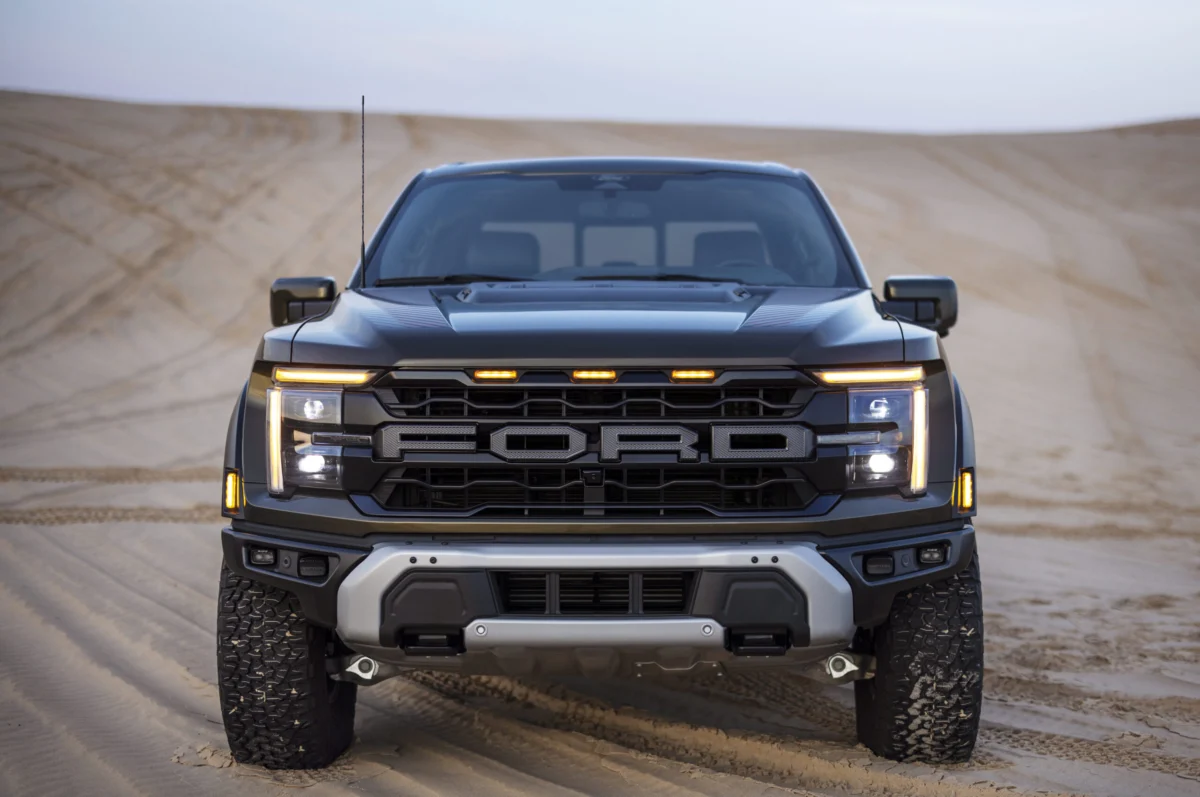
DETROIT – Ford Motor Company has announced significant strategic adjustments to its iconic F-150 pickup truck lineup for the 2027 model year, emphasizing broader customer choice through expanded V-8 engine availability and targeted price reductions on key performance models. These changes, unveiled by the Detroit automaker, are designed to enhance sales of crucial F-150 variants and align with a broader corporate strategy championed by CEO Jim Farley, focusing on greater vehicle customization and responsiveness to market demands. The move comes as the automotive industry grapples with persistent affordability concerns and navigates a shifting regulatory landscape, particularly regarding emissions standards.
Strategic Pricing and Equipment Revisions
At the heart of Ford’s 2027 F-150 strategy are notable price adjustments for some of its most popular performance-oriented trucks. The 2027 Ford F-150 Raptor, a perennial favorite among off-road enthusiasts, will see its starting price reduced by $4,000, bringing it to an MSRP of $77,800. Similarly, the robust F-150 Tremor is slated for a more substantial price cut of approximately $5,300, lowering its entry point to $62,400. These price modifications do not signify a general reduction in the cost of high-performance trucks, which remain premium offerings in the market, but rather a strategic recalibration aimed at making these models more accessible to a wider segment of buyers.
Ford officials elaborated on the methodology behind these price reductions, indicating that the company has meticulously re-evaluated standard equipment packages. To achieve the lower starting prices, certain features previously included as standard will either become optional or be replaced by manual alternatives. For instance, heated second-row seats, often found in higher trim levels, will no longer be standard on these specific models. Additionally, power controls for some components, such as the steering column, may be replaced with manual adjustments. This approach allows Ford to offer a more competitive base price while retaining the core performance and capability that define these trucks.
Todd Eckert, Ford Blue senior director of truck consumer marketing, underscored the rationale behind this strategy in a statement to CNBC, explaining, "For us, it made sense because it just broadens the offer and certainly doesn’t take away from either the capability of that new entry or of the model that it came down from." This sentiment reflects a careful balancing act: making the vehicles more attainable without compromising their fundamental appeal or perceived value. It’s a direct response to consumer feedback, suggesting a desire for more flexibility in configuring their trucks, potentially opting out of certain luxury features in favor of a lower purchase price or the ability to choose specific upgrades à la carte.
The Resurgence of the V-8 Engine
Perhaps one of the most significant announcements for truck purists and performance enthusiasts is the expanded availability of Ford’s venerable 5.0-liter V-8 engine across the entire F-150 lineup. This move marks a notable shift, particularly for the high-end King Ranch and Platinum models, which have not offered a V-8 option since the 2023 model year. The decision to reintroduce the V-8 to these premium trims directly addresses a vocal demand from both customers and dealership networks.
"We heard pretty loudly from both customers and dealers that even on those premium series, that they wanted the option to have a V-8 engine," Eckert confirmed. The V-8 engine, with its characteristic power delivery, robust towing capabilities, and distinctive exhaust note, holds a special place in the hearts of many truck owners. For years, it has been synonymous with rugged capability and traditional American truck heritage. Its absence from certain top-tier F-150 trims was met with disappointment by a segment of the buyer base who prioritize the V-8’s attributes over other powertrain options, such as the increasingly prevalent EcoBoost V-6 engines or hybrid configurations.
This expansion of V-8 availability is not an isolated incident but rather indicative of a broader industry trend, particularly among the "Detroit Three" automakers (Ford, General Motors, and Stellantis). In recent years, there has been a noticeable re-emphasis on V-8 engines in their pickup truck and SUV offerings. This trend is closely linked to a more accommodating regulatory environment, specifically concerning emissions. Under the previous Trump administration, there was a discernible weakening of emissions regulations and a reduction in associated penalties, providing manufacturers with greater latitude to continue offering larger displacement, V-8 engines without incurring prohibitive costs or regulatory hurdles. While the Biden administration has sought to re-tighten some of these regulations, the lingering effects and the market’s demand for V-8 power continue to influence product planning cycles.
Background and Market Context: The F-Series Dominance
The Ford F-Series, encompassing the F-150 and its larger Super Duty siblings (F-250, F-350, F-450), is not merely a product line; it is an economic powerhouse for Ford Motor Company. For over four decades, the F-Series has held the title of America’s best-selling truck and, for an equally impressive period, America’s best-selling vehicle overall. Its sales volume routinely surpasses that of many entire automotive brands, making it an indispensable pillar of Ford’s revenue and profitability. The F-150 alone accounts for a significant portion of Ford’s North American sales and is a critical driver of market share in the highly competitive full-size pickup segment.
The importance of the F-150 to Ford’s bottom line means that any strategic adjustments to its pricing, features, or powertrain options are meticulously calculated. The average transaction price for new vehicles, particularly trucks, has been steadily climbing in recent years, fueled by technological advancements, increasing demand for luxury features, and inflationary pressures. According to industry data, the average new vehicle transaction price in the U.S. frequently hovers above $48,000, with full-size pickups often commanding even higher figures, easily exceeding $60,000 or more for well-equipped models. This upward trajectory has led to growing concerns about vehicle affordability, impacting consumer purchasing power and potentially slowing sales across the industry. Ford’s decision to strategically lower prices on certain F-150 models can be seen as a direct response to these affordability concerns, aiming to maintain sales volume and market share in a tightening economic climate.
Jim Farley’s "Customer Choice" Strategy
The changes to the 2027 F-150 lineup are a direct manifestation of CEO Jim Farley’s overarching strategy for Ford. Since taking the helm, Farley has consistently advocated for a customer-centric approach, emphasizing greater choice, customization, and responsiveness to market feedback. This philosophy has been evident in other Ford product lines, most notably with the successful reintroduction of the Bronco, which offers an extensive array of personalization options and caters directly to enthusiast communities.
Farley’s vision involves streamlining Ford’s operations into distinct business units – Ford Blue for traditional internal combustion engine vehicles, Ford Model e for electric vehicles, and Ford Pro for commercial vehicles – to enhance focus and agility. The F-150’s updates fall under the Ford Blue umbrella, where the goal is to optimize the profitability and market appeal of conventional vehicles by delivering precisely what customers want. By expanding V-8 options and adjusting pricing, Ford is directly empowering customers with more choices, allowing them to tailor their F-150 to their specific needs and budgets, rather than being limited by predetermined packages or powertrain availability. This strategy aims to solidify customer loyalty and attract new buyers who might have previously felt priced out or underserved by the available configurations.
Product Enhancements and Supply Chain Recovery
Beyond powertrain and pricing adjustments, the 2027 F-150 lineup will also receive aesthetic and functional updates. Ford plans to roll out style revisions across many models, refreshing the truck’s exterior and interior to keep it competitive and appealing in a constantly evolving market. A notable addition is the introduction of a Carhartt model, developed in collaboration with the Detroit-based workwear company. This partnership leverages the strong brand identity of Carhartt, known for its durable and rugged apparel, to create a special edition F-150 that resonates with customers who value utility, toughness, and a distinct aesthetic. Such collaborations often generate significant buzz and appeal to niche markets, further broadening the F-150’s reach.
These updates arrive at a crucial time as Ford continues to ramp up production and availability of its F-Series trucks. Over the past year, the company faced significant supply chain disruptions, most notably due to fires at a key aluminum supplier. These incidents severely impacted the output of F-150s and Super Duty trucks, which extensively utilize aluminum in their body structures and other components. The F-Series’ large aluminum content meant it was disproportionately affected by the supplier issues, leading to production slowdowns and reduced inventory at dealerships. Ford has been diligently working to mitigate these challenges, diversify its supply chain, and restore full production capacity to meet the robust demand for its trucks. The successful resolution of these supply chain bottlenecks is paramount for Ford to fully capitalize on the strategic enhancements introduced for the 2027 F-150 lineup.
Implications and Future Outlook
The comprehensive updates to the 2027 Ford F-150 carry significant implications for Ford, the broader automotive market, and consumers. For Ford, these changes represent a proactive effort to reinforce its dominant position in the full-size pickup segment. By addressing affordability concerns through strategic price reductions and catering to enthusiast demand with expanded V-8 availability, Ford aims to strengthen customer loyalty and attract new buyers. This strategy could help Ford maintain or even grow its market share against formidable competitors like General Motors’ Chevrolet Silverado and GMC Sierra, and Stellantis’ Ram 1500, all of which are constantly innovating and vying for supremacy in this lucrative segment.
The re-emphasis on V-8 engines also highlights a potential recalibration of the industry’s electrification timeline, particularly for high-volume, profit-driving segments like pickup trucks. While Ford continues to invest heavily in electric vehicles, including the F-150 Lightning, the sustained demand for traditional internal combustion engines, especially V-8s, indicates that the transition will be gradual and market-driven. The softened emissions regulations under previous administrations provided a window for automakers to continue offering these powerful engines, aligning with consumer preferences for traditional powerplants in heavy-duty applications.
For consumers, the 2027 F-150 lineup promises more choice and potentially better value. Those who desire the raw power and sound of a V-8 will find it available across a broader range of trims, including premium options. Buyers seeking performance models like the Raptor and Tremor may find them more accessible at their new, lower starting prices. However, it will be crucial for buyers to carefully evaluate the standard equipment changes and understand which features have been made optional to ensure the chosen configuration meets their expectations and budget.
In conclusion, Ford’s strategic overhaul of the 2027 F-150 lineup is a multifaceted response to evolving market dynamics, regulatory shifts, and persistent customer feedback. By judiciously expanding powertrain options, adjusting pricing, and introducing compelling new models, Ford aims to solidify the F-150’s enduring appeal and maintain its unparalleled legacy as America’s favorite truck in a highly competitive and rapidly changing automotive landscape.
