

DETROIT – The familiar rumble of V-8 engines is once again asserting its dominance across the Motor City, eclipsing the quieter hum of electric vehicles, as General Motors and Ford Motor Company unveil robust new lineups of gasoline-powered pickup trucks. This strategic pivot comes in response to a significant shift in federal policy by the Trump administration, which has scaled back support for electric vehicles and eased fuel economy regulations, coupled with persistent lukewarm consumer demand for EVs, particularly in the critical full-size truck segment.
General Motors, following closely on the heels of rival Ford, this week detailed an expanded range of gas-powered engines for its forthcoming 2027 Chevrolet Silverado 1500 and GMC Sierra 1500 pickup trucks. The announcement underscores Detroit’s renewed commitment to its highly profitable traditional truck business, which serves as the financial bedrock for these automotive giants. GM’s refreshed engine portfolio includes two entirely new V-8 options, a refined carryover inline-six-cylinder diesel engine, and an enhanced four-cylinder turbocharged variant, aiming to solidify the automaker’s long-held leadership in the fiercely competitive truck market.
A Strategic Recalibration in the Auto Industry
The automotive landscape, which had been rapidly accelerating towards an all-electric future for much of the current decade, is now experiencing a significant recalibration. This shift is largely attributed to the Trump administration’s policy changes, which have seen the removal of federal incentives of up to $7,500 for EV purchases and a reduction or elimination of stringent federal fuel economy rules and associated penalties. These regulatory adjustments have created a more permissive environment for internal combustion engine (ICE) vehicles, allowing automakers to prioritize immediate profitability and consumer preference over a mandated electric transition.
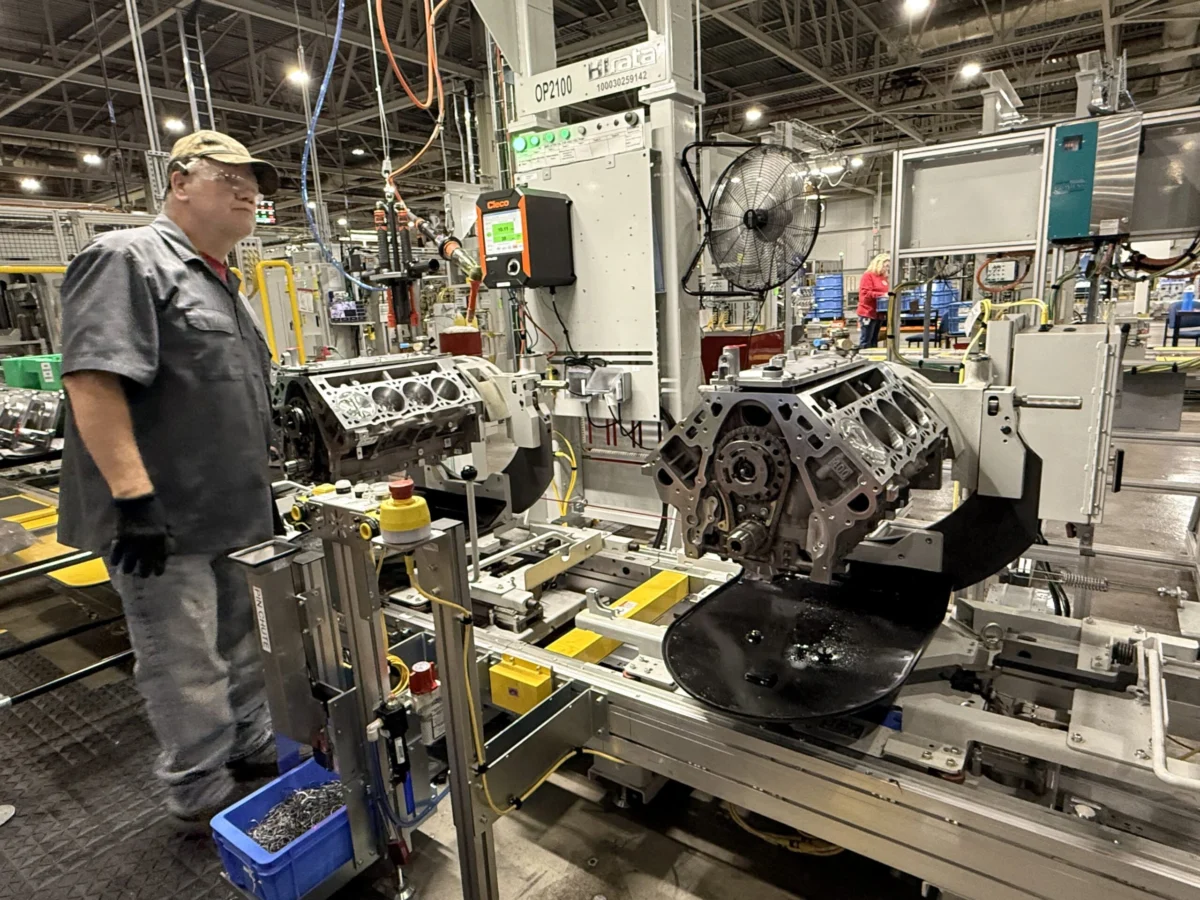
GM President Mark Reuss articulated the company’s aggressive stance during a media event at the sprawling Flint Engine plant, where an employee on September 16, 2026, was observed assembling one of the new 5.7-liter Small Block V-8 engines. "If we don’t stomp the competition with these trucks, then I’d be very sad and questioning myself. That’s the goal," Reuss declared, emphasizing the objective of maintaining "continued truck leadership." This sentiment reflects the immense financial stakes involved in the full-size pickup segment, which historically generates more revenue than many Fortune 100 companies for Ford’s F-Series alone, as per past company statements. These high-margin trucks are indispensable for funding automakers’ broader investments in future technologies and emerging markets.
The Enduring Power of the V-8 and Diesel
GM’s decision to develop a new generation of V-8 engines, its sixth iteration of the iconic small-block series first introduced in 1955, predates the recent regulatory shifts. Development for the Gen 6 small-block began as early as 2018, highlighting a long-term commitment to this powertrain technology. This foresight now positions GM advantageously in a market that is increasingly valuing the traditional strengths of gasoline and diesel engines.
The persistence of strong demand for V-8 engines, particularly in pickup trucks, is a testament to their unparalleled ability to tow and haul heavy loads—a primary use case for many truck owners. Analysts have consistently pointed to the limitations of all-electric pickup trucks in this regard, noting that towing significantly diminishes an EV’s range, a critical drawback for commercial users and those undertaking long-distance hauling.
Even as hybrid vehicles have experienced a rapid surge in sales this year across other segments, pickup trucks remain an outlier. While hybrid options are emerging, their adoption in the truck sector is comparatively slow. Toyota Motor, a pioneer in hybrid technology, reports that only 18.7% of its Tundra full-size pickup truck sales this year have been hybrid models. This data reinforces the notion that for many truck buyers, the established performance, range, and refueling convenience of gasoline and diesel engines still hold sway.
"No one has the efficiency on a diesel that we have," Reuss asserted. "So if you look at the performance efficiency, but also in raw performance and range, hybrids don’t do it… At the end of the day, we have focused on something that the customer wants, and that’s what we have here." This customer-centric approach is validated by GM’s current sales figures, which show V-8 engines powering a majority of its full-size pickup truck sales this year: 55% for the Chevrolet Silverado and approximately 61% for the GMC Sierra 1500. The 3.0-liter TurboMax diesel engine also accounts for a significant portion, representing 20% of Sierra 1500 sales and 35% of Silverado 1500 sales.
The 2027 "Truck Wars" Reignited
The 2027 model year is already being dubbed the newest chapter in the perennial "truck wars" among Detroit’s automotive titans. These battles, characterized by intense competition and significant marketing efforts, intensify whenever a major automaker introduces new or redesigned full-size pickup trucks.
Stephanie Brinley, associate director of Mobility Global’s AutoIntelligence, emphasized the segment’s vital importance: "Full-size pickup trucks are crucial for the three companies, without any doubt. Part of the reason that we have the truck wars cadence that we do is simply because products get refreshed so often."
The current skirmish sees a renewed focus on V-8 engines across the board. Ford is expanding the availability of V-8 options in its updated 2027 F-150 lineup. Ram, a brand that previously faced customer backlash after deemphasizing its iconic Hemi V-8 engines for a more efficient inline six-cylinder, has since announced plans to resurrect them, with new performance "muscle trucks" like the Rumble Bee launching with the 5.7-liter Hemi V-8 in late 2026, followed by the Rumble Bee 392 and Rumble Bee SRT in the first half of 2027. This move by Ram, driven by significant sales losses, serves as a stark reminder of the V-8’s enduring appeal and the risk of alienating a loyal customer base. "Ram showed that you can lose buyers by not having [V-8 engines] available," Brinley noted. "Part of it is because of that expectation that there is something that the V-8 is better at."
Market Dynamics and Customer Loyalty
Full-size pickup trucks have consistently dominated U.S. vehicle sales for decades. Ford’s F-Series has famously been the top-selling vehicle since 1981, with Chevrolet Silverado typically securing the No. 2 spot, and Ram following closely. The GMC Sierra also frequently ranks among the top 10.
GM’s ambitious goal to "stomp" the competition is not without foundation. The company has made notable gains against Ford in recent years, especially since 2020, when Chevrolet and GMC combined sales surpassed Ford’s F-Series. Ford, meanwhile, has faced production challenges over the past year, including disruptions caused by supplier fires, which have impacted its F-Series sales.
Pickup truck buyers are renowned for their fierce brand loyalty, a trait consistently observed by industry analysts. Mobility Global (formerly S&P Global Mobility) reported last year that the Silverado 1500, F-150, and Ram 1500 consistently rank among U.S. vehicles with the highest brand loyalty. However, this loyalty can be tested by significant product changes, such as Ram’s Hemi cancellation, or by persistent quality issues and recalls.
Addressing Quality Concerns and Future Outlook
As GM rolls out its new V-8 engines, which will also power its full-size SUVs, the company is concurrently managing ongoing issues with some engines in its current generation. The National Highway Traffic Safety Administration (NHTSA) opened an investigation into GM’s 6.2-liter V-8 engines following reports of continued failures, even after a previous recall aimed at addressing these problems.
Norman Peralta, GM executive chief engineer of global engines and battery systems, confirmed the company’s full cooperation with the NHTSA and expressed strong confidence that the new Gen 6 engines will be free of similar issues. This assurance is critical for maintaining customer trust and preventing any erosion of the strong loyalty inherent in the truck market.
Recent sales data reflects the dynamic nature of the segment. Through the first half of 2026, GM’s Sierra sales remained level year-over-year, while Silverado experienced a 4.6% decline. In contrast, Ram reported a robust 19% increase in sales, while Ford’s F-Series saw a 13% decline, attributed in part to its ongoing supplier-related production woes.
The renewed emphasis on V-8 and diesel powertrains signals a pragmatic adjustment by Detroit automakers to market realities and policy shifts. While the long-term trajectory towards electrification remains a strategic goal for the industry, the immediate future, particularly in the highly lucrative full-size truck segment, appears firmly rooted in the power and utility of traditional internal combustion engines. This strategic pivot ensures that the iconic roar of the V-8 will continue to echo through the streets of the Motor City for years to come.
