

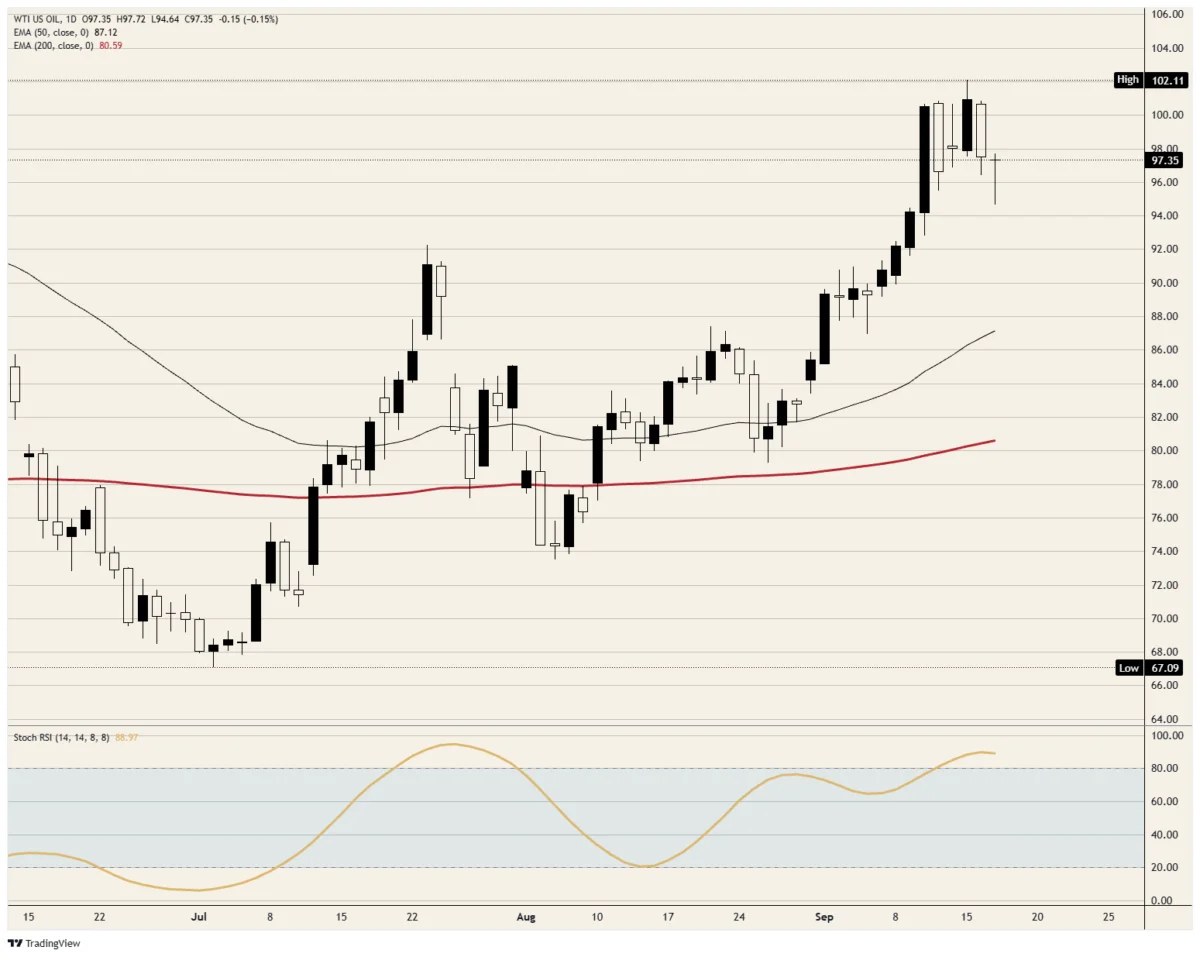
Crude oil prices are demonstrating remarkable resilience, trading near $97.50 after a significant intraday dip to $94.50, followed by a full recovery. This volatile price action unfolds against a backdrop of escalating geopolitical tensions in the Middle East, logistical complexities in global energy supply chains, and the market’s nuanced interpretation of efforts to mitigate risk. Over the past five trading sessions, prices have largely consolidated within a range of $96.50 to $101.00, reflecting a market grappling with conflicting signals, consistently buying and selling the same underlying narrative of supply tightness and regional instability.
The Hormuz Conundrum: Saudi Arabia’s Strategic Cargo Adjustments
A primary driver of recent market discussion has been Saudi Arabia’s offer of "extra cargoes" to Asian refiners, with the crucial caveat that these shipments would be handed over outside the Strait of Hormuz, specifically off Sohar in Oman. Initially, this move was interpreted by some market participants as a potential increase in supply or a strategy to bypass the perilous Strait, contributing to the brief price decline. However, a closer examination of the logistics reveals a more intricate reality.
The mechanism in question is a ship-to-ship (STS) transfer. This arrangement involves shuttle tankers loading Saudi crude at the Kingdom’s Gulf terminals, transporting it through the Strait of Hormuz, and then transferring the cargo to the buyer’s supertanker waiting in safer international waters off Oman. Crucially, the oil still undertakes the journey through the Strait. What effectively moves is the risk. By keeping the larger, more valuable supertankers of Asian refiners outside the Gulf, the direct exposure to potential hazards within the Strait is shifted to smaller, more expendable shuttle vessels. This minimizes the financial and logistical burden on the ultimate buyer, particularly concerning soaring war-risk insurance premiums.
Data underscores this interpretation. Transfers in the Gulf of Oman are currently running near 2.7 million barrels per day (bpd), a substantial increase from 1.5 million bpd in August. This surge indicates not a circumvention of the chokepoint, but rather an increase in the volume of cargo transiting through the Strait of Hormuz, facilitated by this risk-transfer mechanism. The Strait of Hormuz is undeniably the world’s most critical oil chokepoint, through which nearly 20 million barrels per day of crude oil and refined products flowed in 2023, representing approximately a quarter of the world’s total seaborne oil trade. Any perceived "workaround" implemented since February has, at best, replaced only a marginal fraction of this immense volume.
The financial implications of navigating this fraught region have been stark. Before the current month’s escalation in tensions, war-risk cover for a single Hormuz transit was quoted at an alarming 7.5% to 12.5% of a ship’s insured value, a dramatic leap from the mere 0.25% observed prior to the broader regional conflict. This significant cost burden directly impacts shipping companies and, ultimately, the landed price of crude. Furthermore, Saudi Arabia has reportedly doubled daily loadings at its key Ras Tanura and Juaymah terminals, located inside the Gulf, to approximately two supertankers, equating to roughly 4 million barrels. This substantial increase in loadings further confirms the continued reliance on the Strait of Hormuz and indicates that the cost of doing business in the region has not diminished due to the availability of alternative parking for tankers.
The East-West Pipeline: A Critical Artery Under Attack
While the Strait of Hormuz remains central to Saudi oil exports, a truly bypass-capable route exists in the form of the East-West pipeline, also known as the Petroline. This vital artery stretches 1,200 kilometers from Saudi Arabia’s eastern oil fields to the Red Sea port of Yanbu, boasting a substantial capacity of 5 million barrels per day. This pipeline offers a direct alternative for Saudi crude destined for European markets and some Asian destinations via the Suez Canal, circumventing the Strait of Hormuz entirely.
However, this critical infrastructure suffered a significant blow on September 11, when Houthi drones targeted and damaged the pipeline, forcing its immediate shutdown by the Kingdom. News of this disruption sent a palpable shockwave through the crude oil market, propelling prices to a high of just over $102.00 on September 15, as concerns over genuine supply reductions intensified.
The timeline for repairing this crucial pipeline remains a point of contention and market uncertainty. While regional officials have offered estimates ranging from three to five weeks for full repair, Saudi Aramco, the state oil giant, has expressed a more optimistic outlook, stating it expects to bring about half the pipeline’s capacity back online within "days." This discrepancy in repair estimates creates significant ambiguity for market participants attempting to gauge the duration and severity of the supply disruption.
Until the East-West pipeline is fully operational again, every single Saudi barrel earmarked for Asian markets must inevitably traverse the Strait of Hormuz. Consequently, buyers who had anticipated receiving their loadings via the Red Sea route have been informed of delays. More critically, some European cargoes scheduled for this month have been outright canceled, highlighting the immediate and tangible impact of the pipeline’s closure on supply commitments. The arithmetic is clear: the pipeline’s rated capacity of 5 million bpd vastly overshadows the approximately 1.2 million bpd increase observed in the Gulf of Oman transfers since August. These transfers, while alleviating some risk for buyers, merely shift the queue of barrels waiting to cross the Strait, rather than offering a genuine alternative to the pipeline’s substantial capacity.
Market Dynamics: Distinguishing Substance from Symbolism

The crude oil market has demonstrated a swift ability to discern between symbolic gestures and actual barrel-moving events. This pattern was evident on September 11, when news of a "shipping arrangement" for the Strait of Hormuz initially shaved about four dollars off the price. Yet, just two sessions later, crude oil rebounded to hit the high of the recent move above $102.00. Similarly, the initial dip on news of the pipeline damage was quickly followed by a robust recovery. The market quickly recognized that a "meeting" or a "hand-off" between two tankers, while potentially easing risk or logistics, does not equate to an actual increase in available barrels or a genuine bypass of a chokepoint. The same dynamic played out within a single session recently, as the low at $94.50 proved unsustainable, giving way to a full recovery.
It is also critical to understand that current market tightness is not primarily a function of global crude oil inventories. While commercial crude stocks in the United States did fall by 600,000 barrels in the week leading up to September 11, settling at 423.4 million barrels, and distillate stocks rose, these figures do not capture the core constraints impacting the market. The true tightness lies in the availability of tanker capacity willing to navigate high-risk zones and, more significantly, the exorbitant cost of war-risk insurance in the Gulf. Neither of these critical factors is reflected in American tank farm measurements. The issue is not a lack of oil globally, but rather the increasing difficulty and cost associated with transporting it safely and reliably from production hubs to demand centers.
Geopolitical Undercurrents and Energy Security Implications
The ongoing volatility in crude oil markets is inextricably linked to the broader geopolitical instability plaguing the Middle East, particularly the Red Sea and Gulf regions. The Houthi rebels, who claimed responsibility for the East-West pipeline attack, have repeatedly stated that Saudi-linked vessels remain legitimate targets. This persistent threat not only impacts the operational safety of existing infrastructure but also casts a long shadow over any repaired routes, raising concerns about the long-term security of energy transit.
For major oil-importing nations, particularly in Asia and Europe, these developments amplify energy security concerns. The Strait of Hormuz is a non-negotiable gateway for a significant portion of their energy supplies. Any disruption, perceived or real, sends ripples through their economies, potentially leading to higher energy costs, inflationary pressures, and a re-evaluation of supply chain resilience. The increased cost of shipping, driven by elevated insurance premiums and potential rerouting, adds another layer of economic burden to global trade. The current situation underscores the urgent need for diplomatic solutions to de-escalate regional tensions and safeguard critical international shipping lanes and energy infrastructure.
The Path Forward: Pipeline Repair as the Key Driver
Looking ahead, the primary determinant of crude oil prices from here will be the status and operational timeline of the East-West pipeline. A swift and successful restart of this vital artery would enable Saudi crude to once again flow directly to the Red Sea, significantly reducing the reliance on the Strait of Hormuz for those barrels. Such an event would likely be interpreted by the market as a genuine easing of supply concerns and a reduction in transit risk, potentially exerting downward pressure on prices. The market impact of a fully restored pipeline capacity of 5 million bpd would undoubtedly be far more significant than the combined effect of all the ship-to-ship transfers off Sohar.
Conversely, a repair process that extends beyond the more optimistic "days" and closer to the "three to five weeks" estimate would leave a substantial volume of Saudi crude barrels on the water for an extended period, burdened by the attached insurance bills and logistical challenges. This scenario would likely sustain, if not intensify, the current market tightness and upward price pressure. Moreover, even with a successful repair, the lingering threat of Houthi attacks on the Red Sea coast means that the "repaired route delivers to a coast that is also being shot at," introducing an element of persistent risk that the market will continue to price in.
Technical Outlook and Price Levels
From a technical perspective, the crude oil market faces immediate resistance at the $100.00 level. This psychological and technical barrier has capped four consecutive sessions leading into Wednesday, with prices trading above it but only one session managing a daily close above this mark. Beyond $100.00, the next significant resistance is the recent high of $102.00, achieved on September 15.
On the support side, $94.50 represents the session low and the weakest level observed since September 10. A break below this point would open the door to the next critical support at $93.00, which marked the low of the September 10 flush.
The current bias for crude oil remains higher as long as the $94.50 support level holds. The initial objective for bulls would be a decisive breach of $100.00, followed by a test of $102.00. However, momentum indicators suggest that the market might require a fresh catalyst. The daily Stochastic Relative Strength Index (Stoch RSI), a momentum gauge, is currently near 89 and flattened at the top of its range. This indicates that the market is currently overbought and a sustained push above $100.00 might necessitate a significant new headline or development rather than relying solely on existing momentum. A daily close below $93.00 would unequivocally negate the current bullish case and suggest a deeper correction is underway.
In conclusion, the crude oil market is caught in a complex interplay of geopolitical tensions, logistical innovations, and critical infrastructure vulnerabilities. While Saudi Arabia’s strategic maneuvers aim to mitigate risk, the fundamental challenges of securing key transit routes remain. The East-West pipeline’s operational status will be the most significant variable dictating price direction in the coming weeks, as the market continues to weigh the real-world impact of disruptions against the perceived efficacy of alternative strategies.
