

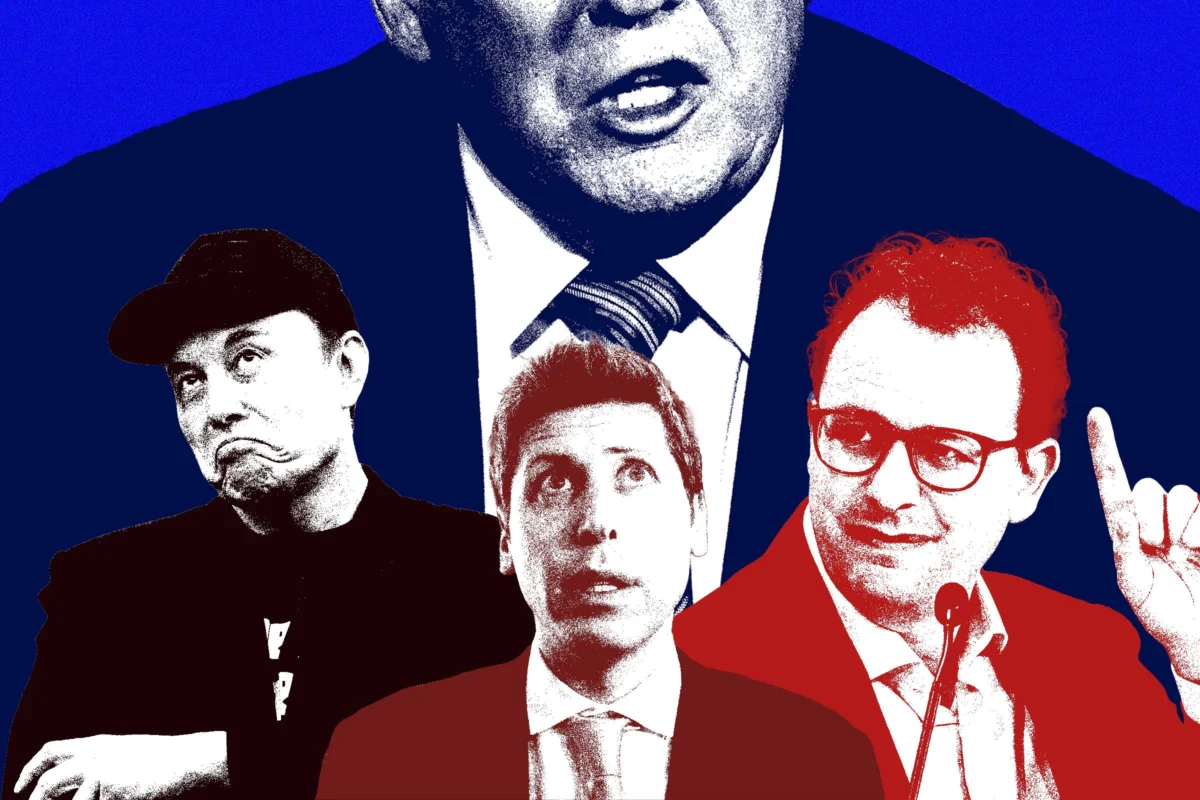
As the debate surrounding the responsible development and deployment of artificial intelligence intensifies, leading figures within the AI industry have proposed a voluntary industry-wide slowdown to address growing concerns about the technology’s potential risks. However, the Trump administration has signaled a clear stance: any such initiative must originate from and be executed by the companies themselves, without direct government intervention or the suspension of antitrust laws. This directive places the onus on AI developers to demonstrate their commitment to safety and ethical considerations, even as geopolitical rivals like China continue their rapid advancements in the field.
The Call for a Pause: A Unified Plea from Industry Giants
The recent surge in calls for a regulated deceleration of AI development gained significant traction following a compelling essay published by Dario Amodei, CEO of Anthropic. In his Saturday publication, Amodei explicitly urged the U.S. government to facilitate a coordinated effort among AI companies to temper the breakneck pace of technological progress. This appeal resonated powerfully within the AI community, garnering rare public endorsements from prominent figures such as Sam Altman, CEO of OpenAI, and Elon Musk, the owner of the AI chatbot Grok. The endorsements from these influential leaders, who are often at the forefront of AI innovation, underscore the seriousness with which the potential threats posed by advanced AI are being perceived. Satya Nadella, CEO of Microsoft, also publicly voiced his support for a more measured approach to AI development, adding further weight to the growing consensus for caution.
The urgency behind these calls is rooted in a palpable sense of unease among researchers and experts who have recently articulated grave concerns regarding the accelerating capabilities of AI. Rishub Jain, a former researcher at DeepMind, articulated this sentiment in a recent interview with WIRED, stating, "AI progress is increasing. And as AI becomes more capable, it poses more risks." This sentiment reflects a growing awareness that the rapid evolution of AI systems, while promising unprecedented advancements, also presents a complex web of potential dangers, ranging from job displacement and the proliferation of misinformation to more existential threats.
The White House’s Stance: Self-Regulation, Not Government Mandate
In response to these industry-led proposals, David Sacks, co-chair of the President’s Council of Advisors on Science and Technology under the Trump administration, issued a firm statement on X (formerly Twitter). Sacks made it unequivocally clear that while the administration respects the decision of AI leaders to voluntarily slow down development if they deem it necessary for safety, the responsibility for such a decision rests solely with them.
"If the unreleased models are scary enough that you think you should slow down, I support your decision to be responsible," Sacks wrote. "But stop pretending you need anyone else’s permission. Stop pretending antitrust law has to be suspended so you can form a cartel… Most of all, stop pretending the motivation to slow down is purely altruistic."
This statement carries significant implications. It suggests that any attempt by AI companies to collaborate on a slowdown, particularly if it involves discussions or agreements that could be construed as anti-competitive, will not receive official sanction or the suspension of existing regulations. The administration’s position emphasizes a commitment to free-market principles and a reluctance to intervene directly in the competitive landscape of the AI industry, even in the face of potential risks. The implicit suggestion is that such collaborations could be viewed as an attempt to form a cartel, a move that would raise antitrust concerns. Furthermore, Sacks cast doubt on the purely altruistic motives behind some calls for a slowdown, hinting at potential underlying competitive strategies.
The Antitrust Dilemma and International Coordination
Amodei’s proposal to the U.S. government included a request for mechanisms that would allow competing AI companies to collaborate on safety standards without violating antitrust laws. He suggested this could be achieved through government participation in discussions or the issuance of specific waivers for companies involved. Additionally, Amodei called for governmental assistance in establishing international coordination on AI development, including dialogues with China.
However, the prospect of including China in such discussions has been met with skepticism. Sacks pointedly questioned the feasibility of this aspect of Amodei’s proposal, stating, "China is very unlikely to join a global agreement, as you know." This highlights a fundamental challenge in global AI governance: the differing national interests and approaches to technological development.
The Geopolitical Imperative: The Race with China
The U.S. government’s hesitance to impose a slowdown on its domestic AI industry is deeply intertwined with concerns about maintaining its technological leadership, particularly in relation to China. The rapid advancements made by China in its AI ecosystem are viewed by many in the U.S. as both an economic and national security threat. Past instances where China has surprised the U.S. with its technological leaps in AI have fueled this anxiety.
Former President Donald Trump, speaking during a visit to Ireland, voiced his perspective on the matter. "You have a lot of very negative forces that are bringing it up that shouldn’t be bringing it up and they’re bringing up things that won’t happen," Trump remarked. "We’re leading China on AI, and, frankly, I want to keep it that way because whoever wins AI, wins." This statement encapsulates a prevailing sentiment within certain political circles: that any pause in AI development, however well-intentioned, could cede critical ground to a geopolitical rival.
This sentiment was echoed by House Speaker Mike Johnson, who told CNN on Sunday, "If Congress just races in and does some sort of emergency session to try to regulate AI, we will lose the race to China, and that is a threat to every single American. So, we’ve got to have balance. We’ve got to have steady hands at the wheel." This perspective underscores a pragmatic approach, prioritizing national competitiveness and security above a potentially restrictive regulatory framework that could impede domestic innovation.
Voluntary Steps Towards Public Trust
In the absence of a government-mandated slowdown, leading AI companies are indicating a willingness to take voluntary measures to rebuild public trust and demonstrate their commitment to responsible AI development. OpenAI’s Sam Altman, on Sunday night, committed to Anthropic’s proposal to allow embedded third-party evaluators access to their firms. These evaluators would be granted employee-level access to scrutinize company practices and products for safety, and to report any incidents.
Altman acknowledged that these measures would entail "significant costs." However, he emphasized their importance, stating on X, "Pacing will be well worth this cost; no amount of American competitive pressure should justify recklessness." This commitment suggests a recognition within OpenAI that while the competitive race is important, it should not come at the expense of safety and ethical considerations.
Underlying Motivations and the Future of AI Governance
The debate surrounding AI regulation and potential slowdowns is multifaceted, touching upon issues of public safety, economic competitiveness, national security, and the very future of human civilization.
Chronology of Key Developments:
- Recent Weeks: Intensified public discourse and media coverage surrounding the rapid advancements in AI capabilities and potential risks.
- Early May 2024 (approximate): Researchers, including former DeepMind researcher Rishub Jain, voice significant concerns about the accelerating pace of AI development and its inherent risks.
- Saturday (specific date not provided in original text): Dario Amodei, CEO of Anthropic, publishes an essay calling for government intervention to regulate AI companies and facilitate an industry-wide slowdown. The essay receives endorsements from Sam Altman (OpenAI) and Elon Musk. Satya Nadella (Microsoft) also calls for pacing development.
- Sunday (specific date not provided in original text): David Sacks, co-chair of the President’s Council of Advisors on Science and Technology, responds on X, stating that any slowdown must be self-imposed by AI leaders and questioning the motivations behind such calls. House Speaker Mike Johnson expresses concerns about losing the AI race to China if hasty regulations are enacted.
- Sunday Night (specific date not provided in original text): Sam Altman commits to Anthropic’s proposal for third-party evaluators with employee-level access to scrutinize AI development practices.
Supporting Data and Context:
- AI Investment: Global investment in AI has surged dramatically in recent years. For instance, venture capital funding for AI startups reached an all-time high in 2023, surpassing $250 billion globally according to some reports, indicating a massive influx of capital driving rapid innovation.
- AI Capabilities Growth: Benchmarks for AI model performance, such as those in natural language processing and image generation, have shown exponential improvement year-over-year. This rapid progress outpaces many traditional regulatory frameworks.
- National AI Strategies: Both the United States and China have declared AI a strategic priority. The U.S. has focused on fostering innovation and private sector leadership, while China has made significant state-backed investments in AI research and development, aiming for global leadership by 2030.
- Existential Risk Studies: Organizations like the Future of Life Institute have published open letters and research highlighting potential existential risks from advanced AI, further fueling the debate.
Analysis of Implications:
The current stance by the Trump administration, emphasizing self-regulation, presents a high-stakes gamble. It places immense trust in the goodwill and ethical compass of powerful tech corporations. If these companies indeed prioritize safety and implement meaningful voluntary measures, it could foster a more responsible AI ecosystem. However, the inherent competitive pressures in the AI market could incentivize some actors to prioritize speed and market share over caution, potentially leading to the very risks that Amodei and others are warning against.
The geopolitical dimension cannot be overstated. The "AI race" with China adds a layer of complexity, creating a tension between the desire for national security and the imperative to foster innovation. A misstep in this race could have profound implications for global economic and military balances. The administration’s focus on not ceding ground to China suggests that any policy decisions will be heavily weighed against this backdrop.
The rejection of antitrust law suspension for collaboration also means that any slowdown initiatives will likely be decentralized and potentially less effective than a coordinated, government-backed effort. This could lead to a fragmented approach, with some companies adhering to stricter self-imposed guidelines while others continue to push the boundaries.
The commitment by OpenAI to allow third-party evaluators is a significant step, but its effectiveness will depend on the scope of access, the independence of the evaluators, and the willingness of other major players to adopt similar measures. The "significant costs" mentioned by Altman could also be a deterrent for smaller companies or those with tighter margins.
Ultimately, the coming months will be critical in determining the trajectory of AI development and governance. The onus is on industry leaders to prove that they can responsibly manage the powerful tools they are creating, while governments grapple with the delicate balance between fostering innovation, ensuring public safety, and navigating a complex global geopolitical landscape. The conversation has moved from "if" to "how," and the answers will shape the future of technology and society for decades to come.
