

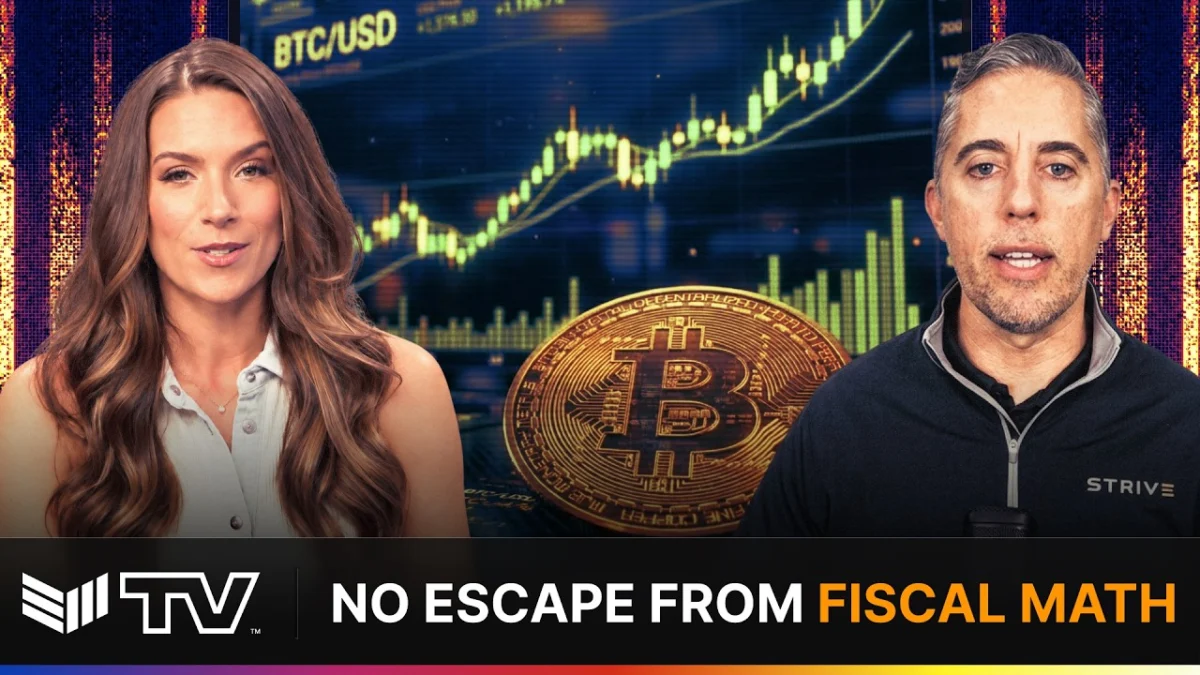
The Federal Reserve and the U.S. Treasury Department are pivotal institutions in managing the nation’s economy, wielding significant influence over monetary policy and fiscal operations, respectively. Their decisions, particularly concerning interest rates and the management of government debt, ripple through global financial markets. In recent times, discussions have intensified regarding the potential for these entities to intervene and actively suppress long-term interest rates, a move that could trigger profound macroeconomic shifts. According to Matt Cole, CEO of Strive, such an intervention would likely see the U.S. dollar acting as a primary release valve for market pressures, while scarce assets, notably Bitcoin, would experience significant appreciation. This perspective was articulated in a recent interview where Cole outlined his three-part macroeconomic thesis, focusing on the interplay between the dollar, long-end Treasury yields, and Bitcoin’s emergence as a superior store of value compared to gold.
Understanding the Fed and Treasury’s Mandates and Tools
The Federal Reserve, as the central bank of the United States, has a dual mandate: to foster maximum employment and maintain stable prices. It achieves these goals primarily through monetary policy tools, the most prominent being the setting of the federal funds rate – the target rate for overnight lending between banks. The Fed also influences longer-term interest rates through its control of the money supply and its ability to purchase or sell government securities in the open market, a process known as quantitative easing (QE) or quantitative tightening (QT).
The U.S. Treasury Department, on the other hand, is responsible for managing the federal government’s finances. This includes collecting taxes, paying the government’s bills, and issuing debt to finance government operations when tax revenues are insufficient. The Treasury manages the issuance of Treasury bills, notes, and bonds, which are crucial instruments for both government financing and as benchmarks for interest rates across the economy.
The Dynamics of Long-End Treasury Rates
Long-term Treasury yields, particularly those on 10-year and 30-year bonds, are closely watched indicators of economic expectations. They reflect investor sentiment about future inflation, economic growth, and the expected path of short-term interest rates. When investors anticipate higher inflation or stronger economic growth, they demand higher yields to compensate for the erosion of purchasing power and the opportunity cost of tying up their capital for longer periods. Conversely, expectations of slower growth or deflation tend to push long-term yields lower.
Historically, the Fed’s direct intervention in suppressing long-end rates has been less common than its influence on short-term rates. However, during periods of severe economic stress, such as the 2008 financial crisis or the COVID-19 pandemic, the Fed has employed unconventional measures, including large-scale asset purchases (QE) that explicitly targeted longer-duration Treasury securities. The aim of these actions is to lower borrowing costs across the economy, stimulate investment, and prevent a credit crunch.
Cole’s Three-Part Macroeconomic Thesis
Matt Cole’s analysis centers on the potential consequences of a deliberate and sustained effort by the Fed and Treasury to cap long-end Treasury rates. He posits that this intervention would not occur in a vacuum but would initiate a chain reaction with significant implications for global capital flows and asset valuations.
Part 1: The Dollar as the Release Valve
Cole’s first point addresses the U.S. dollar’s role in this scenario. If the Fed and Treasury actively suppress long-end rates, it suggests a deliberate attempt to maintain accommodative financial conditions, potentially signaling concerns about economic fragility or a desire to manage debt servicing costs. This action, he argues, would inadvertently make the dollar a "release valve."
Historically, the U.S. dollar has served as the world’s primary reserve currency, a status underpinned by the size and stability of the U.S. economy, its deep and liquid financial markets, and the widespread use of the dollar in international trade and finance. However, sustained interventions that artificially suppress yields could erode confidence in the dollar’s long-term value.
If U.S. interest rates are perceived as artificially low due to central bank intervention, investors seeking higher yields might look elsewhere. This could lead to capital outflows from the U.S., increasing the supply of dollars in global markets. Furthermore, if the intervention is seen as a sign of economic weakness or an unsustainable fiscal path, it could further diminish the dollar’s appeal as a safe-haven asset. In such a scenario, the dollar could weaken significantly against other major currencies and even against hard assets.
Supporting Data Context: The U.S. dollar index (DXY), which measures the dollar’s value against a basket of six major currencies, has historically shown sensitivity to interest rate differentials and perceptions of U.S. economic health. A sustained period of suppressed yields, if accompanied by rising inflation or geopolitical instability, could lead to a notable decline in the DXY. For instance, during periods of quantitative easing, concerns about currency debasement have often been raised, contributing to volatility in the dollar’s exchange rate.
Part 2: Scarce Assets Rip
Cole’s second tenet is that in an environment where the dollar weakens and long-end rates are suppressed, scarce assets would experience a significant surge in value. This phenomenon is driven by several factors:
- Inflation Hedge: When fiat currencies are perceived to be losing value due to inflationary pressures or aggressive monetary policy, investors flock to assets that are seen as hedges against inflation. These are typically assets with a limited or fixed supply.
- Flight to Quality/Tangibility: In times of economic uncertainty or when traditional financial instruments are perceived as being manipulated, investors often seek tangible assets with intrinsic value.
- Yield-Seeking Behavior: With U.S. long-end yields artificially suppressed, investors seeking returns would be compelled to explore alternative assets that offer the potential for capital appreciation.
Cole specifically highlights Bitcoin as a prime example of a scarce asset poised to benefit. Bitcoin’s supply is capped at 21 million coins, a characteristic that makes it inherently deflationary and distinct from fiat currencies, whose supply can be expanded indefinitely by central banks. This scarcity, combined with its decentralized nature and growing adoption, positions Bitcoin as a potential digital gold.
Supporting Data Context: The historical performance of Bitcoin during periods of high inflation or significant monetary stimulus has been notable. For example, following the substantial monetary easing implemented in response to the COVID-19 pandemic, Bitcoin experienced a dramatic price surge. Its correlation with inflation indicators and its performance relative to traditional safe havens like gold are key areas of focus for investors assessing its role as a scarce asset. Data from various cryptocurrency analytics firms consistently show the limited and predictable issuance schedule of Bitcoin, contrasting sharply with the expanding balance sheets of major central banks.
Part 3: Bitcoin Reclaims its Role as the Fastest Horse Against Gold
Cole’s third point refines the narrative on scarce assets by focusing on the relative performance of Bitcoin and gold. Gold has traditionally been viewed as the ultimate store of value and a hedge against inflation and currency devaluation. However, Cole argues that in the scenario he describes, Bitcoin would not only outperform fiat currencies but would also demonstrate superior returns compared to gold, thus reclaiming its position as the "fastest horse."
The term "fastest horse" implies a comparative advantage in terms of potential for rapid and significant price appreciation. While gold’s value is often seen as more stable and less volatile than Bitcoin’s, its growth potential is also typically more modest. Bitcoin, with its nascent stage of adoption, technological innovation, and significant volatility, has the capacity for much larger price swings, both up and down.
In an environment where long-end rates are suppressed and the dollar weakens, the demand for stores of value would intensify. Gold would likely benefit, but Bitcoin, with its digital scarcity and potential for widespread adoption as a medium of exchange and store of value in a digitalizing world, could see a more explosive growth trajectory. This would be particularly true if institutional adoption of Bitcoin continues to accelerate, driven by the search for uncorrelated assets and higher potential returns.
Supporting Data Context: Comparing the performance of Bitcoin and gold over extended periods reveals stark differences. While gold has provided a relatively stable store of value over centuries, Bitcoin, in its short history, has delivered returns that dwarf those of gold, albeit with significantly higher volatility. For instance, over the past decade, Bitcoin has generated astronomical returns, while gold has seen more moderate, though still positive, growth. The annual percentage returns of Bitcoin have often exceeded 50%, and at times, several hundred percent, whereas gold typically returns in the single-digit to low double-digit percentages annually, with significant periods of stagnation or decline.
Base Case: 50% Annual Bitcoin Returns into 2030
Based on this macroeconomic framework, Cole articulates a base case scenario for Bitcoin’s future performance. He projects approximately 50% annual returns for Bitcoin leading up to 2030. This projection is not a mere speculative forecast but is rooted in his thesis that the confluence of factors – dollar debasement, suppressed yields, and the increasing demand for scarce digital assets – would create a sustained tailwind for Bitcoin’s price appreciation.
Implications of the Base Case: A consistent 50% annual return is an extraordinary figure, far exceeding the historical average returns of most traditional asset classes. If realized, it would significantly alter the landscape of investment portfolios and wealth accumulation. Such returns would imply a substantial increase in Bitcoin’s market capitalization, potentially surpassing that of many established global companies and even some sovereign debt markets.
- Institutional Adoption: These projected returns would likely accelerate institutional interest in Bitcoin, further validating its role as a legitimate asset class.
- Democratization of Wealth: If Bitcoin becomes more accessible and its price continues to rise, it could offer new avenues for wealth creation for a broader segment of the population.
- Macroeconomic Realignments: A significant shift of capital into Bitcoin would have ripple effects on traditional financial markets, potentially altering liquidity and investment patterns.
Background Context and Potential Triggers for Intervention
The discussion around the Fed and Treasury intervening to suppress long-end rates is not entirely theoretical. Several factors could prompt such actions:
- High Debt Levels: The U.S. government’s debt has grown substantially, particularly in recent decades. As debt levels rise, the cost of servicing that debt also increases. Suppressing long-term yields can reduce the government’s interest payments, easing fiscal pressure. The Congressional Budget Office (CBO) regularly projects interest payments on the national debt, and these figures often highlight the sensitivity of the budget to interest rate fluctuations. For example, a sustained increase of 1 percentage point in interest rates across all maturities could add trillions of dollars to the U.S. debt over a decade.
- Economic Slowdown or Recession Fears: If the U.S. economy faces a significant downturn, the Fed might lower short-term rates. However, if long-term rates remain elevated due to market concerns about inflation or fiscal sustainability, it could hinder the effectiveness of monetary policy. In such a scenario, the Fed might consider yield curve control or direct asset purchases to bring down longer-term borrowing costs and stimulate economic activity.
- Global Financial Stability Concerns: In times of global financial stress, the U.S. Treasury and Federal Reserve might act in concert to ensure the smooth functioning of markets. Suppressing long-end yields could be part of a broader strategy to prevent a credit crunch and maintain liquidity.
Timeline and Chronology of Potential Events
While no specific timeline for such intervention has been announced, the conditions for it to be considered could emerge under various macroeconomic scenarios:
- Near-Term (Next 1-2 Years): If inflation proves more persistent than anticipated, leading to aggressive Fed rate hikes, but simultaneously economic growth falters significantly, creating a stagflationary environment. In this scenario, the Treasury might face increasing pressure to manage its debt servicing costs, while the Fed might be hesitant to cut rates if inflation remains high. This could create a tension that prompts a discussion about yield management.
- Medium-Term (2-5 Years): As the U.S. national debt continues to climb and demographic pressures increase entitlement spending, the fiscal burden will become more pronounced. If economic growth remains sluggish, the ratio of debt to GDP could reach levels where market participants become increasingly concerned about fiscal sustainability. This could lead to upward pressure on long-term yields, potentially forcing the Treasury and Fed to consider interventions to maintain affordability.
- Long-Term (5+ Years): Ongoing global geopolitical shifts, potential supply chain disruptions, and the transition to a greener economy could all contribute to inflationary pressures and necessitate significant government spending. In such a world, managing the cost of debt would remain a critical challenge, making yield suppression a more likely policy consideration.
Broader Impact and Implications
The implications of the Fed and Treasury actively suppressing long-end rates and the subsequent rise of scarce assets like Bitcoin would be far-reaching:
- Redefinition of Investment Strategies: Traditional asset allocation models would need to be re-evaluated. Investors would need to incorporate a greater allocation to hard assets and digital scarcity, potentially reducing their reliance on traditional fixed-income instruments that offer diminished real returns.
- Geopolitical Shifts: A weakening dollar and the rise of alternative stores of value could alter global power dynamics. Countries and blocs that hold significant dollar reserves might seek to diversify, and the U.S.’s ability to finance its deficits through dollar issuance could be challenged.
- Technological Adoption: The increased demand for Bitcoin and other digital assets could accelerate the development and adoption of blockchain technology and decentralized finance (DeFi) solutions.
- Regulatory Scrutiny: A significant surge in the price and adoption of cryptocurrencies would undoubtedly attract greater regulatory attention from governments worldwide, aiming to balance innovation with investor protection and financial stability.
Conclusion
Matt Cole’s macroeconomic thesis presents a compelling, albeit potentially disruptive, vision of the future financial landscape. The premise hinges on the idea that deliberate intervention by the U.S. Federal Reserve and Treasury to suppress long-end interest rates, while seemingly a tool to manage economic conditions, could trigger a cascade of events. This would involve the U.S. dollar acting as a depreciating "release valve" for market pressures, leading to a significant appreciation of scarce assets. Bitcoin, with its fixed supply and growing adoption, is positioned by Cole as the leading beneficiary, potentially outperforming even gold and delivering substantial annual returns. This scenario underscores the intricate relationship between monetary policy, fiscal management, and the evolving nature of value in the global economy. As always, such analyses are subject to market dynamics and the ultimate decisions of policymakers, but they offer valuable frameworks for understanding potential future economic trajectories.
Disclaimer: The views and opinions expressed in this article are those of the interviewed individual and do not necessarily reflect the official policy or position of Bitcoin Magazine or any affiliated entities. This content is provided for informational and educational purposes only and should not be construed as investment, legal, tax, or accounting advice. Nothing contained in this article constitutes a solicitation, recommendation, endorsement, or offer to buy or sell any securities or financial instruments. Viewers should consult their own advisors before making financial or business decisions.
