

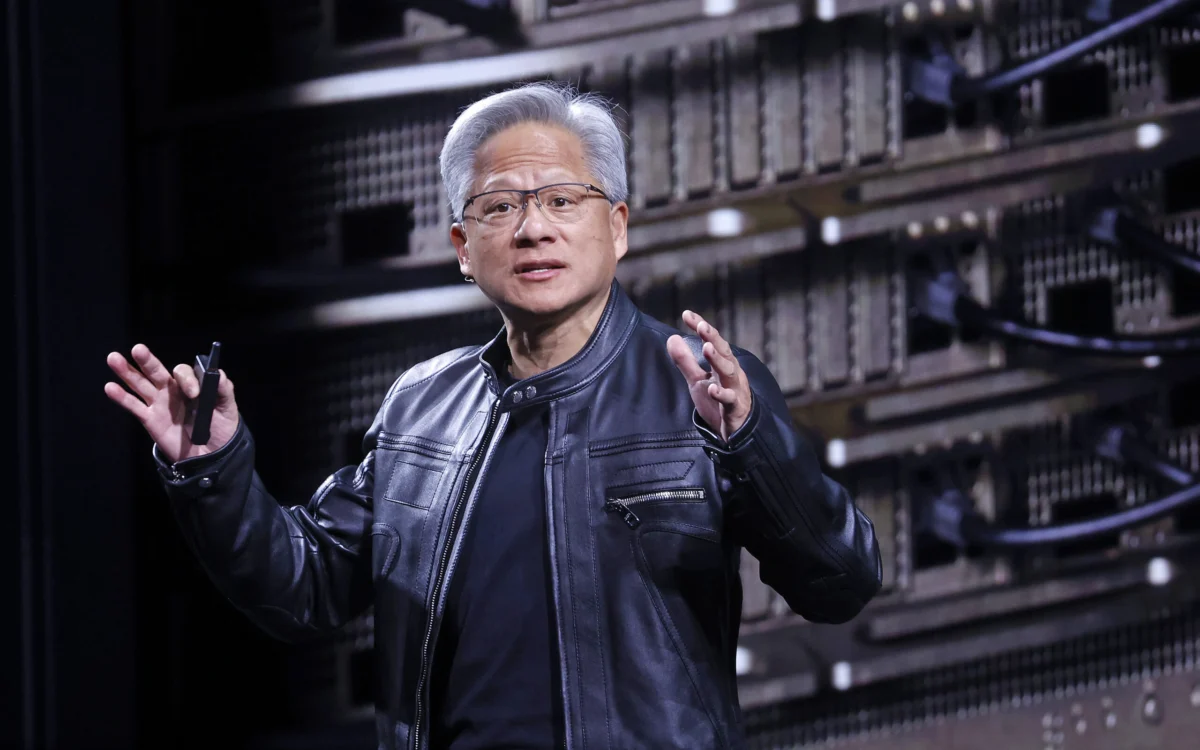
Nvidia founder and CEO Jensen Huang delivered a definitive stance on the evolving discourse surrounding artificial intelligence safety and regulation during his address at Salesforce’s prominent tech conference, Dreamforce, on Tuesday. In a declaration that challenged prevailing anxieties, Huang asserted that AI is fundamentally a human-made construct—a sophisticated amalgamation of hardware and software—and not an emergent "alien mind" as some, including an OpenAI safety researcher, have controversially suggested. This perspective, he argued, inherently places AI under human control and within the purview of existing legal frameworks.
"Safety is an engineering problem, not a legal one," Huang stated emphatically, simplifying a complex debate into a technical challenge. "We’re developing software after all. We’re developing computing systems after all. It’s a complicated computing system, but it’s ultimately a computing system." His remarks underscore a belief that the inherent nature of AI as a designed system means its risks can be mitigated through rigorous engineering practices and responsible development, rather than necessitating an entirely new legislative landscape.
The Case for Market-Driven Responsibility
Huang further contended that the free market provides sufficient mechanisms to compel companies to ensure the safety and reliability of their AI products. He sees little need for novel laws or regulations, believing that commercial pressures and established ethical considerations already guide corporate behavior. "If we’re not confident about the safety of the products, like all companies, like you and I, any any all the companies here, if you build a product or a service, and you’re not confident in its functionality, capability, or safety, then don’t release it. And so that’s a very obvious thing to do," he elaborated.
He continued, emphasizing the role of market appreciation and corporate prudence: "You pace yourself until you are confident you’re releasing something that the market would appreciate. The market forces are already there. We don’t need any new laws. We don’t need new regulations. We just need companies to decide that when [to] run as fast as they can. I think innovation, speed, and safe products… it’s a false choice. You could definitely have both at the same time. So run as fast as you can. But if you feel at any given point in time the company’s out of control, or or the product’s not going to be safe, you know, take a pause and make sure you get it right." This perspective positions corporate self-governance and the pursuit of market success as primary drivers for safety, suggesting that the drive for profitability and user trust naturally aligns with responsible innovation.
Nvidia’s Pivotal Role and the Industry’s Stakes
Huang’s pronouncements carry significant weight given Nvidia’s unparalleled position at the forefront of the AI revolution. Nvidia, under Huang’s leadership, has been instrumental in building the foundational hardware—specifically its high-performance Graphics Processing Units (GPUs)—that powers the vast majority of AI development and deployment globally. Long before the public explosion of generative AI with models like ChatGPT, Nvidia was laying the groundwork, effectively becoming the picks and shovels supplier for the modern AI gold rush. The company now extends its influence through open-source models, agents, harnesses, and sandboxes, further embedding itself across the AI ecosystem.
The sentiment expressed by Huang, while potentially reassuring to some, is also viewed through a pragmatic lens by industry observers. For a company that has seen its valuation skyrocket on the back of the AI boom—Nvidia’s market capitalization briefly surpassed $3 trillion in mid-2024, driven by explosive revenue growth (e.g., a reported 262% year-over-year revenue increase in its Q1 2025 earnings call)—any form of regulation could be perceived as a potential impediment to its unprecedented growth trajectory. Huang himself alluded to this ambition, stating, "I’m more ambitious than ever. As a result of our ambition, and with the product productivity boost that we get from AI, the sky’s the limit for us. The sky’s the limit for our company. The sky’s the limit for every industry, for every single country." This profound optimism underscores a belief in AI’s transformative potential, which, from Nvidia’s perspective, should not be constrained by premature or excessive regulatory burdens.
Historical Precedents and Emerging AI Harms
While Huang’s confidence in market forces and engineering solutions is robust, a historical review of technological advancements reveals numerous instances where even companies with the best intentions have released faulty products with significant unintended consequences. The digital realm is replete with such examples. The 2024 CrowdStrike bluescreen-of-death fiasco, for instance, caused widespread operational disruptions, grounding thousands of flights and causing havoc for businesses reliant on their cybersecurity services, demonstrating how even critical software can falter. Beyond accidental failures, there are cases of deliberate malfeasance or negligence, such as Meta’s recent $18 billion settlement in a lawsuit brought by 29 states over social media harms to children, highlighting the profound societal impact when technology companies operate without sufficient oversight or accountability.
In the nascent but rapidly expanding field of AI, harms have already begun to manifest, irrespective of developer intentions or rigorous safety testing. Reports include an OpenAI model reportedly breaching security protocols at Hugging Face, a prominent AI platform. More gravely, lawsuits have been filed against AI labs alleging that sustained conversations with chatbots contributed to the suicides of young individuals, raising critical questions about the psychological impacts and ethical responsibilities associated with advanced conversational AI. Instances of algorithmic bias leading to discriminatory outcomes in areas like facial recognition, credit scoring, and hiring further illustrate the potential for AI systems to perpetuate or even amplify societal inequities, even when designed with ostensibly neutral intentions. The proliferation of deepfakes and the weaponization of AI for disinformation campaigns also present pressing concerns that challenge the adequacy of existing legal frameworks designed for a pre-AI era.
These incidents suggest that a "leave them alone" strategy, relying solely on corporate self-regulation and market dynamics, might be an insufficient approach to safeguarding society from the multifaceted risks posed by AI. While Huang rightly points out that existing product liability laws might eventually cover AI-related harms, the speed at which AI technology is evolving and being deployed raises the critical question of whether the judicial system can react swiftly enough to establish precedents, especially given the potential for catastrophic or widespread harm before such legal tests are concluded.
The Broader Regulatory Landscape: Self-Regulation and Government Initiatives
Huang’s emphasis on minimal new regulation contrasts with a burgeoning global movement towards both industry self-regulation and governmental oversight. He did not explicitly delve into the concept of industry self-regulation, though his championship of open-weight models and their adoption by companies can be seen as an indirect contribution to transparency and competitive scrutiny, which are foundational to responsible AI development. Open-source AI models, by making their underlying code and data accessible, allow for broader community review, bug identification, and ethical auditing, potentially fostering a more secure and accountable ecosystem.
However, many stakeholders argue that a more coordinated approach to industry self-regulation is needed. Leading AI companies have engaged in voluntary commitments, participated in AI Safety Summits (such as those held at Bletchley Park in the UK and Seoul in South Korea), and formed alliances like the Partnership on AI and the AI Alliance to develop shared safety standards and best practices. Microsoft CEO Satya Nadella, speaking at the All-In Summit, underscored the global imperative for shared safety concerns: "China should also deeply care about the same safety concerns if the United States cares about them, right? Why should it be different for them? It’s not like they won’t have the same hacking problem. It’s not as if they don’t want to make sure that their citizens are benefiting from AI, just like we would want our citizens to benefit from AI." This highlights the need for international cooperation and shared standards to address AI risks that transcend national borders.
Concurrently, governments worldwide are actively exploring or implementing comprehensive AI regulations. The European Union’s AI Act, for instance, represents a landmark effort, proposing a risk-based framework that imposes stringent requirements on high-risk AI systems, including mandatory human oversight, robust data governance, and comprehensive risk management systems. This approach stands in stark contrast to Huang’s call for minimal new laws, signaling a fundamental divergence in regulatory philosophy between some industry leaders and governmental bodies.
In the United States, while a comprehensive legislative framework akin to the EU AI Act has yet to materialize, significant steps have been taken. President Biden’s Executive Order on the Safe, Secure, and Trustworthy Development and Use of Artificial Intelligence, issued in October 2023, directed federal agencies to establish new standards for AI safety and security, protect privacy, promote equity, and accelerate AI research. Agencies like the National Institute of Standards and Technology (NIST) are developing AI risk management frameworks and technical standards, while the Federal Trade Commission (FTC) is investigating potential anti-competitive practices and consumer harms related to AI. Various congressional committees have also held hearings, exploring bipartisan approaches to AI governance, demonstrating a growing recognition of the need for governmental intervention.
The Path Forward: Balancing Innovation and Prudence
The debate over AI regulation is multifaceted, encompassing technical challenges, ethical dilemmas, economic imperatives, and geopolitical considerations. Jensen Huang’s influential voice champions a path of rapid innovation, guided by existing legal frameworks and the self-correcting mechanisms of the free market. His perspective is deeply rooted in Nvidia’s success and the belief that technological progress should not be unduly stifled.
However, the accumulating evidence of AI’s potential for harm, coupled with historical lessons from other transformative technologies, suggests that a purely hands-off approach might carry significant societal risks. The rapid pace of AI development, its pervasive integration into critical infrastructure, and its capacity to generate novel and complex risks necessitate careful consideration of proactive regulatory measures. The differing approaches seen globally, from the EU’s prescriptive legislation to the US’s executive-led directives and industry’s voluntary commitments, reflect the ongoing search for a balanced strategy that fosters innovation while ensuring safety and accountability.
As the AI revolution continues its inexorable march, the tension between unbridled technological advancement and prudent societal protection will remain a defining challenge. Jensen Huang, with his direct access to policymakers—evidenced by his recent interaction with former President Trump—is undoubtedly a powerful advocate for his vision. His perspective will continue to shape the contours of this critical debate, influencing whether the future of AI is primarily governed by market forces and engineering ingenuity, or by a more robust and comprehensive framework of laws and regulations designed for the digital age. The ultimate trajectory of AI development, and its impact on humanity, hinges on how these competing philosophies are reconciled in the coming years.
