

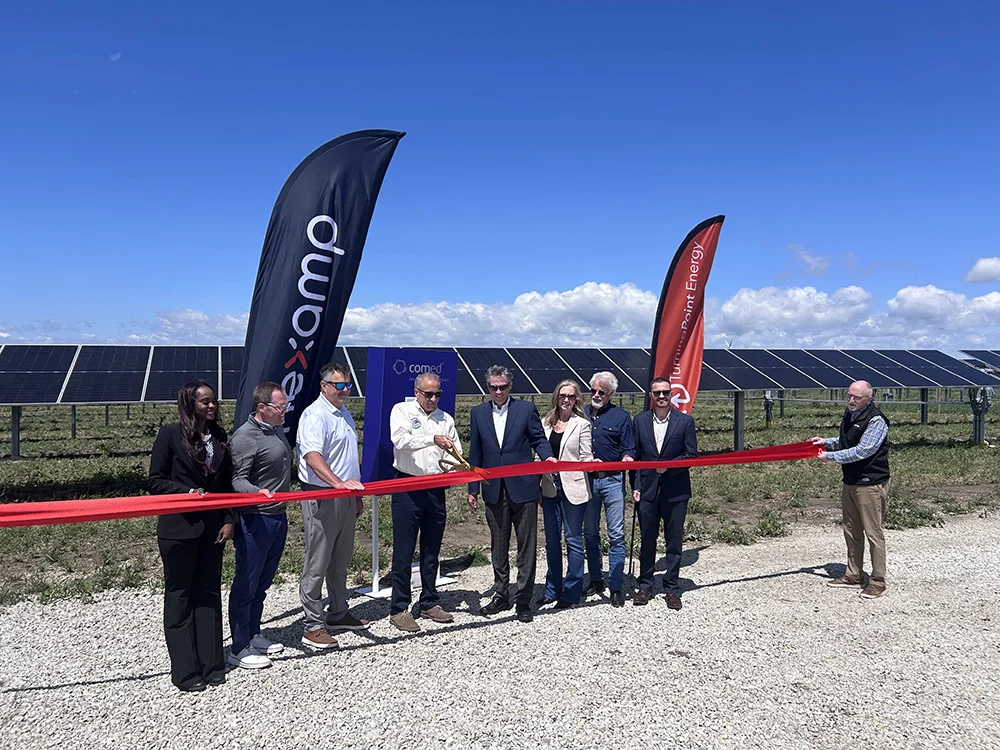
The landscape of the American power grid is undergoing a fundamental transformation, moving away from a century-old model of centralized generation toward a decentralized, multi-directional network. At the heart of this transition is Commonwealth Edison (ComEd), the largest electric utility in Illinois, which recently marked a significant milestone in grid modernization. In Minonk, Illinois, representatives from ComEd, Nexamp, and Turning Point Energy gathered to cut the ribbon on a pioneering community solar project. This facility represents one of the first in the nation to be enabled by a Distributed Energy Resource Management System (DERMS) and stands as the first in ComEd’s northern Illinois service territory to utilize a DERMS featuring a wireless connection. This development is not merely a local success story but a blueprint for how utilities across the United States can navigate the increasingly complex challenges of integrating renewable energy while maintaining grid stability and customer affordability.
The Challenge of Traditional Grid Interconnection
For decades, the standard operating procedure for electric utilities was predicated on a "worst-case scenario" planning model. Infrastructure was designed to handle peak customer demand while assuming that distributed energy resources (DERs)—such as solar arrays and wind farms—would produce maximum output during periods of minimum load. This conservative approach often led to "static hosting capacity" limits. When a developer proposed a new project that exceeded these limits, the traditional solution was a physical upgrade to the grid: thicker wires, larger transformers, or entirely new substations.
These physical upgrades come with two primary drawbacks: high costs and long timelines. In many instances, the financial burden of these upgrades fell entirely on the developer, often rendering otherwise viable renewable energy projects economically impossible. Furthermore, the multi-year wait times for infrastructure construction contributed to a massive backlog in interconnection queues across the country. According to data from the Lawrence Berkeley National Laboratory, the amount of generation and storage capacity seeking interconnection has skyrocketed, with wait times for projects often exceeding five years. ComEd’s new approach seeks to bypass these bottlenecks by shifting the focus from physical expansion to digital optimization.
A Chronology of Innovation: From Policy to Implementation
The journey toward flexible interconnection in Illinois was accelerated by the state’s aggressive climate goals. The Climate and Equitable Jobs Act (CEJA), signed into law in 2021, set Illinois on a path to 100% clean energy by 2050. This legislation necessitated a rapid scaling of community solar and other renewable resources.
In response, ComEd began rethinking its engineering paradigms. By 2023, the utility started moving toward "flexible interconnections." Unlike traditional firm interconnections, which guarantee the right to export power at all times, flexible interconnections allow developers to connect to the grid sooner under the condition that their output may be temporarily reduced—or curtailed—during rare instances when the grid reaches its physical limits.
The Minonk project, unveiled in late 2024, serves as the operational proof of concept for this strategy. By integrating DERMS with wireless communication, ComEd can now monitor and manage these solar assets in real-time, ensuring that they contribute to the state’s green energy goals without requiring tens of millions of dollars in immediate hardware upgrades.
The Mechanics of Flexible Interconnection and DERMS
The technical core of this initiative is the Distributed Energy Resource Management System (DERMS). While many utilities have historically viewed DERMS as a secondary component of an overarching Advanced Distribution Management System (ADMS), ComEd took the strategic step of deploying DERMS as an independent, standalone control system.
This decision was driven by localized grid pressures, specifically in high-density areas like the Mendota Network. In such regions, high wind and solar outputs frequently threatened to overload the system during periods of low consumer demand. Waiting for a multi-year, enterprise-wide ADMS rollout was deemed unfeasible. Instead, ComEd’s engineering team, led by Scott Wethy, senior manager of DER engineering and planning, focused on modularity.
"We couldn’t wait around to build a system with every single bell and whistle," Wethy noted. "We had an urgent grid need to address today. The goal was to solve that immediate challenge right away, while structuring the platform so we could iterate and layer on advanced use cases over time."
The DERMS acts as the "brain" of the distribution grid. When a storm or an equipment failure forces a circuit to be reconfigured (a process known as feeder reconfiguration), the system instantly recalculates the capacity of the new network topology. If the re-routed circuit cannot handle the full output of a solar farm, the DERMS automatically sends a signal to the facility to curtail its output to a safe level. Once the grid returns to normal operation, the curtailment is lifted.
Data-Driven Certainty for Developers and Financers
One of the greatest hurdles to flexible interconnection was the element of financial risk. Solar developers and their lenders were initially hesitant to agree to curtailment without knowing how often it would occur. To solve this, ComEd analyzed three years of granular, historical grid data to create precise models of expected curtailment at specific points of interconnection.
By establishing an estimated maximum annual curtailment threshold, ComEd provided the quantitative certainty required for project financing. This transparency allowed developers like Nexamp and Turning Point Energy to factor potential energy losses into their business models. To manage the growing number of projects fairly, ComEd implemented a two-tiered queue system:
- Pro-Rata Pool: Projects within a shared risk threshold share the burden of curtailment equally.
- Last-In, First-Out (LIFO): Subsequent developers who join the queue after the pro-rata pool is full accept a higher operational risk (meaning they are the first to be curtailed) in exchange for immediate grid access.
This evolution has also streamlined daily operations within ComEd’s control rooms. By automating non-compliance workflows and consolidating various alarms into a single, intuitive interface, grid operators can focus on high-level system reliability rather than manual adjustments for individual solar sites.
Implications for Customer Affordability and Grid Resilience
The primary beneficiary of this digital-first approach is the rate-paying customer. In the traditional utility model, the costs of massive infrastructure projects are often passed down to consumers through rate increases. By leveraging "dynamic hosting capacity"—which uses real-time data to absorb higher volumes of energy—ComEd defers heavy capital expenditures.
This preservation of affordability is a critical component of the clean energy transition. As energy demand rises due to the electrification of transportation and heating, keeping the underlying infrastructure costs low is essential for maintaining public support for renewable energy initiatives.
Furthermore, the integration of DERMS prepares the grid for the rise of Virtual Power Plants (VPPs). VPPs aggregate smaller resources, like residential batteries and smart thermostats, to act as a single power plant. However, if a VPP dispatches battery power onto a circuit already saturated with solar energy, it could cause local voltage issues. ComEd’s DERMS provides the necessary oversight to ensure that these various programs—market incentives for VPPs and operational controls for solar—work in harmony rather than in conflict.
Analysis of Broader Industry Impact
The ComEd blueprint offers a scalable model for the broader utility industry, which has historically been characterized by risk aversion and a reliance on proven, physical solutions. The success in Minonk demonstrates that grid capacity should not be viewed as a static, physical constraint, but as a dynamic resource that can be managed through software and data.
Industry analysts suggest that if other major utilities adopt similar flexible interconnection policies, the national interconnection backlog could be significantly reduced within the next decade. The move toward wireless DERMS connections also lowers the "last mile" cost of communication infrastructure, making it easier for smaller community solar projects in rural areas to participate in the energy market.
However, the transition is not without its challenges. The ComEd experience highlights the need for technology providers to offer "granular" solutions. As Scott Wethy emphasized, engineers need to see the "exact piece of technology sitting in the middle that bridges the gap." This requires a higher level of collaboration between utility engineering teams, software developers, and solar installers than has been seen in the past.
Conclusion: A New Paradigm for the 21st Century Grid
The ribbon-cutting in Minonk, Illinois, is more than just the opening of a new solar farm; it is a signal that the utility industry is entering a new era of agility. By redefining grid capacity through the lens of DERMS and flexible interconnections, ComEd has shown that it is possible to accelerate the deployment of clean energy without compromising the financial stability of the grid or the wallets of its customers.
As ComEd continues to iterate on this model, layering on more advanced use cases and expanding its DERMS capabilities, the lessons learned in northern Illinois will likely serve as a foundational guide for the national energy transition. The shift from "building bigger" to "operating smarter" is no longer a theoretical goal; in Illinois, it is a functioning reality.
