

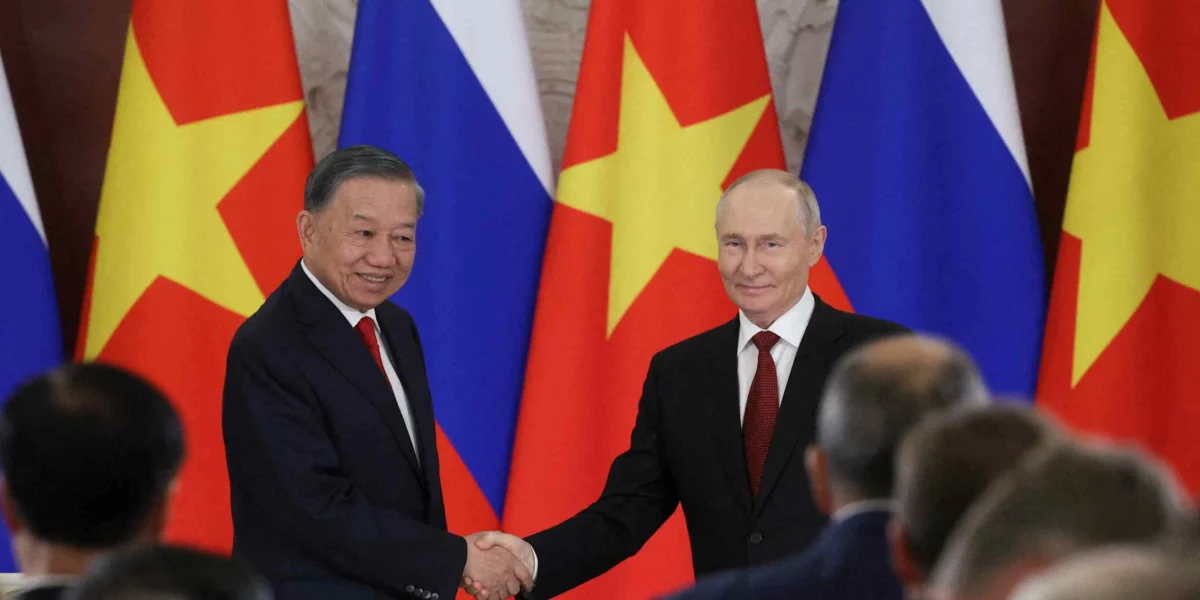
Russian President Vladimir Putin and Vietnamese Party General Secretary and President To Lam cemented a strategic deepening of energy cooperation, with a particular focus on nuclear power and oil and gas ventures, during high-level discussions in Moscow this week. The agreement, as reported by the Vietnam News Agency, signals Hanoi’s continued commitment to diversifying its energy sources and strengthening its long-standing ties with Russia, even as global geopolitical dynamics continue to evolve. The meeting, held at the Kremlin on September 9th, underscored the enduring nature of the Russia-Vietnam relationship, a partnership that has weathered numerous international storms and now appears poised for renewed collaboration in critical energy sectors.
The discussions between President Putin and President To Lam, who also holds the powerful position of General Secretary of the Communist Party of Vietnam, transcended mere diplomatic pleasantries, delving into concrete proposals for joint projects. While specific details of the energy agreements remain under wraps, the emphasis on nuclear power is particularly noteworthy. Vietnam has previously explored the possibility of developing a nuclear energy program, a complex and capital-intensive undertaking. Russia, through its state-owned nuclear corporation Rosatom, is a global leader in nuclear technology and construction, having successfully implemented projects in numerous countries. The renewed focus on this sector suggests that Vietnam may be closer than ever to realizing its nuclear ambitions, with Russia positioned as a key partner.
This renewed impetus for nuclear cooperation comes at a time when Vietnam is grappling with a rapidly growing energy demand driven by its robust economic expansion. The country has been a manufacturing powerhouse, attracting significant foreign investment, and this growth necessitates a stable and scalable energy supply. While Vietnam has made strides in renewable energy, particularly solar and wind, the intermittent nature of these sources presents challenges for baseload power generation. Nuclear power, with its consistent and low-carbon output, could offer a crucial solution to bridge this gap and support Vietnam’s long-term energy security objectives.
Beyond nuclear power, the agreement also highlighted continued collaboration in the oil and gas sector. Russia has been a significant player in Vietnam’s upstream and downstream oil and gas industry for decades, through companies like Zarubezhneft, which has a substantial presence in Vietnam’s offshore blocks. This ongoing partnership is vital for Vietnam’s energy independence and economic development. The reinforcement of these ties suggests a commitment to further exploration, extraction, and potentially joint refining or petrochemical projects.
Background and Chronology of Russia-Vietnam Energy Relations
The energy nexus between Russia and Vietnam is not a new phenomenon. Their relationship dates back to the Soviet era, when Moscow provided substantial technical and financial assistance to Vietnam’s nascent industrial sector. This included crucial support for developing its oil and gas industry. In the 1980s, Soviet geologists played a pivotal role in discovering and developing Vietnam’s first major offshore oil fields in the South China Sea, primarily through the Vietsovpetro joint venture, which remains a cornerstone of Vietnam’s energy production.
The post-Soviet era saw a continuation and evolution of this partnership. Despite initial economic challenges in Russia, cooperation persisted, albeit with adjustments. Zarubezhneft’s investments in Vietnam became increasingly prominent, securing concessions and expanding production. The potential for nuclear energy was first seriously explored in the early 2000s, with Vietnam signing a cooperation agreement with Russia on the peaceful uses of atomic energy in 2001. This led to feasibility studies and discussions regarding the construction of Vietnam’s first nuclear power plants. However, the Fukushima Daiichi disaster in Japan in 2011 prompted a reassessment of nuclear safety concerns globally, and Vietnam, like several other nations, temporarily shelved its nuclear ambitions.
The current agreement signals a potential resurgence of these plans. The meeting between Putin and To Lam occurred during a period of heightened geopolitical tension, with Russia facing unprecedented sanctions and international isolation following its invasion of Ukraine in 2022. For Vietnam, maintaining strong economic and strategic partnerships is paramount. The country has historically pursued a non-aligned foreign policy, seeking to balance its relationships with major global powers. Its decision to deepen ties with Russia, particularly in the energy sector, can be viewed within this broader strategic context.
Supporting Data and Emerging Trends
Vietnam’s energy landscape is characterized by a rapidly expanding demand. According to the International Energy Agency (IEA), Vietnam’s electricity consumption has grown at an average annual rate of over 10% in the past decade. This growth is projected to continue, driven by industrialization, urbanization, and a rising middle class.
The country’s energy mix is currently dominated by coal, which accounts for a significant portion of its electricity generation. However, Vietnam has pledged to reduce its reliance on coal and achieve net-zero emissions by 2050. This transition necessitates a diversification of its energy sources. While renewable energy, particularly solar and wind, has seen substantial growth, challenges remain in grid integration and storage.
Russia, on the other hand, possesses one of the world’s largest reserves of fossil fuels and is a leading exporter of oil, gas, and nuclear technology. Rosatom, its state nuclear corporation, has a robust portfolio of international projects and a reputation for expertise in reactor design, construction, and fuel supply. The company is currently involved in building nuclear power plants in several countries, including Turkey, Egypt, and Bangladesh.
The strategic importance of energy security for Vietnam cannot be overstated. As a rapidly developing economy, disruptions in energy supply can have severe economic consequences. Russia’s willingness to engage in long-term energy partnerships, including the transfer of advanced technology, offers Vietnam a pathway to enhance its energy independence and meet its growing needs.
Official Responses and International Reactions
The joint statement issued by the Kremlin and the Vietnamese Presidential Palace, though brief, emphasized the "strategic and comprehensive partnership" between the two nations and a shared commitment to "further strengthening mutually beneficial cooperation." The Vietnam News Agency quoted President To Lam as stating that Vietnam values its traditional friendship with Russia and is committed to deepening bilateral ties across various sectors. President Putin, in turn, reportedly expressed satisfaction with the progress of bilateral relations and highlighted the importance of continued collaboration in key areas like energy.
While official reactions from other countries are likely to be measured, the deepening of Russia-Vietnam energy ties will undoubtedly be observed closely by global powers. For the United States and its allies, who have imposed sanctions on Russia, such agreements highlight the ongoing efforts by Moscow to forge new economic and strategic partnerships. However, Vietnam’s independent foreign policy and its historical relationship with Russia mean that such developments are not entirely unexpected. The focus on nuclear energy may also attract attention from international bodies like the International Atomic Energy Agency (IAEA), which oversees nuclear safety and non-proliferation.
Broader Impact and Implications
The implications of this renewed energy cooperation are multifaceted. For Vietnam, it offers a potential solution to its escalating energy demands and a path towards greater energy security, particularly with the prospect of nuclear power. It also signifies a continued strategic alignment with Russia, providing Hanoi with a key partner in a complex geopolitical environment.
For Russia, these agreements are crucial for maintaining its international influence and economic relevance amidst Western sanctions. Deepening energy ties with countries like Vietnam allows Russia to secure export markets for its energy resources and technologies, thereby mitigating the impact of sanctions. It also serves as a geopolitical statement, demonstrating that Russia is not entirely isolated on the global stage.
The potential development of nuclear power in Vietnam, with Russian assistance, would represent a significant technological leap for the country. It would require substantial investment, rigorous safety protocols, and a skilled workforce. Successful implementation could pave the way for other nations in Southeast Asia to consider similar ventures, further reshaping the regional energy landscape.
However, challenges remain. The global energy market is volatile, and the long-term viability of any energy project depends on a complex interplay of economic, political, and technological factors. The international political climate surrounding Russia could also influence the pace and scale of these collaborations. Nevertheless, the commitment to deepen energy cooperation, particularly in the strategic realm of nuclear power, signals a deliberate and long-term strategic direction for both Russia and Vietnam. This partnership, forged in the crucible of shared history and evolving global dynamics, is poised to play a significant role in shaping Vietnam’s energy future and reinforcing Russia’s enduring international partnerships.
