

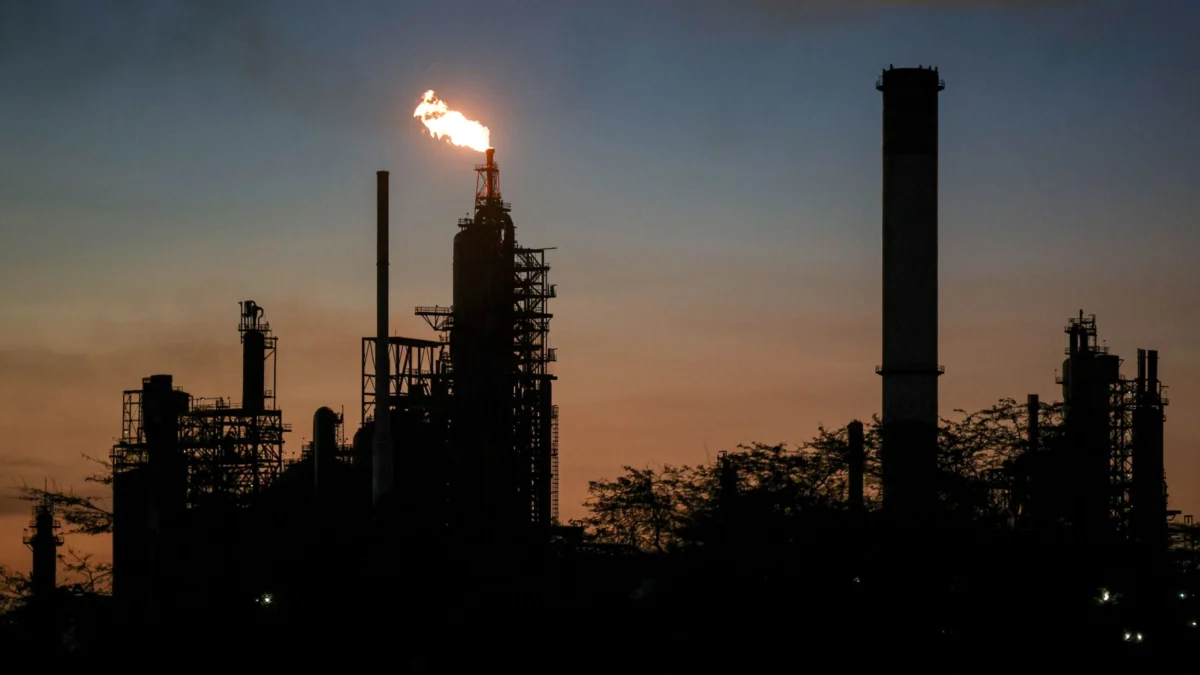
New York – In a significant geopolitical development, United States President Donald Trump announced that the U.S. has secured control over substantial oil reserves in Venezuela, amounting to over 65 billion barrels. This accord, disclosed by Trump on his social media platform Truth Social, represents a major shift in the long-standing economic and political dynamics between the two nations. Details regarding the specific terms of the agreement remain scarce, but the announcement signals a potential recalibration of U.S. energy policy and its engagement with the South American nation, which has been grappling with an economic crisis and political instability for years.
The alleged agreement comes at a critical juncture for Venezuela, a country possessing the world’s largest proven oil reserves. For years, Venezuela’s oil sector has been hampered by mismanagement, corruption, and the impact of international sanctions, leading to a dramatic decline in production. The Trump administration has been actively seeking to isolate Venezuelan President Nicolás Maduro’s government, imposing sanctions and backing opposition leader Juan Guaidó. However, this new development suggests a potential strategic pivot, moving beyond purely punitive measures to encompass resource acquisition.
Background: A Deepening Crisis and Shifting U.S. Policy
Venezuela’s economic collapse has been a complex, multi-faceted issue. Decades of reliance on oil revenue, coupled with policies implemented by the socialist governments of Hugo Chávez and Nicolás Maduro, have led to hyperinflation, widespread shortages of basic goods, and a mass exodus of its population. The U.S. has consistently condemned Maduro’s leadership, particularly following disputed elections and allegations of human rights abuses.

The U.S. government’s strategy had largely focused on exerting economic pressure through sanctions, aiming to force Maduro from power and facilitate a transition to a democratic government. Key actions included sanctions on Venezuela’s state-owned oil company, Petróleos de Venezuela S.A. (PDVSA), and designating Maduro himself as a target. Earlier in the year, U.S. special forces were reportedly involved in actions that led to the apprehension of Maduro, although official confirmation of the extent of this involvement and its immediate aftermath has been limited.
The initial charges against Maduro and his inner circle, including allegations of "narco-terrorism," underscored the U.S.’s intent to hold the Venezuelan leadership accountable. Critics at the time argued that such actions could violate international law, highlighting the delicate balance of sovereignty and intervention. This latest announcement of a resource-sharing agreement appears to represent a departure from the previous confrontational approach, hinting at a more pragmatic, resource-driven engagement.
Timeline of Key Developments: From Sanctions to a Resource Deal
The path leading to this purported oil deal can be traced through several key events:
- 2017-2019: The Trump administration significantly escalates sanctions against Venezuela, targeting PDVSA and individuals associated with the Maduro regime. The U.S. recognizes Juan Guaidó as the interim president of Venezuela, intensifying diplomatic pressure.
- Early 2024: Reports emerge of U.S. special forces operations in Venezuela, reportedly leading to the apprehension of Nicolás Maduro. These actions were part of a broader strategy to destabilize Maduro’s government and dismantle alleged criminal networks.
- Recent Announcement: President Trump declares a significant agreement granting the U.S. control over substantial Venezuelan oil reserves. This announcement, made via Truth Social, lacks immediate independent confirmation from Venezuelan authorities.
The precise timing and nature of the apprehension of Maduro, as well as the subsequent negotiation of this oil deal, remain subjects of limited public information. However, the sequence suggests a period of intense, behind-the-scenes diplomatic and possibly covert operations culminating in this announcement.

Quantifying the Gain: Over 65 Billion Barrels
President Trump stated that the agreement brings "more than 65 billion barrels of proven oil reserves" under U.S. control. This figure is substantial, especially when compared to the U.S.’s current domestic oil reserves. According to the U.S. Energy Information Administration (EIA), the United States possessed approximately 46 billion barrels of proven oil reserves at the end of 2024. This figure, however, includes both crude oil and condensate, a light hydrocarbon liquid recovered during oil and natural gas production.
The acquisition of an additional 65 billion barrels would more than double the nation’s proven reserves, significantly enhancing its energy security and potentially influencing global oil markets. Venezuela’s oil reserves are primarily heavy crude, which requires specialized refining processes. However, the sheer volume represents a strategic asset of immense value.

The U.S. has historically been a major importer of Venezuelan oil, a relationship that was severed due to sanctions. The potential resumption of oil flows, even if under a new ownership structure, could impact global supply dynamics and price stability.
Official Responses and Inferred Implications
Confirmation of the deal from Venezuelan authorities has not yet been forthcoming, adding a layer of uncertainty to the announcement. However, Trump’s statement indicated that the agreement was reached in consultation with Delcy Rodríguez, who has served as Venezuela’s executive vice president. The involvement of the private sector was also mentioned, suggesting a multi-pronged approach to the potential exploitation of these resources.

If confirmed, this deal implies a significant shift in U.S. foreign policy towards Venezuela. It moves beyond solely punitive measures and into a realm of direct resource management. This could be interpreted in several ways:
- Enhanced Energy Security: A substantial increase in proven oil reserves would bolster U.S. energy independence and provide a strategic buffer against global supply disruptions.
- Economic Leverage: Control over such vast reserves could give the U.S. considerable leverage in global energy markets and in its diplomatic relations with other oil-producing nations.
- Reconstruction and Stabilization: The potential exploitation of these reserves could, in theory, provide a pathway for Venezuela’s economic recovery, albeit under U.S. oversight. This could involve significant investment in infrastructure and production, creating jobs and generating revenue.
- Geopolitical Realignment: Such an agreement would fundamentally alter the geopolitical landscape of Latin America, potentially creating new alliances and tensions.
The involvement of the private sector suggests a model where U.S. companies might be tasked with reviving and managing Venezuela’s oil production. This could lead to significant investment in the country’s dilapidated oil infrastructure, a key factor in its production decline.

Broader Impact and Future Outlook
The long-term implications of this reported oil deal are far-reaching and complex. The U.S. has historically sought to promote democracy and stability in the Western Hemisphere. If this agreement is indeed finalized and implemented, it raises questions about the extent of U.S. involvement in Venezuela’s internal affairs and its commitment to democratic principles in the region.
Economically, a surge in U.S. oil reserves could lead to lower global oil prices, benefiting consumers and energy-intensive industries. However, it could also create new challenges for other oil-producing nations, potentially leading to market volatility and geopolitical realignments.

The situation in Venezuela remains precarious. The country’s political future, its ability to regain stability, and the welfare of its citizens are intertwined with the potential outcomes of this reported resource deal. The lack of immediate confirmation from Caracas, coupled with the complex history of U.S.-Venezuelan relations, suggests that the road ahead will be fraught with challenges and uncertainties.
Further developments will likely focus on the specifics of the agreement, the degree of Venezuelan government cooperation, and the role of international bodies. The global community will be watching closely to see how this significant shift in energy diplomacy unfolds and what its ultimate consequences will be for both nations and the broader international order. The prospect of securing such a vast quantity of oil reserves undoubtedly represents a strategic coup for the United States, but its ethical, political, and economic ramifications will be debated for years to come.
