

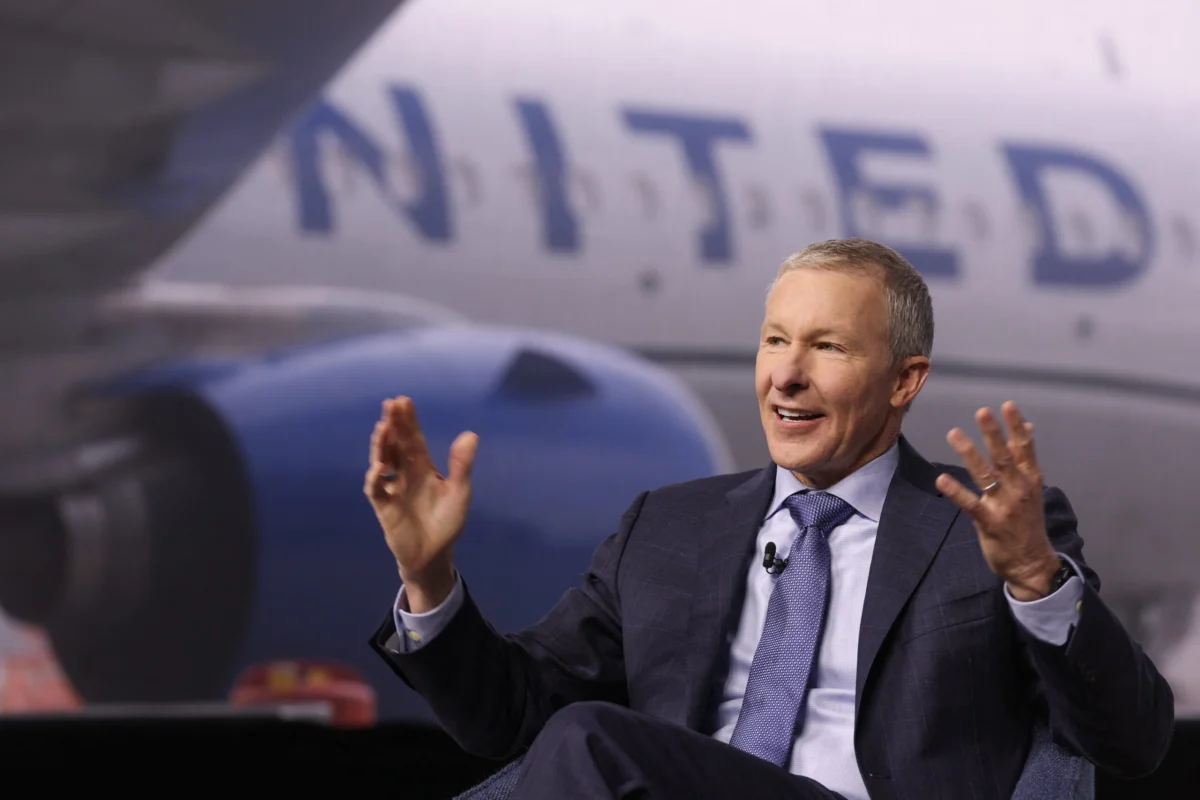
NEWARK, New Jersey – Scott Kirby, the outspoken CEO of United Airlines, emphatically states he does not believe in revenge, despite a career trajectory that has seen him rise to helm one of the world’s largest carriers after a high-profile departure from a rival. "Everyone thinks I do, but no, I don’t," Kirby asserted during a recent interview, reflecting on his dismissal from American Airlines a decade ago where he served as president. "I compete aggressively." This philosophy has defined his tenure at United, transforming it into the second-most profitable U.S. airline, trailing only Delta Air Lines, and notably surpassing his former employer, American, which now occupies a distant third among the major, century-old U.S. carriers.
Kirby’s journey to the top of United is a testament to his relentless drive and strategic acumen, marked by audacious proposals for mega-mergers with both Delta and American within the past year. These ambitious overtures, which would have consolidated some of the world’s largest airlines, have so far been rebuffed, and antitrust experts remain highly skeptical of their feasibility. Yet, Kirby’s vision extends beyond mere consolidation, encompassing a future where United dominates key international markets, expands its domestic footprint in strategic hubs like New York’s JFK, and leverages advanced technologies like artificial intelligence to redefine the passenger experience and operational reliability amidst an industry grappling with escalating costs, infrastructure constraints, and a burgeoning demand for premium travel.
A Rapid Ascent: From American’s President to United’s CEO
The saga of Scott Kirby’s career took a dramatic turn on August 29, 2016, a day etched in airline industry lore for its swift executive reshuffle. American Airlines disclosed Kirby’s departure from his role as president, and in what Kirby famously termed a "60-second" transition, United Airlines simultaneously announced his immediate appointment as its new president. "I joke that most people take a few weeks, a couple months between jobs. I took 60 seconds," Kirby recounted, highlighting the instantaneous nature of his move. This rapid transition underscored not only Kirby’s high demand but also the intense competitive dynamics within the U.S. airline industry.
At American, Kirby had been a key architect of the airline’s strategy following its merger with US Airways. However, a clear path to the CEO position eluded him, leading to his exit. Robert Isom, then American’s Chief Operating Officer, was promoted to president on the same day, eventually succeeding Doug Parker as American’s CEO in late 2021. Kirby’s experience at American, particularly his reflections on the limitations of a number two executive, profoundly shaped his approach at United. "One of the things also I learned at American: There’s only so much change you can make as the No. 2," he observed. "You can push too hard and you get fired."
Upon joining United in 2016, the airline was already embarking on significant cabin upgrades, including its high-end Polaris business class pods designed for long-haul international flights. However, Kirby’s immediate priority was a forensic review of United’s route network, meticulously identifying underperforming and unprofitable routes. This strategic overhaul was critical. He famously halted plans to close United’s bases at Los Angeles International Airport (LAX) and Washington Dulles International Airport (IAD), recognizing their critical importance. LAX remains one of United’s most vital hubs, handling millions of passengers annually, though no single carrier fully dominates the sprawling airport. IAD, particularly its recently unveiled $22.5 billion revamp, underscores its significance as a gateway, highlighted by Kirby’s meeting with President Donald Trump last month to showcase the investment.
Kirby’s leadership was tested profoundly when he was promoted to CEO in May 2020, at the height of the COVID-19 pandemic, arguably the worst crisis in aviation history. Guiding United through unprecedented travel restrictions, plummeting demand, and immense financial strain, he made a public vow to navigate the airline through the crisis, focusing on long-term resilience and employee welfare. This period, during which United faced billions in losses and implemented voluntary separation programs, forged his reputation as a decisive leader unafraid to make tough calls for the airline’s future while simultaneously planning for a post-pandemic recovery that would see United emerge stronger.
The Bold Pursuit of Scale: Mega-Mergers and Market Consolidation
Kirby’s strategic vision has always leaned towards scale, a characteristic evident in his recent proposals for industry-redefining mergers. Over the past year, he floated the idea of combining United with either Delta Air Lines or American Airlines, combinations that would create aviation behemoths dwarfing current market leaders. These discussions, first reported by The Wall Street Journal regarding Delta, were confirmed by sources familiar with the matter, who spoke on condition of anonymity. However, Delta swiftly rebuffed the overture, with its president, Peter Carter, publicly stating in June that a merger or acquisition was not in Delta’s future plans. Similarly, American Airlines publicly rejected United’s merger offer this spring. American CEO Robert Isom told CNBC in late June, "At the end of the day, we spend time looking at things that have a chance of happening. We don’t spend a lot of time pursuing impossibilities."
Kirby’s rationale for such ambitious mergers stems from the industry’s evolving landscape: ever-higher operating costs, constrained airport infrastructure, and a growing consumer willingness to pay more, particularly for premium travel. He maintains his stance, asserting that he is not interested in acquiring smaller carriers like JetBlue, a former American partner. "Everything I say would require a willing partner," Kirby clarified, acknowledging the bilateral nature of such colossal deals. This position underscores his focus on transformative, rather than incremental, growth.
The significant hurdles to such mergers are primarily regulatory. Stock analysts and legal experts have expressed profound skepticism regarding the likelihood of approval, citing severe antitrust concerns. The U.S. airline industry has already undergone a dramatic consolidation over the past two decades, with four major carriers – United, Delta, American, and Southwest – now controlling more than three-quarters of U.S. flight capacity. Notable mergers like United-Continental (2010), American-US Airways (2013), and Delta-Northwest (2008) significantly reshaped the landscape. Merging two of the "Big Three" would undoubtedly face fierce opposition from state attorneys general and federal regulators, who would likely view such a move as detrimental to competition and consumer choice, leading to higher fares and reduced service.
Kirby, however, counters these objections by arguing that "all of the objections are… based on a premise that the airline industry is a commodity." He contends that major carriers like United and Delta have successfully differentiated themselves through vast global networks, enhanced onboard products (such as premium cabins, in-flight entertainment, and Wi-Fi), and lucrative loyalty programs, moving beyond a simple commodity service. While this argument holds some merit in terms of customer experience, regulators often focus on market share concentration, pricing power, and route overlap, areas where mega-mergers would inevitably raise red flags, potentially leading to lengthy legal battles and eventual rejection.
Expanding Horizons: International Dominance and JFK Re-entry
United Airlines already holds the distinction of having the largest international footprint among U.S. carriers, a strategic advantage Kirby is determined to amplify. With U.S. tourists showing sustained high demand for global travel, United’s vast international network serves as a cornerstone for customer loyalty and enrollment in lucrative travel rewards credit card programs. This week, the airline is poised to make its annual splash with the announcement of a host of new international routes, following a tradition that has previously introduced exotic destinations like Ulaanbaatar, Mongolia, and Bilbao, Spain, to its network. Kirby’s team, aware of his propensity to prematurely reveal exciting news, now strategically withholds the full details of these Instagram-friendly routes until closer to the official announcement. "They no longer tell me in advance because they’re afraid I’ll spill the beans, which is fair," he admitted with a chuckle.
Beyond international expansion, Kirby is aggressively pursuing a larger presence at New York’s John F. Kennedy International Airport (JFK), a highly congested and strategically vital gateway. United’s return to JFK, anticipated as early as next year, is facilitated through a partnership with JetBlue Airways, notably American’s former partner. This alliance, formed after American dissolved its "Northeast Alliance" with JetBlue, provides United a crucial pathway back into a market it exited in 2004. "We got a bunch of irons in the fire to try to find ways to do it," Kirby stated, hinting at potential future acquisitions of slots from less profitable carriers operating out of JFK. This move is crucial for United to challenge Delta and American’s strongholds in the competitive New York market, where a robust presence across all major airports (JFK, Newark Liberty International, and LaGuardia) is essential for capturing premium corporate and leisure travelers.
The competitive landscape in international travel is fierce. While United boasts its extensive global network, Delta is actively challenging this dominance, particularly across the Pacific. Delta CEO Ed Bastian, a formidable rival, has explicitly stated his intent to compete aggressively in all markets. "People say, ‘Well, when is it someone else’s turn?’ Well, I’m never going to let that be someone else’s turn. It’s always our turn," Bastian declared at Columbia Business School in April 2024, signaling Delta’s unwavering commitment to maintaining its lead and expanding into United’s traditional strongholds. This rivalry, characterized by strategic route launches and fierce competition for premium passengers, ensures a dynamic and competitive environment, ultimately benefiting consumers with more choices and potentially better services.
Strategic Gaps and the Role of AI in Future Travel
Despite United’s impressive network, Kirby acknowledges strategic gaps, particularly in South America and the Southeast U.S., areas he deems "holes for United that are hard to fix on a stand-alone basis." He identifies Miami International Airport (MIA) as the optimal hub for serving South America, a market currently dominated by American Airlines, which held over 60% of passenger enplanements at MIA in the 2025 fiscal year. Filling these gaps through organic growth or a smaller, strategic acquisition, however, remains challenging given the scarcity of suitable airport infrastructure and slot availability, requiring creative solutions or further market consolidation.
Beyond network expansion, Kirby is a strong proponent of leveraging artificial intelligence (AI) to enhance both employee efficiency and customer experience. He envisions AI tools as critical for improving operational reliability, a perennial challenge for an industry susceptible to weather disruptions, air traffic control constraints, and mechanical issues. A core application of AI, according to Kirby, will be to provide customers with clear, plain-English explanations for delays, fostering transparency and trust. "I firmly believe in no excuses, and so we don’t make excuses," he stated, emphasizing a culture of accountability that seeks to mitigate the impact of unforeseen events rather than merely explaining them.
However, the path to perfect reliability is long and arduous. In the first half of 2026, United ranked behind Delta and Alaska Airlines (which recently merged with Hawaiian Airlines, expanding its Pacific network significantly) for on-time arrivals, according to the Transportation Department. This data underscores the complex operational environment airlines navigate daily and the continuous effort required to improve performance amidst a myriad of external and internal pressures. Kirby acknowledges that external factors and unforeseen crises will always challenge the industry, reinforcing his long-term focus on setting the company up for enduring success and stability, rather than chasing short-term metrics.
A Leader’s Philosophy: No Sleepless Nights, No Furloughs
Kirby’s leadership philosophy is rooted in a profound commitment to his employees. His ultimate goal is to never again have to implement furloughs, a painful measure common during industry downturns, most notably during the early days of the COVID-19 pandemic when thousands of airline workers faced job insecurity. "Our employees often ask me like, ‘What keeps you awake at night,’ and I tell them, ‘nothing,’" he shared. "My job is to set the company up so none of you ever have to have a sleepless night worrying about your jobs." This dedication to employee security and stability is a distinguishing feature of his leadership, aiming to foster a resilient and motivated workforce that feels valued and protected, contributing to higher morale and better service.
The executive ranks across the "Big Three" airlines often trace their roots back to earlier carriers like America West, reflecting a legacy of consolidation that has shaped the industry over the past two decades. Kirby’s experiences within these evolving structures have instilled in him a pragmatic understanding of the industry’s cyclical nature and the importance of strategic foresight. When questioned about his eventual retirement, Kirby responded with characteristic introspection: "I hope I will know when to retire and do it gracefully with a great transition with great people." This statement reflects a leader focused not just on immediate gains but on building a sustainable legacy for United Airlines, ensuring its continued prosperity and competitive edge in the dynamic global aviation market. His tenure, marked by aggressive growth strategies, a bold vision for the future, and a deep commitment to the airline’s long-term health, continues to significantly shape the trajectory of United Airlines and influence the broader aviation industry.
