

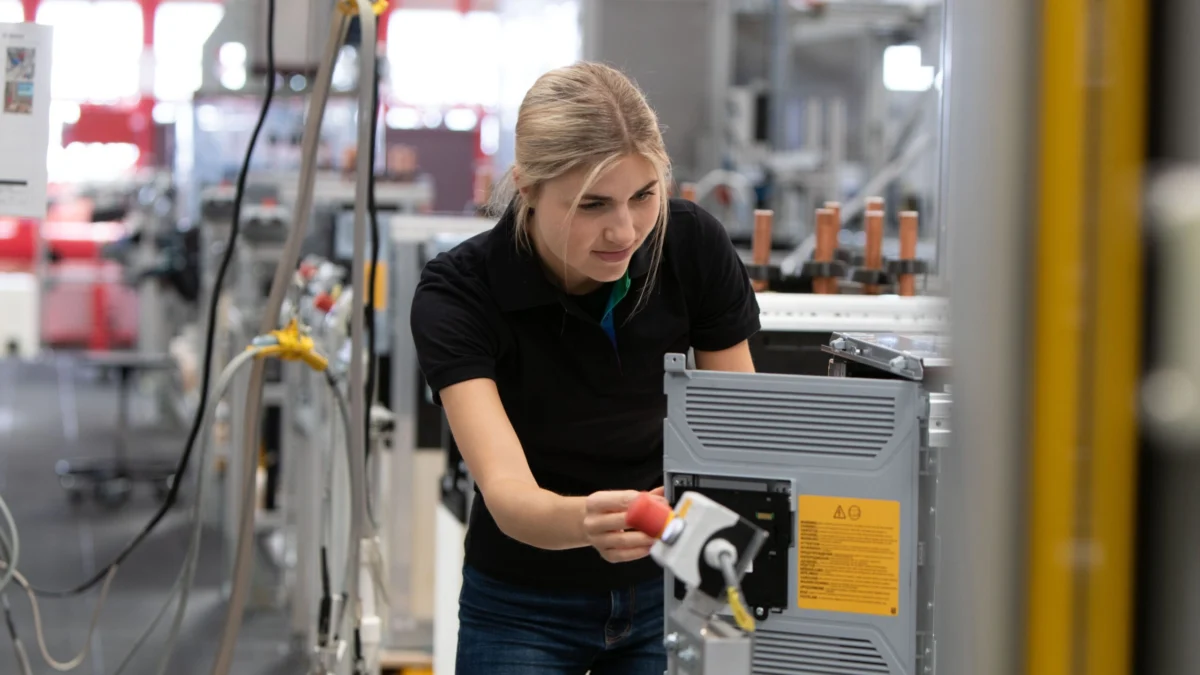
Berlin – Paul von Hagemeister, a 22-year-old master craftsman, embodies a practical approach to a future increasingly shaped by artificial intelligence. Having graduated from gymnasium in Munich with his Abitur in 2022, von Hagemeister consciously chose a career in the skilled trades, specializing in installing air conditioning systems, maintaining gas heating, and fitting heat pumps. He believes his chosen profession offers a level of job security that artificial intelligence, including rapidly evolving tools like ChatGPT, cannot easily displace. "When I started my apprenticeship, ChatGPT was still very new," he stated. "Nevertheless, job security in the age of AI was already a crucial factor in my career choice."
Von Hagemeister’s perspective is not an isolated one. Data from the Federal Institute for Vocational Training (BIBB) reveals a consistent upward trend in new apprenticeships within the skilled trades sector over the past three years, marking a significant recovery after a downturn during the COVID-19 pandemic. This positive trajectory is projected to continue, with approximately 67,800 young individuals signing new apprenticeship contracts in the trades during the first half of 2026. This represents a 4.9% increase compared to the same period in 2025, during which a total of 346,000 young people were engaged in qualified vocational training within the trades.
The German Confederation of Skilled Crafts (ZDH) also acknowledges the influence of AI development on this trend. ZDH President Jörg Dittrich commented, "Young people are recognizing that the skilled trades offer a real alternative if they desire a secure job." This sentiment arises as machine learning has already rendered human competencies redundant in numerous areas of professional life. AI can now generate complex code, handle accounting tasks, and create personalized customer offers, often at a significantly lower cost than human labor.

The impact of AI is particularly evident in the diminishing demand for entry-level academic positions. Junior roles in IT, legal, and accounting sectors are being filled less frequently. According to the Federal Employment Agency, job advertisements for university graduates saw an 8% decrease in 2025 compared to the previous year. The IT sector, a field heavily impacted by AI, experienced a notable 23% reduction in advertised positions.
The AI Disruption: A Shift in the Job Market
The rapid advancement of artificial intelligence is fundamentally altering the landscape of the global job market. While AI offers unprecedented opportunities for efficiency and innovation, it also presents significant challenges, particularly concerning job displacement. Tasks that are repetitive, data-driven, or follow predictable patterns are increasingly susceptible to automation. This has led to a growing concern among workers and policymakers alike about the future of employment.
The development of AI technologies has been accelerating over the past decade, with significant breakthroughs in areas like natural language processing, machine learning, and computer vision. Tools like ChatGPT, capable of generating human-like text and engaging in complex conversations, have brought the potential of AI into mainstream awareness. This has prompted a reevaluation of traditional career paths, especially those perceived as vulnerable to automation.
In the academic sphere, fields like law, accounting, and even certain areas of software development are experiencing a shift. The ability of AI to process vast amounts of legal documents, analyze financial data, and write code is leading to a reduction in the need for human professionals in entry-level roles. This phenomenon is not limited to white-collar jobs; AI is also impacting manufacturing, logistics, and customer service.

This shift has created a sense of uncertainty for many, particularly recent graduates and those early in their careers. The traditional assumption that a university degree guarantees a stable and prosperous career is being challenged. As a result, individuals are increasingly seeking career paths that offer greater resilience against technological disruption.
A Resurgence of the Skilled Trades
In contrast to the challenges faced by some academic professions, the skilled trades are experiencing a renewed surge in popularity. This resurgence is driven by a confluence of factors, including the perceived job security offered by hands-on, practical work, and the growing demand for essential services that cannot be easily automated.
Paul von Hagemeister’s decision to pursue a career in HVAC and heat pump installation exemplifies this trend. His work involves physical labor, problem-solving in real-world environments, and direct interaction with clients, all of which are less susceptible to AI automation than many desk-based jobs. The demand for skilled tradespeople is further amplified by societal needs, such as maintaining infrastructure, building and renovating homes, and transitioning to sustainable energy sources.
The German Confederation of Skilled Crafts (ZDH) has been actively promoting vocational training and highlighting the career opportunities available in the trades. Their efforts, coupled with the evolving perception of these professions, are contributing to the growing interest among young people. The ZDH’s statistics indicate a steady increase in apprenticeship contracts, underscoring the sector’s growing appeal.

The Economic Landscape: Industry Woes and Trade Opportunities
The current economic climate presents a complex picture for both industrial sectors and the skilled trades. While the broader industrial sector in Germany has been facing challenges, the skilled trades are demonstrating resilience and even growth.
The original article notes that approximately 4.9% more young people signed apprenticeship contracts in the trades in the first half of 2026 compared to the same period in 2025. This indicates a robust demand for skilled labor. In 2025, 346,000 young individuals were enrolled in qualified vocational training programs within the trades.
Conversely, the industrial sector has seen a decline in new apprenticeship contracts. The article states that in 2025, 4.6% fewer apprenticeship contracts were offered in industry and trade compared to the previous year. This trend is attributed to the ongoing economic and industrial crisis affecting Germany. Experts like Harald Gerster, a vocational training specialist at the Munich and Upper Bavaria Chamber of Crafts, predict that this industrial downturn will eventually impact trades that supply the industry, such as precision mechanics and metalworkers. This economic reality may be influencing career decisions, prompting some individuals to consider more stable vocational paths.
Climate Policy as a Catalyst for Trade Growth
Beyond the immediate impact of AI, the green transition and climate policy are emerging as significant drivers for growth in the skilled trades. Innovations in environmental technologies, such as solar energy, heat pumps, and climate control systems, are creating new job opportunities and increasing the demand for skilled professionals.

Harald Gerster highlights that "before AI, the topic of the energy transition was the big draw." This sentiment is echoed by young individuals who are drawn to trades that allow them to "make the world a better place." The prospect of contributing to a sustainable future through work in heating technology or renewable energy installations is a powerful motivator.
The German Federal Ministry for the Environment, in its climate protection program introduced in early 2026, also points to job opportunities within the trades stemming from federal climate measures. These include incentives for building renovations, heating system replacements, and the installation of electric vehicle charging stations. These growing sectors are expected to see a significant increase in demand for skilled labor in the coming years.
The Evolving Profile of Trade Apprentices
A notable shift in the demographics of trade apprentices is the increasing proportion of individuals with higher education entrance qualifications (Hochschulreife). Twenty years ago, only about five percent of new apprentices held such qualifications. By 2025, this figure had risen to nearly 16 percent, according to ZDH data. This indicates that a growing number of students who could pursue university degrees are opting for vocational training instead, seeking the perceived stability and practical fulfillment of a trade.
This trend reflects a broader societal reevaluation of educational pathways. The traditional hierarchy that placed university degrees above vocational training is being challenged. The "Aufstiegs-Bafög" (a federal funding program for continuing vocational education and training) and the harmonization of vocational qualification titles with academic degrees are initiatives aimed at enhancing the comparability and prestige of trades.

Expert Perspectives on Future Career Paths
Professionals in career counseling and education offer insights into the evolving job market and the considerations young people face. Thomas Müller, a career counselor at the Employment Agency in Regensburg, observes that the pressure to attend university remains high, particularly within academic families. He notes that "prejudices about skilled trades often stem from outdated knowledge." Müller emphasizes the importance of adaptability and flexibility in today’s job market, acknowledging that professions once considered job guarantees may soon be obsolete due to technological advancements.
Müller encourages young individuals to make informed career decisions while remaining aware of potential risks. He refrains from making direct recommendations but sees long-term positive prospects for the skilled trades, stating, "Craftsmanship has a future."
Mathias Albert, a political scientist and youth researcher at Bielefeld University, points out the growing anxiety among professionals in fields like law, who previously felt secure. "Most people with a state law examination did not suffer from great fears of decline," he stated. "Suddenly, they are confronted with the possibility of completely losing their value. This is a completely new experience." Albert predicts that this trend will continue as technology advances, forecasting a slight decline in academic entry-level positions in the coming years, though still from a high baseline. He concludes, "One needs to worry the least about people with intermediate educational qualifications who can and want to pursue vocational training in the trades."
The Future of Work: Adaptability and the Enduring Value of Skills
The interplay between technological advancement, economic shifts, and evolving societal values is reshaping career trajectories. While artificial intelligence presents challenges to traditional employment models, it also creates new opportunities and highlights the enduring importance of practical skills and human ingenuity.

The rise in popularity of the skilled trades is a testament to the resilience and adaptability of the labor market. As AI automates routine tasks, the demand for professions that require critical thinking, complex problem-solving, manual dexterity, and interpersonal skills is likely to grow. The trades, with their emphasis on tangible results and direct impact, are well-positioned to thrive in this evolving landscape.
For young individuals like Paul von Hagemeister and Rick Ziehm, the choice of a career in the skilled trades represents a pragmatic and forward-looking decision. It is a path that offers not only job security but also the opportunity to contribute meaningfully to society, particularly in the crucial areas of sustainability and infrastructure development. As the world continues to grapple with the implications of AI and climate change, the value of skilled craftsmanship is poised to become even more pronounced. The ongoing success of the trades underscores the fundamental truth that while technology may advance, the need for human skill, dedication, and practical expertise remains indispensable.
