

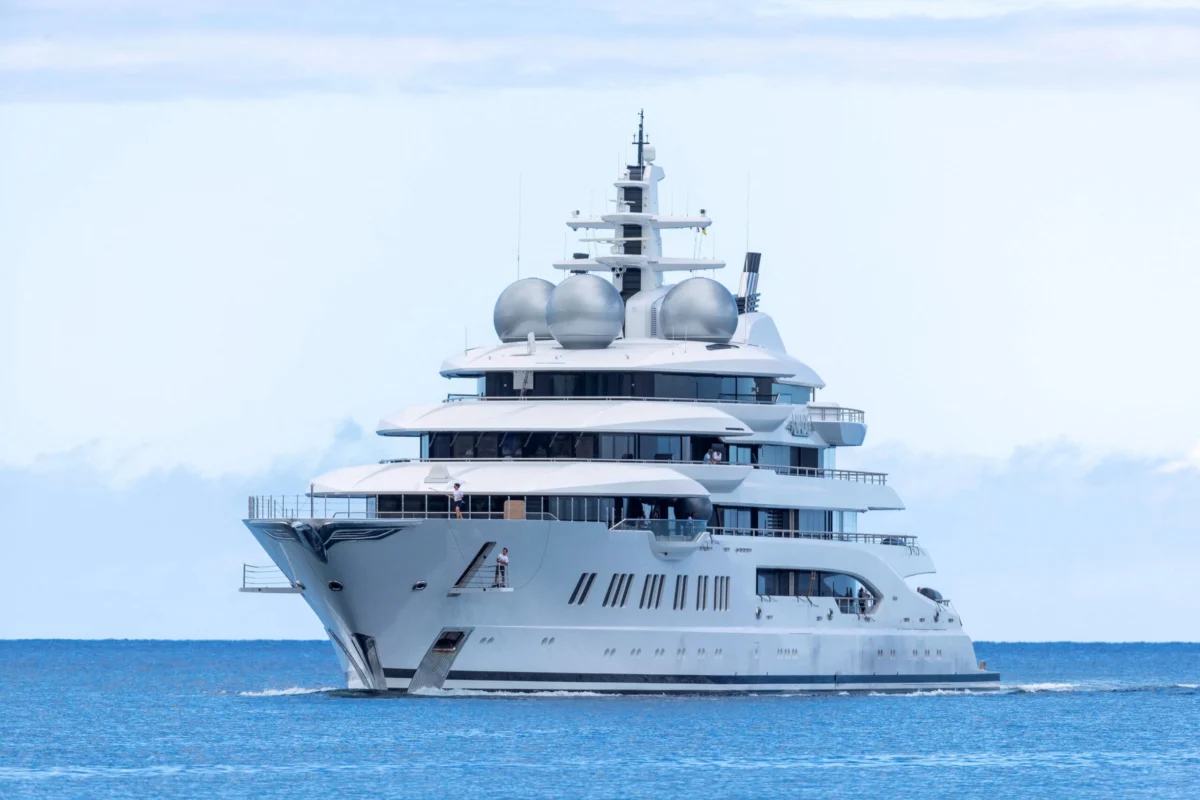
A megayacht, once estimated to be worth over $300 million, has been successfully sold by the U.S. government for $187 million to an Emirati billionaire whose family maintains a prominent business partnership with the Trump Organization. This high-profile transaction, involving the 348-foot luxury vessel Amadea, marks a significant development in the ongoing efforts by federal authorities to seize and liquidate assets belonging to sanctioned Russian oligarchs following Russia’s full-scale invasion of Ukraine. The sale’s details, including the buyer’s identity and the final price, remained undisclosed by the government for a period, fueling speculation within yachting and political circles, until government documents and industry executives brought the information to light.
The Sale: A High-Profile Transaction Amidst Geopolitical Tensions
The Amadea, a symbol of extreme wealth and, more recently, geopolitical tension, was a prized asset in the U.S. government’s crackdown on Russian illicit finance. Seized by federal authorities in 2022, the yacht became the subject of a protracted legal battle that spanned several years and continents. Ultimately, following a forfeiture order from a U.S. District Court judge, the vessel was put up for auction by the Justice Department. The final sale price of $187 million, while substantial, was considerably lower than some earlier valuations, raising questions about the efficacy and financial outcomes of such asset seizures.
The buyer was identified as Abbas Sajwani, the 27-year-old son of Dubai-based real estate magnate Hussain Sajwani. The Sajwani family’s company, DAMAC Properties, is a well-known entity in the global luxury real estate market and has established a significant partnership with the Trump Organization, including the development of Trump-branded golf courses in the Middle East. This connection has added another layer of intrigue to the Amadea’s sale, drawing attention to the intersections of international business, high finance, and political affiliations.
The Buyer: Abbas Sajwani and DAMAC’s Enduring Trump Ties
Abbas Sajwani, at 27, is a rising figure in the global real estate and investment landscape. As the head of AHS Properties, he has been actively involved in high-profile luxury developments in Dubai, including the acquisition of the Shangri-La Hotel for an reported $300 million and ambitious projects along the Dubai Water Canal. Forbes estimates his personal net worth at $1.9 billion, placing him among the world’s youngest billionaires. His acquisition of the Amadea is not merely a purchase but a statement, reflecting his taste for ultra-luxury assets and his family’s continued prominence.
The Sajwani family’s ties to the Trump Organization are extensive and well-documented. Hussain Sajwani, Abbas’s father, has been dubbed the "Donald of Dubai" due to his opulent real estate ventures and his close association with former U.S. President Donald Trump. Their partnership dates back to 2013, when DAMAC Properties entered into an agreement with the Trump Organization to develop the first Trump-branded golf course in the Middle East, which officially opened its doors in 2017. This collaboration saw DAMAC pay millions in upfront fees and subsequent management fees to the Trump Organization. Plans for a second Trump-branded golf course with DAMAC have been initiated but are currently delayed.
Hussain Sajwani has also been a visible supporter of Donald Trump. He notably appeared with President Trump at Mar-a-Lago in January 2024 to announce a $20 billion investment in U.S. data centers by one of Sajwani’s companies. During this press conference, Trump lauded Sajwani as "one of the most respected business leaders in the Middle East and indeed the world." Furthermore, in April 2025 (likely a typo, assumed 2024), Hussain Sajwani shared photos of a breakfast at the White House, where he was seen mingling with other influential figures, including Elon Musk. These sustained connections underscore a deep and ongoing business relationship that has, at times, drawn scrutiny due to its proximity to U.S. political power. Neither Hussain Sajwani, Abbas Sajwani, nor DAMAC responded to requests for comment regarding the Amadea acquisition. The Department of Justice and the White House also declined to comment on the matter.
Amadea’s Tumultuous Journey: From Seizure to Auction
The story of the Amadea’s sale is inextricably linked to its tumultuous journey under U.S. government custody. Built by the renowned German shipyard Lurssen in 2017, the Amadea is a marvel of maritime engineering and luxury design, boasting six decks, accommodation for 16 guests and 36 crew members, and an array of lavish amenities. These include a glass "winter garden," an infinity pool with a swim-up bar, a movie theater equipped with motion seats for a "4D experience," a party deck with integrated speakers, lights, and laser beams, and a spa featuring a hammam, sauna, and chromotherapy pool. A unique feature is its five-ton stainless-steel sculpture of an albatross figurehead gracing the bow, alongside a lobster tank in the galley for fresh seafood.
Task Force KleptoCapture and Sanctions:
The Amadea’s fate was sealed in the broader context of international sanctions against Russia. In response to Russia’s full-scale invasion of Ukraine in February 2022, the Biden administration launched "Task Force KleptoCapture," an interagency law enforcement task force designed to enforce the sweeping sanctions imposed on Russian oligarchs and entities. The task force’s mandate was to seize assets, including luxury yachts, private jets, and real estate, belonging to individuals identified as facilitators of the war or beneficiaries of the Russian state.
The Justice Department alleged that the Amadea was beneficially owned by Suleiman Kerimov, a prominent Russian mining tycoon who had been under U.S. sanctions since 2018 for alleged money laundering and corruption. These sanctions were part of a wider effort to pressure the Russian elite and isolate the country’s economy. The seizure of the Amadea in June 2022 off the coast of Fiji represented one of the highest-profile and most complex operations undertaken by Task Force KleptoCapture, testing the legal and logistical capabilities of the U.S. government in international waters.
The Legal Battle and Cost of Custody:
Following its seizure, the Amadea was sailed by a newly hired crew, under U.S. authority, from Fiji across the Pacific to San Diego, California. There, it remained docked in San Diego Bay for three years, becoming an expensive and high-maintenance ward of the state. The legal battle over its ownership was intense, with parties claiming beneficial ownership attempting to thwart the forfeiture process. These legal challenges added significantly to the time the yacht remained in government hands.
Maintaining a superyacht of the Amadea’s caliber is an incredibly costly endeavor. The U.S. government incurred expenses ranging from $600,000 to $1 million per month to cover crew salaries, insurance, docking fees, fuel, and ongoing maintenance. Over its three-year tenure under U.S. control, the estimated total cost to U.S. taxpayers for maintaining the Amadea reached approximately $36 million. This substantial expenditure highlighted the financial burden associated with enforcing sanctions and seizing high-value assets, prompting public debate on the cost-effectiveness of such operations.
The Auction Process and Valuation Discrepancies
After navigating the complex legal landscape, a U.S. District Court judge issued a forfeiture order, mandating the auction of the Amadea. The auction was officially ordered on September 10, 2024, with the actual sale taking place approximately a month later, overseen by the U.S. Marshals Service, an agency within the Justice Department. The Marshals Service is responsible for managing and selling assets seized by the U.S. government. Notably, the director of the Marshals Service at the time was Gadyaces Serralta, who had been appointed by President Trump and sworn in on August 1, 2024, weeks before the Amadea auction.

The auction itself was conducted through a sealed bid process, where interested parties submitted their offers confidentially to the Marshals Service, which then selected the winning bid. This method, while standard for government auctions of high-value assets, contributed to the lack of immediate transparency regarding the sale’s outcome.
Official Secrecy and Transparency Concerns:
The U.S. Marshals Service never publicly announced the winner of the auction or the final sale price. In a statement, a spokesperson for the Marshals Service explained, "The USMS does not routinely disclose or confirm the identity of the buyer when selling assets. That information is withheld under federal privacy exemptions unless ordered released by federal courts." This policy, while adhering to federal regulations, nonetheless sparked discussions about transparency, especially given the political sensitivities surrounding the asset’s origin and the buyer’s connections.
Adding to the complexity were the varying valuations of the Amadea throughout the legal process. When initially seized, Justice Department filings cited valuations ranging "between $300 million and $500 million," and also "more than $300 million." By 2024, a more recent independent valuation quoted by the Justice Department placed the yacht’s worth at $230 million. The final sale price of $187 million, while a significant sum, represented a considerable discount from these earlier estimates. Abbas Sajwani, in an interview with Forbes, claimed he had previously rejected an offer to sell Amadea "for much more, in the hundreds of millions," suggesting he believed the $187 million was a favorable acquisition. He also stated, without specifying how he knew, that his winning bid was only $1 million higher than the next highest offer, which underscores the competitive nature of the auction despite the lower-than-expected final price.
A New Chapter: Amadea Under Sajwani Ownership
Just a month after the $187 million sale, registration documents revealed that the Amadea was officially registered by Beyond Holding Group Ltd., a British Virgin Islands holding company. The company lists a headquarters address in Dubai that precisely matches that of DAMAC Properties, confirming the Sajwani family’s acquisition.
Under its new ownership, the Amadea has already begun a new chapter. Yacht tracking data from VesselFinder showed that after the auction, the superyacht sailed to Fort Lauderdale, Florida, and Charleston, South Carolina. Yacht industry executives indicated these trips were for minor repairs and upgrades, a common practice for newly acquired vessels to personalize them to the owner’s taste. One notable change immediately implemented by Abbas Sajwani was converting the helipad on the bow deck into a pickleball court, a unique modification reflecting contemporary leisure trends among the ultra-wealthy. The albatross figurehead, a distinctive feature, remains a prominent part of the yacht’s aesthetic.
In a June 2024 interview with Forbes, Abbas Sajwani offered a rare glimpse into his plans for the Amadea, anchored off the coast of Monaco. "I love the boat’s interior, I love the style," he shared, "It’s beautiful." He also revealed his unconventional approach to yacht ownership: "Many people say they go on a boat for a holiday. For me, it’s not the case. It’s more of a place to live." Indeed, he stated that when he’s not in Dubai, he often runs his real estate business from the Amadea, utilizing its advanced facilities and serene environment as a floating office and residence.
The Luxury Yacht Market in a Post-Pandemic World
The sale of the Amadea occurs within a booming global market for luxury superyachts. The pandemic era, paradoxically, fueled an unprecedented surge in demand for such vessels as ultra-high-net-worth individuals sought secluded and secure environments for leisure and business. With the number of billionaires worldwide now exceeding 3,500, and a finite number of elite shipyards capable of producing these bespoke vessels, demand has far outstripped supply. This has led to extensive waitlists for new builds and a significant appreciation in the value of pre-owned yachts.
According to Fraser Yachts, a leading brokerage, sales of pre-owned yachts measuring 30 meters or more saw a remarkable 36% increase in 2023, reaching a staggering $6.44 billion. This robust market context helps explain the competitive bidding for the Amadea, even if the final sale price was below the highest government valuations. The opportunity to acquire a relatively new, highly customized Lurssen yacht without the multi-year wait for a new build is a compelling proposition for discerning buyers in this exclusive market segment. Despite the current geopolitical uncertainties, Abbas Sajwani remains optimistic about the broader luxury market, stating in his Forbes interview that "The Dubai market is still very healthy, there’s a lot of demand," even as the Iran war has reportedly slowed parts of the region’s property sector.
Proceeds and Broader Implications
The U.S. government has yet to announce the specific use for the $187 million proceeds from the Amadea sale. However, a significant legislative development occurred in May 2024, when a U.S. aid package was signed into law. This legislation grants the government the authority to seize Russian state assets located within the United States and, crucially, to use the proceeds to benefit Ukraine. While the Amadea was a privately owned asset, its seizure was directly linked to the broader effort to impose costs on Russia for its aggression. The precedent set by this law opens the door for a clearer pathway for funds from such seizures to be directed towards Ukrainian reconstruction and humanitarian aid.
The sale of the Amadea highlights several broader implications. It underscores the challenges and complexities of enforcing international sanctions, from the initial seizure and the subsequent legal battles to the financial burden of maintenance and the ultimate disposition of the assets. While Task Force KleptoCapture has successfully seized billions in assets, the lengthy legal processes and operational costs can diminish the net recovery.
Furthermore, the transaction brings to the fore the intricate web of global finance and political connections. The sale of a sanctioned Russian oligarch’s asset to a billionaire whose family has close business ties with a former U.S. President inevitably raises questions about transparency, influence, and the perception of fairness in such high-stakes government actions. While no wrongdoing has been alleged, the optics of the situation warrant careful consideration in a journalistic context.
Conclusion: A Symbol of Shifting Wealth and Power
The Amadea, in its journey from a bespoke luxury creation for a Russian tycoon to a seized asset of the U.S. government, and now to the prized possession of an Emirati billionaire with significant political connections, serves as a powerful symbol of shifting wealth, geopolitical dynamics, and the complex enforcement of international law. Its story encapsulates the ambitions of the super-rich, the far-reaching consequences of global conflicts, and the persistent challenges faced by governments in navigating the intersection of finance, diplomacy, and justice. The $187 million sale marks not just the conclusion of a chapter for the U.S. government but the beginning of a new one for the Amadea and its prominent new owner, Abbas Sajwani, who now commands a vessel with a history as opulent and complex as its design.
