

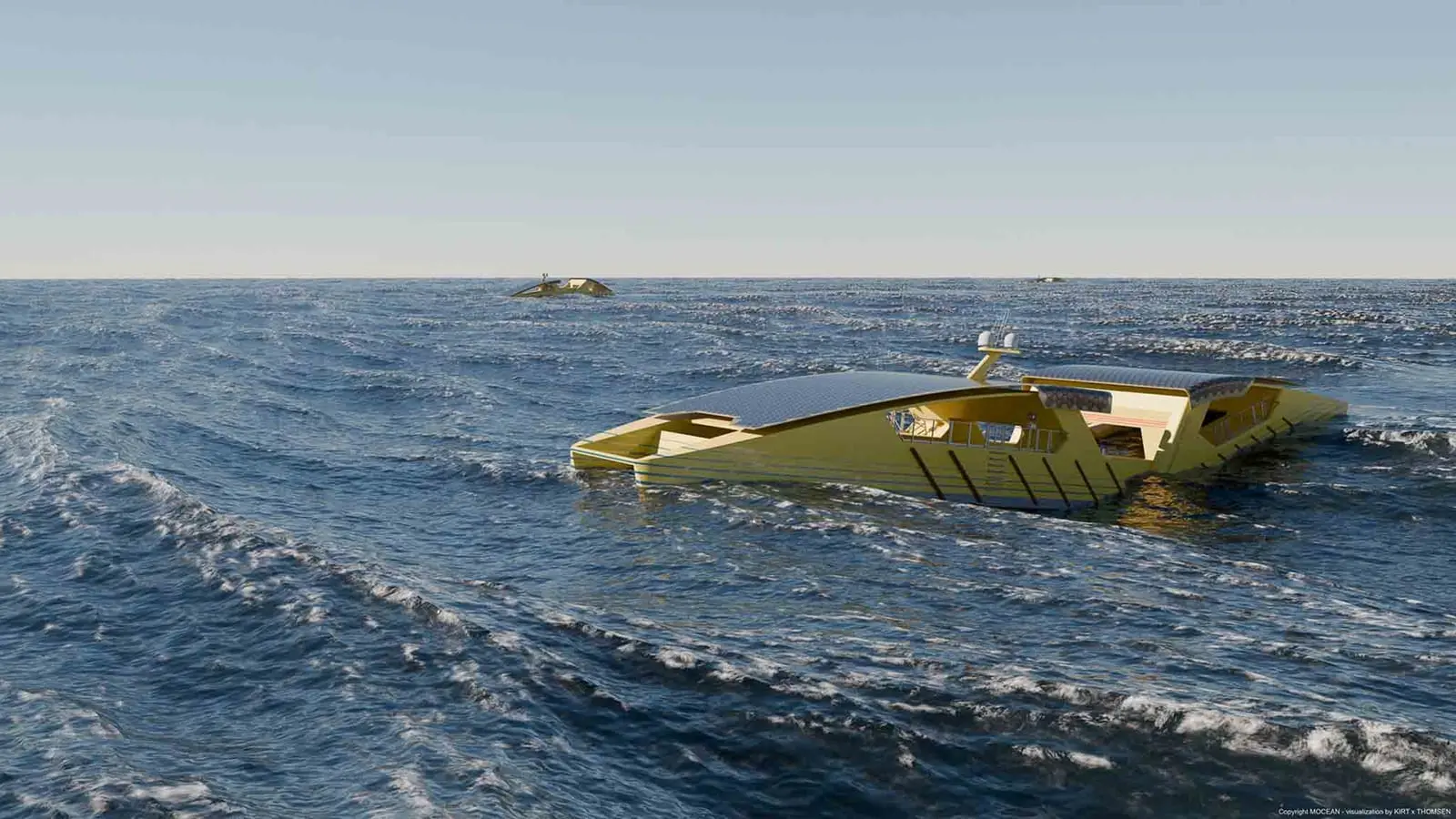
Edinburgh-based wave energy developer Mocean Energy has unveiled Blue Core, an ambitious offshore data center concept designed to address the escalating power, land, and environmental challenges currently facing the global artificial intelligence (AI) industry. Building on the company’s established Blue Star offshore power system, the Blue Core initiative seeks to provide a scalable, self-sustaining solution for AI-optimized computing by leveraging the untapped energy potential of the world’s oceans. The proposal involves modular, floating data center units equipped with independent wave-energy power supplies, sophisticated closed-loop cooling systems, and high-speed satellite connectivity.
The introduction of Blue Core comes at a critical juncture for the technology sector. As generative AI and large language models (LLMs) continue to proliferate, the infrastructure required to support them is reaching a breaking point. Onshore data centers are increasingly criticized for their massive consumption of grid electricity and local freshwater resources, often leading to significant regulatory hurdles and community opposition. Mocean Energy’s strategy is to bypass these terrestrial constraints entirely by moving the infrastructure to the sea, where energy is abundant and cooling is naturally efficient.
Technical Architecture and Modular Design
The Blue Core system is built around individual modular units, each capable of generating and managing its own power supply. According to technical specifications released by the company, these units are designed to provide between 500kW and 1MW of continuous power, derived from wave energy. These individual modules can operate independently or be clustered together to form massive "data farms," allowing for a flexible scaling model that can grow in tandem with a client’s computational needs.
One of the most significant technical hurdles for offshore infrastructure is data connectivity. To resolve this, Mocean Energy plans to utilize low-Earth orbit (LEO) satellite constellations. This approach ensures that the data centers can operate in deep-water environments far from the coastline, reducing the need for expensive and vulnerable subsea fiber-optic cables for all but the most latency-sensitive applications.
Maintenance and operational longevity are also addressed through the modular design. Unlike previous submerged data center experiments, the Blue Core units are designed to be floating assets. This allows individual modules to be disconnected and towed to shore for maintenance, hardware upgrades, or repairs without disrupting the operations of the surrounding farm. This "plug-and-play" architecture is intended to solve the reliability concerns that have historically plagued offshore energy and computing projects.
Revolutionizing Cooling and Resource Consumption
A primary driver for the offshore shift is the inherent thermal advantage of the marine environment. In traditional onshore data centers, cooling is a massive operational expense and environmental burden. Standard facilities typically allocate between 15% and 35% of their total energy budget toward thermal management. Furthermore, many facilities rely on evaporative cooling towers that consume millions of gallons of drinking water daily, a practice that has drawn sharp criticism in water-stressed regions.
Mocean Energy estimates that the Blue Core system will reduce the energy budget for cooling to approximately 5%. This is achieved through a closed-loop heat exchange system that utilizes the surrounding ocean as a massive, consistent heat sink. By exchanging heat with seawater through a sealed system, the technology eliminates the need for freshwater consumption and significantly lowers the Carbon Usage Effectiveness (CUE) and Power Usage Effectiveness (PUE) of the facility.
Managing Director of Mocean Energy, Cameron McNatt, emphasized that the technology is not merely a conceptual leap but a refinement of proven engineering. He noted that the company has spent years validating its wave-energy converters in some of the most volatile sea conditions globally. "Blue Core takes that same proven system and points it at a much bigger problem," McNatt stated. "AI data centers are going to need more power than the grid can easily give them, and the ocean can provide that. We’re not trying to build another data center. We’re trying to remove the barriers around power, land, and social licensing that are currently holding the industry back."
The Chronology of Offshore Computing and Mocean’s Development
The concept of offshore data centers has evolved through various experimental phases over the last decade. Mocean Energy’s Blue Core represents the latest iteration of this evolution, benefiting from the successes and failures of its predecessors.

- 2013–2020: The Submerged Era. Microsoft launched Project Natick, a high-profile experiment that involved sinking a sealed data center container to the seafloor off the coast of Scotland’s Orkney Islands. While the project proved that the nitrogen-filled, cold environment improved server reliability, Microsoft reportedly shelved the project as a commercial venture in mid-2024, likely due to the extreme difficulty of maintaining and upgrading submerged hardware.
- 2021: The Barge Model. Nautilus Data Technologies began operations of its Stockton 1 facility in California. Rather than submerging the servers, Nautilus used a repurposed 90-meter freight barge. This demonstrated the viability of using river or ocean water for cooling while keeping the hardware accessible above the waterline.
- 2023–2024: Wave Energy Validation. Mocean Energy’s Blue Star offshore power system completed 18 months of full-scale testing in harsh maritime environments. The system was tested alongside international energy supermajors, proving that wave-energy converters could provide reliable power to subsea equipment and autonomous vehicles.
- 2026 (Projected): The Japanese Pivot. A Japanese consortium, including NYK Line and NTT Facilities, is scheduled to launch a demonstration of a floating data center at the Osanbashi pier in Yokohama. This project will focus on salt damage mitigation and vibration stability, paving the way for wind-powered offshore facilities.
- 2028–2030: Commercialization Roadmap. Mocean Energy expects the first commercial sales of its Blue Star power system by 2028. Following this, the company aims to deploy its first Blue Core offshore demonstrator by 2030.
- 2035: Scaling to Gigawatt Capacity. Mocean has set a ten-year target to reach 6GW of installed capacity, coinciding with the period when global AI energy demand is projected to peak.
Economic and Environmental Drivers
The economic case for Blue Core is built on the rising cost of land and electricity. In major data center hubs like Northern Virginia, Dublin, and Singapore, the "social license" to operate is becoming harder to obtain. Governments are increasingly hesitant to approve new facilities that strain the local power grid or compete with residential areas for water.
Mocean Energy is currently raising £5 million in pre-Series A funding to accelerate the development of Blue Core alongside its existing offshore power business. The company argues that once the initial capital expenditure of a unit is covered, the marginal cost of power is effectively zero for the life of the asset. This "free" energy model could fundamentally alter the economics of AI training and inference, which are currently dominated by volatile energy prices.
From an environmental perspective, the implications are substantial. Mocean Energy estimates that by 2035, its offshore approach could save approximately 13 million tonnes (Mt) of CO2 emissions annually. This calculation is based on the displacement of fossil-fuel-heavy grid power with clean, renewable wave energy. As major tech firms like Google, Microsoft, and Amazon strive to reach "Net Zero" targets, the ability to decouple data growth from grid carbon intensity becomes a primary selling point.
Supporting Data: The Impending AI Energy Crisis
The urgency of the Blue Core project is supported by recent industry forecasts regarding AI’s energy appetite. According to various energy research reports, the global demand for AI-optimized computing is expected to quadruple by the mid-2030s.
- Projected Energy Consumption: AI data centers are expected to consume approximately 1,200 Terawatt-hours (TWh) per year by 2035. For context, this is roughly equivalent to the total annual electricity consumption of Japan.
- Cooling Efficiency: Onshore facilities spend billions on water treatment and infrastructure. A shift to a 5% cooling budget represents a potential multi-billion dollar operational saving across the industry.
- Grid Constraints: In several European and North American markets, data center applications are being placed on waitlists lasting up to a decade due to lack of grid capacity. The Blue Core concept bypasses this queue by generating power at the point of consumption.
Global Competition and Collaborative Efforts
While Mocean Energy is a frontrunner in wave-powered computing, it is part of a broader global movement toward maritime industrialization. Other players are exploring different power sources for floating data centers. For instance, the partnership between Karpowership subsidiary Kinetics and ammonia-to-power developer Amogy aims to create zero-emission "powerships" that can provide clean energy to floating data centers.
Similarly, Mitsui O.S.K. Lines (MOL) and other Japanese firms are exploring the retrofitting of existing vessels to serve as mobile data centers. These could be deployed to regions with temporary high demand or used as disaster-recovery infrastructure.
Mocean’s competitive advantage lies in its integration of the power source with the data facility. While other projects rely on external power ships or shore-based renewables, Blue Core is designed as a self-contained energy-plus-computing ecosystem.
Broader Impact and Industry Implications
The successful deployment of Blue Core could signal a paradigm shift in how the world views "the cloud." By moving infrastructure away from populated areas and into international or territorial waters, the industry may find a way to grow without the social and political friction currently hampering development.
However, challenges remain. The maritime environment is notoriously corrosive and physically demanding. While Mocean Energy has 18 months of testing data, scaling to a 6GW farm will require unprecedented levels of reliability in offshore robotics and automated maintenance. Furthermore, the legal and regulatory framework for "data islands" in international waters remains a complex area of maritime law that will need to be navigated as these facilities move from demonstrators to commercial reality.
As the 2030 demonstrator target approaches, the tech and energy sectors will be watching closely to see if wave energy can finally bridge the gap between renewable potential and the insatiable demands of the digital age. If Mocean Energy succeeds, the future of artificial intelligence may not be found on land, but floating on the horizon.
