

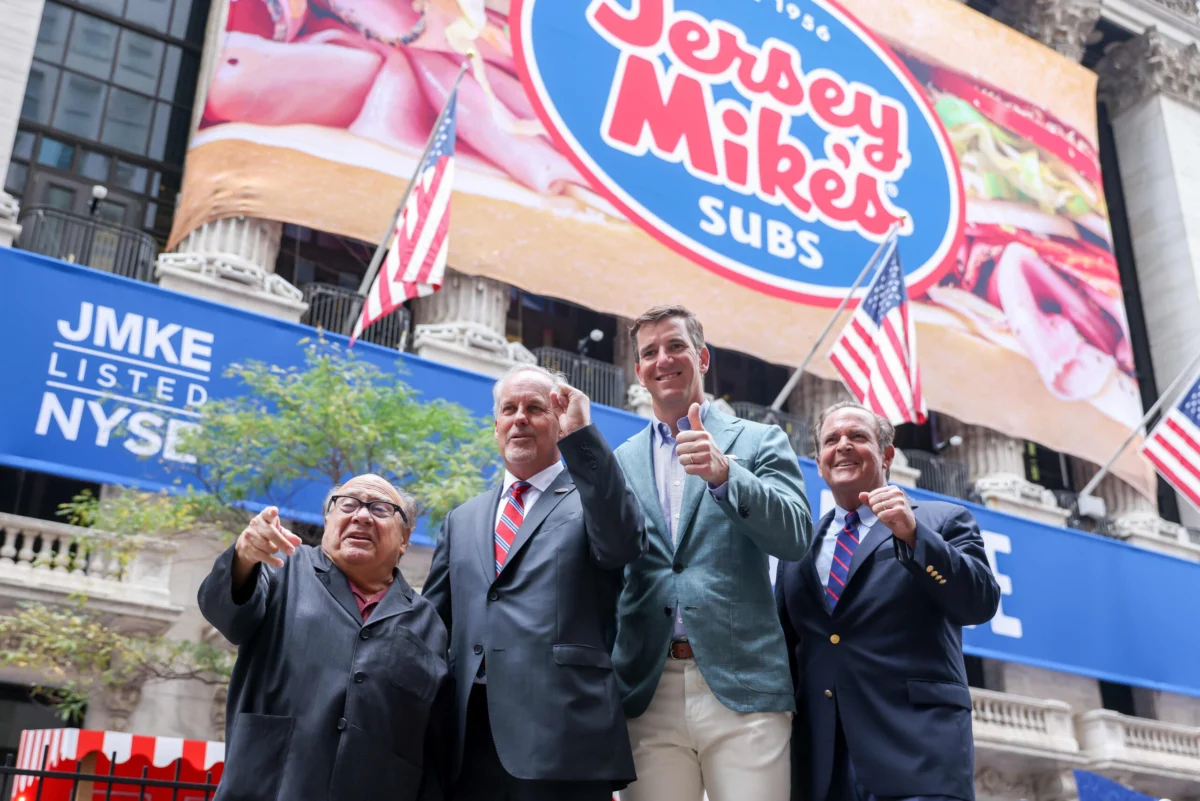
Jersey Mike’s Subs Inc. officially marked its transition to a publicly traded entity on Thursday, July 30, 2026, with its shares commencing trading on the New York Stock Exchange (NYSE) under the ticker symbol "JMKE." The highly anticipated initial public offering (IPO) saw the sandwich chain’s stock open at $21 per share, a notable dip below its initial pricing of $23 per share, which itself was set at the midpoint of the expected range of $21 to $25. Throughout Thursday afternoon trading, shares of Jersey Mike’s experienced a decline of approximately 3%, reflecting a cautious market reception to its public market debut.
The ceremonial bell-ringing at the NYSE was a star-studded affair, underscoring the brand’s growing profile. Gracing the podium were prominent figures including actor Danny DeVito, a New Jersey native whose presence added a touch of local celebrity endorsement; Charlie Morrison, the company’s chief executive officer; Eli Manning, the former National Football League (NFL) quarterback and a founding partner of Brand Velocity Partners, an investment firm with ties to the brand; and Peter Cancro, the visionary founder and chairman of Jersey Mike’s Subs Inc. This gathering highlighted the blend of corporate leadership, strategic investment, and cultural appeal that Jersey Mike’s has cultivated as it embarks on this new chapter.
A Significant Capital Raise in a Challenging Market
Despite the initial lukewarm stock performance, the IPO proved to be a substantial financial success for Jersey Mike’s. The company sold 43.5 million shares, successfully raising approximately $1 billion in capital. This transaction valued the company at an impressive $7.3 billion, positioning it among the largest-ever initial fundraises for a restaurant IPO. This achievement is particularly noteworthy given the broader economic environment, which has seen consumer spending on discretionary items, including dining out, face headwinds from inflation and economic uncertainty.
The restaurant industry, in general, has navigated a period of softened traffic and sales, with diners increasingly seeking value or opting to eat at home more often. However, Jersey Mike’s has demonstrated remarkable resilience, largely bucking these prevailing trends. Its robust financial performance and strategic business model have made it an attractive proposition for investors, even in a cautious market.
Understanding Jersey Mike’s Market Position and Financial Health
Jersey Mike’s has established itself as a formidable player in the quick-service restaurant (QSR) sector, particularly within the competitive hoagie and sub sandwich segment. With nearly 3,300 locations across the United States, it proudly holds the title of the second-largest hoagie sandwich chain, trailing only the ubiquitous Subway. Critically, its IPO catapults it to the position of the largest publicly traded chain in this category, offering investors a direct stake in a segment traditionally dominated by private entities.
The company’s financial health, as reported for the previous year, painted a picture of steady growth and profitability. Jersey Mike’s reported a net income of $55 million on total revenue of $724 million. A key indicator of its operational strength was the 3% increase in same-store sales over the same period. Same-store sales, a crucial metric in the retail and restaurant industries, tracks the sales growth at locations that have been open for at least one year, providing insight into the underlying health and customer appeal of the brand, rather than growth driven solely by new store openings. This positive trend underscores the brand’s ability to maintain customer loyalty and drive repeat business amidst a challenging economic backdrop.
Strategic Advantages: Franchise Model and Customer Demographics
A significant factor contributing to Jersey Mike’s appeal to investors is its highly efficient, asset-light franchise model. An overwhelming 99.2% of Jersey Mike’s locations are operated by franchisees, meaning the company primarily earns revenue from franchise fees and royalties rather than directly managing the operational costs and capital expenditures of individual stores. This model significantly reduces the company’s overhead, enhances its free cash flow generation, and allows for rapid, capital-efficient expansion. This operational structure, combined with high average unit volumes (the average sales generated per restaurant), presents a compelling investment case, indicating strong demand for its product and efficient store-level economics.
CEO Charlie Morrison shed light on another crucial element of Jersey Mike’s resilience: its customer base. In a post-IPO interview with CNBC, Morrison explained that Jersey Mike’s typically caters to a demographic that skews "a little higher income." This demographic characteristic has provided a significant buffer against the broader pullback in consumer spending, as these consumers are generally less impacted by inflationary pressures and economic uncertainties compared to lower-income segments. "We’re seeing the consumer come back," Morrison stated, adding, "We’ve seen positive transition growth. In fact, most of our same-store sales growth this year to date has been driven primarily by transaction growth." This indicates that not only are existing customers spending, but new customers are also being drawn to the brand, contributing to a robust organic growth trajectory.
The Journey from Local Shop to Public Giant: A Timeline
The story of Jersey Mike’s is one of humble beginnings and ambitious growth, deeply rooted in the entrepreneurial spirit of its founder, Peter Cancro.
- 1971: A 14-year-old Peter Cancro begins working at a local sandwich shop named "Mike’s Subs" on the Jersey Shore, learning the trade from the ground up.
- 1975: At just 17 years old, Cancro, with the help of his high school football coach, musters enough money to purchase Mike’s Subs. His youthful ambition and vision laid the groundwork for what would become a national phenomenon.
- 1987: Recognizing the potential for broader appeal, Cancro changes the name to Jersey Mike’s Subs and begins franchising the concept, aiming to share his authentic "Sub Above" experience with a wider audience.
- Late 2024: A pivotal moment in the company’s trajectory occurs when Blackstone, one of the world’s largest private equity firms, acquires a majority stake in Jersey Mike’s. This deal, reportedly valued at around $8 billion including debt, signaled the company’s readiness for a significant expansion phase and potential public offering. Blackstone’s involvement typically provides strategic guidance, operational expertise, and capital infusion necessary to scale a business and prepare it for the rigor of public markets.
- Post-Blackstone Acquisition: Following the Blackstone transaction, Charlie Morrison, a seasoned industry veteran, is appointed as Chief Executive Officer. Morrison brought with him a wealth of experience, having previously led Wingstop for over a decade, including steering the chicken wing chain through its own successful IPO. His appointment was a clear signal of Jersey Mike’s intent to professionalize its corporate structure and prepare for a public listing. Morrison himself drew parallels between the two companies, noting that like Wingstop, Jersey Mike’s is largely franchised and generates significant free cash flow, attributes highly valued by public market investors.
- July 30, 2026: Jersey Mike’s makes its public market debut on the New York Stock Exchange, marking the culmination of decades of growth and strategic planning.
The proceeds from the IPO are earmarked for strategic financial maneuvers, primarily to pay down existing debt and for general corporate purposes. This infusion of capital will provide Jersey Mike’s with enhanced financial flexibility to pursue its ambitious growth objectives.
Ambitious Global Expansion: The Next Frontier
With a strong domestic footprint, Jersey Mike’s is now setting its sights on aggressive international expansion, a strategy critical for sustaining long-term growth in a relatively mature U.S. market for hoagies. The vast majority of its current restaurants are concentrated within the United States, prompting the company to look beyond national borders for its next phase of development.
A testament to this global vision, Peter Cancro, who has wisely retained significant equity in the company, has personally signed a master franchise agreement to introduce Jersey Mike’s to the United Kingdom and Ireland. The master franchise model is a common and effective strategy for international expansion, where a single entity (the master franchisee) is granted the exclusive rights to develop and sub-franchise the brand within a specified territory. This approach leverages local market expertise and capital, accelerating market penetration while minimizing the franchisor’s direct operational burden.
Looking ahead, Jersey Mike’s harbors an incredibly ambitious long-term vision: to establish a global network of 15,000 restaurants worldwide. This colossal target is evenly split, with plans for half of these locations to be in the U.S. and the other half in international markets. Such a goal underscores the company’s confidence in the universal appeal of its brand and its operational model’s scalability. Charlie Morrison articulated the strategic advantage of public listing in achieving this goal, stating, "One of the benefits of being a publicly traded company on the New York Stock Exchange is that we get a lot of awareness of the brand, not only in the U.S., but also around the world." This increased visibility and credibility associated with a NYSE listing can significantly aid in attracting international partners and customers.
Broader Market Implications and Competitive Landscape
Jersey Mike’s successful IPO, even with its initial trading fluctuations, is widely seen as a positive harbinger for other consumer companies contemplating going public. It demonstrates that strong brands with robust fundamentals and clear growth strategies can still attract significant investor interest, even when the broader IPO market sentiment remains somewhat cautious.
The restaurant industry is particularly abuzz with similar activity. Rival restaurant conglomerate Inspire Brands, a powerhouse that owns popular chains such as Dunkin’ and Jimmy John’s, has already confidentially filed for its own initial public offering. Industry observers suggest that Inspire Brands, given its diverse portfolio and substantial scale, could easily snatch Jersey Mike’s title for the biggest-ever restaurant IPO. This impending competition highlights a dynamic period for the QSR and fast-casual sectors, as successful private entities seek to leverage public capital for further expansion and market dominance.
Beyond the restaurant sector, other consumer-focused companies are also testing the waters. The clothing company Reformation, for instance, also made its public market debut on the same Thursday, pricing its shares at $15, which was at the low end of its expected range of $15 to $17. This simultaneous activity underscores a broader trend of consumer brands seeking public capital, albeit with varying degrees of initial market enthusiasm.
Investor Outlook and Future Challenges
For investors, Jersey Mike’s presents a compelling narrative of a proven brand with significant growth runway. Despite the initial dip, market analysts will likely focus on the company’s strong unit economics, its resilient performance in a challenging market, its experienced leadership, and its ambitious yet clearly articulated global expansion strategy. The asset-light franchise model minimizes capital risk for the parent company while maximizing scalability, a combination often favored by institutional investors.
However, the path forward is not without its challenges. Jersey Mike’s will need to skillfully navigate intense competition within the QSR space, manage the inherent volatility of consumer spending, and meticulously execute its ambitious international expansion plans. Maintaining brand consistency and operational excellence across a rapidly expanding, globally diverse franchise network will be paramount. The company’s ability to adapt its menu and marketing strategies to diverse international palates while preserving its core "Sub Above" identity will be a critical determinant of its long-term success.
In the long run, initial trading performance often serves as merely a snapshot. The true measure of Jersey Mike’s IPO success will be its sustained ability to deliver on its growth promises, maintain profitability, and generate consistent value for its shareholders as it transitions from a high-growth private entity to a mature public company with global aspirations. The journey has just begun for Jersey Mike’s on the world stage of public markets.
