

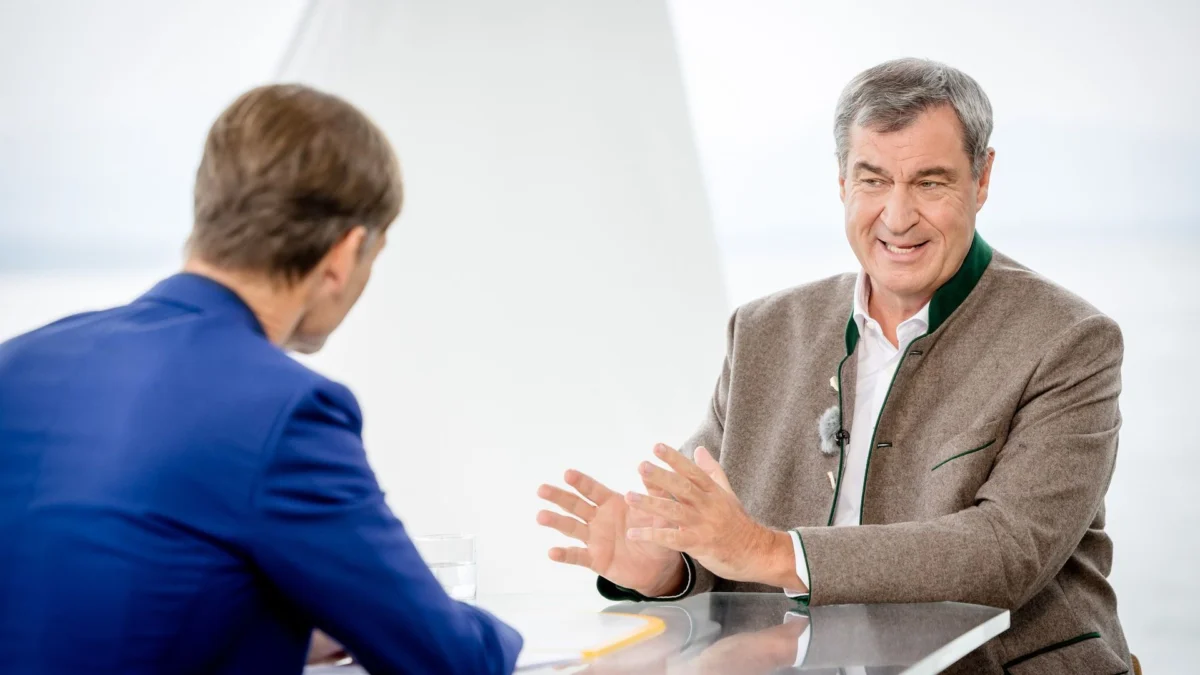
The CSU leader shows understanding for the cabinet reshuffle in Berlin in the ZDF interview and does not want to break down the firewall to the AfD. He compares the job of Chancellor to that of a football coach.
Berlin – In a wide-ranging interview with ZDF at the scenic Starnberger See, Bavarian Minister-President Markus Söder, also the leader of the Christian Social Union (CSU), articulated his views on the current political landscape in Germany. The interview, conducted against the backdrop of the upcoming Tutzinger Fischerhochzeit, a traditional celebration where Söder serves as patron, touched upon the recent cabinet reshuffling in Berlin, the persistent threat of right-wing extremism, and his party’s stance on political alliances.
Reflections on Berlin’s Cabinet Reshuffle and Political Strategy

Söder acknowledged the recent changes within the federal government, expressing a degree of understanding for the rationale behind such moves. While not explicitly detailing which specific personnel shifts he found justifiable, his comments suggest an acceptance of the dynamic nature of political leadership and the necessity for governments to adapt. This perspective aligns with a pragmatic approach to governance, where adjustments are made to address evolving challenges and maintain public confidence. The federal government, led by Chancellor Olaf Scholz, has faced significant pressure in recent months due to a variety of domestic and international issues, prompting speculation about the need for strategic recalibrations. Söder’s measured response indicates a recognition of these pressures without overtly criticizing the federal coalition’s actions.
A significant portion of Söder’s remarks centered on the CSU’s steadfast policy regarding political engagement with the Alternative for Germany (AfD). He unequivocally stated his refusal to dismantle the "Brandmauer" – the political firewall erected by mainstream parties to prevent cooperation with the far-right AfD. This stance is crucial to the CSU’s identity and its positioning within the broader conservative spectrum. Söder’s commitment to this principle underscores a broader concern within the established political parties about the potential normalization of extremist ideologies and their influence on democratic discourse. The CSU, in particular, has sought to differentiate itself from the AfD, often emphasizing its commitment to conservative values rooted in Christian traditions and a strong adherence to democratic norms.
Söder’s analogy of the Chancellor’s role to that of a football coach offered a colorful, yet insightful, perspective on the demands of high-level political leadership. He suggested that a successful Chancellor, much like an effective coach, must possess the ability to motivate their team, make difficult strategic decisions, and adapt to changing game conditions. This implies a focus on leadership qualities such as decisiveness, team building, and strategic foresight. The metaphor also hints at the immense pressure and constant scrutiny faced by the head of government, who must balance the needs of various coalition partners, manage public expectations, and navigate complex policy challenges. In the context of a coalition government, the Chancellor’s role is particularly challenging, requiring a delicate balance of consensus-building and firm direction.

Addressing the Shadow of Extremism: The Berlin Attack and its Implications
The interview also addressed the deeply disturbing attack that occurred at the Christopher Street Day (CSD) celebration in Berlin shortly before the recording. Söder condemned the act as a "deliberate attack on the idea of freedom in our country," emphasizing that such violence must be met with the utmost severity. This strong condemnation reflects a broader societal shock and a call for decisive action against religiously or ideologically motivated extremism. The incident, which led to multiple injuries, has reignited debates about migration policies, security measures, and the underlying causes of radicalization.
While acknowledging the gravity of the situation, Söder also cautioned against allowing such acts to erode the fundamental freedoms and the spirit of openness that characterize German society. His statement, "We must not let our entire joy of life be taken away from us because of this," serves as a plea to maintain resilience and to resist the impulses that extremist violence seeks to sow. This sentiment highlights a tension between the immediate need for enhanced security and the imperative to preserve the liberal democratic values that extremists seek to undermine. The challenge for policymakers, as Söder implicitly suggests, lies in finding the right equilibrium between robust security measures and the safeguarding of civil liberties.
The investigation into the Berlin attack is ongoing, with initial indications pointing towards a religiously motivated perpetrator. The CSU, and Söder in particular, have often advocated for stricter migration policies and a firm "law and order" approach as a means to counter such threats. However, in this instance, Söder’s immediate reaction focused on the violation of freedom rather than immediately calling for specific policy changes, suggesting a more nuanced initial response to the evolving details of the case. This approach allows for a thorough investigation while still conveying a clear message of zero tolerance for politically motivated violence.
The "Franz von Papen" Analogy: A Warning Against Political Opportunism
Söder’s most striking statement, which gave the interview its headline, was his declaration, "I do not want us to become a kind of Franz von Papen." This historical reference is a potent warning against the dangers of political expediency and the erosion of democratic principles through ill-advised alliances. Franz von Papen, a conservative politician in the Weimar Republic, played a pivotal role in facilitating Adolf Hitler’s rise to power through a series of backroom deals and strategic miscalculations. By invoking this figure, Söder is issuing a stark warning about the potential consequences of compromising core values for short-term political gains, particularly in the context of dealing with parties perceived as a threat to democratic stability.

This statement is particularly relevant given the ongoing discussions about potential shifts in political alignments and the increasing influence of right-wing populist movements across Europe. Söder’s reluctance to engage with or legitimize such forces, even indirectly, signals a deep-seated concern about the long-term health of German democracy. The CSU, as a party that has historically anchored itself in the center-right, is acutely aware of the potential for political polarization and the damage that can be inflicted by sacrificing principles for power. The analogy serves as a historical reminder of how seemingly pragmatic political maneuvers can have catastrophic unintended consequences.
Data and Context: The Political Landscape
Recent polling data and election results provide a backdrop to Söder’s statements. While the AfD has seen a surge in support in some parts of Germany, particularly in the East, the CSU has maintained a strong base in Bavaria. However, the broader political climate, marked by economic uncertainty, concerns about energy security, and the ongoing war in Ukraine, has created fertile ground for populist sentiments. The federal government’s handling of these issues has been met with mixed public reception, contributing to a fluid political landscape.

The "Brandmauer" policy, while broadly supported by the major parties, is not without its critics, particularly among those who argue for a more pragmatic engagement with voter concerns that may be reflected in AfD support. Söder’s firm reiteration of this policy, however, suggests that the CSU believes its long-term strategic advantage lies in maintaining a clear ideological distinction from the far-right. This approach aims to consolidate its traditional conservative base while appealing to moderate voters who may be wary of the AfD’s platform.
The cabinet reshuffle in Berlin, occurring amidst these pressures, was seen by some as an attempt by Chancellor Scholz to regain political momentum and present a more cohesive front. The specific nature of these changes, which involved shifts in key ministerial portfolios, aimed to address perceived weaknesses and to project an image of renewed dynamism. Söder’s acknowledgement of these efforts, even if measured, reflects an awareness of the internal dynamics of the federal government and the challenges it faces in maintaining public trust.
Broader Implications and Analysis

Markus Söder’s remarks in the ZDF interview offer a glimpse into the strategic thinking of a prominent conservative leader in Germany. His emphasis on maintaining a clear distinction from the AfD, his pragmatic acknowledgment of governmental adjustments, and his use of historical analogy all point to a calculated approach to navigating a complex and often volatile political environment.
The "Franz von Papen" reference is particularly significant, serving as a powerful reminder of the responsibilities that come with political power and the potential for historical missteps. It underscores a commitment to safeguarding democratic institutions and avoiding the pitfalls of political opportunism. By drawing this parallel, Söder is not only articulating his own party’s principles but also issuing a broader cautionary note to the entire political spectrum.
The CSU’s stance on the "Brandmauer" is likely to remain a defining feature of its political strategy. While the AfD continues to pose a challenge to the established parties, the CSU’s commitment to this policy suggests a belief that long-term electoral success and the preservation of democratic norms are best served by maintaining a clear ideological boundary. This approach, while potentially alienating some voters, aims to secure the party’s identity and its role as a guardian of conservative values within the German political system.

The comparison of the Chancellor’s role to a football coach, while informal, highlights the demanding nature of executive leadership. It emphasizes the need for strong, adaptable leadership capable of motivating teams, making tough decisions, and navigating unpredictable circumstances. This perspective resonates with the current challenges facing the German government, which must contend with a multitude of domestic and international crises.
Ultimately, Markus Söder’s interview provided a clear articulation of his political philosophy and his party’s strategic direction. His words serve as both a reflection of current political realities and a forward-looking statement on the principles that he believes should guide German politics. The careful balance he struck between acknowledging governmental changes, firmly rejecting extremist alliances, and issuing historical warnings positions him as a key voice in the ongoing discourse about the future of Germany and its democratic institutions.
