

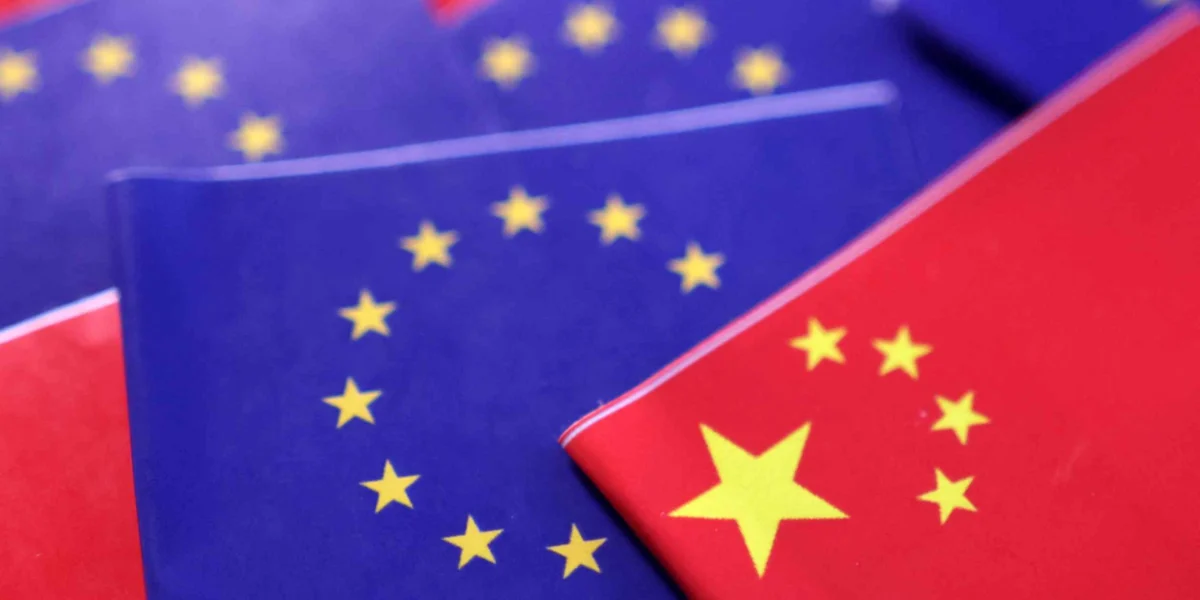
China on Friday imposed fresh trade curbs on more than a dozen European industrial companies, a decisive move that signals a significant escalation in the ongoing trade war with the European Union. This retaliatory action follows the EU’s recent decision to sanction Chinese firms accused of providing material support to Russia’s war effort in Ukraine. The tit-for-tat measures are poised to further destabilize global supply chains and deepen geopolitical tensions, raising concerns among international businesses about the increasing weaponization of trade policy.
The Chinese Ministry of Commerce announced the sweeping sanctions, targeting a range of sectors including advanced manufacturing, aerospace components, and specialized industrial machinery. While the specific names of the sanctioned companies were not immediately released, sources close to the ministry indicated that the list comprises firms deemed critical to the EU’s industrial base. The restrictions will likely involve limitations on exports to China, potential bans on importing certain goods from these companies, and possibly asset freezes or travel bans for key executives. This broad stroke approach suggests Beijing’s intent to inflict significant economic pain on European entities, mirroring the EU’s efforts to curtail perceived Chinese assistance to Russia.
The move marks a dramatic turn in the economic relationship between China and the EU, which has already been strained by a multitude of issues, including trade imbalances, intellectual property disputes, and differing approaches to international norms. The EU’s latest sanctions package, approved in early July, aimed to pressure China by targeting entities accused of supplying dual-use goods and technologies that could be repurposed for military use by Russia. The EU’s justification for these sanctions hinged on international law and the imperative to uphold global security by deterring support for acts of aggression.
Background and Chronology of Escalation
The roots of this escalating trade conflict can be traced back to the full-scale invasion of Ukraine by Russia in February 2022. The international community, led by Western nations, swiftly implemented extensive sanctions against Russia to cripple its economy and military capabilities. However, China has maintained a stance of strategic neutrality, refusing to condemn Russia’s actions and continuing to deepen its economic ties with Moscow. This has led to increasing scrutiny and suspicion from the EU and its allies, who believe China’s continued engagement with Russia, particularly through trade, undermines the effectiveness of global sanctions.
In the months leading up to the EU’s latest sanctions, intelligence reports and independent analyses began to surface, detailing instances of Chinese companies allegedly supplying Russia with components and technologies that have military applications. These reports, often citing customs data and shipping manifests, suggested a pattern of trade that skirted international sanctions regimes. The EU, after conducting its own investigations and consultations with member states, decided to act.
The EU’s sanctions, announced on July 10, 2026, targeted a select group of Chinese companies identified as being involved in this circumvention. The measures were designed to be targeted but impactful, aiming to send a clear message to Beijing that such activities would not be tolerated. The EU’s official statement emphasized that the sanctions were not aimed at the Chinese economy as a whole but at specific entities engaged in activities deemed detrimental to European security and international stability.
However, Beijing swiftly denounced the EU’s actions as unfounded and a clear violation of international trade principles. Chinese officials argued that the EU’s sanctions were politically motivated and lacked concrete evidence, asserting that China’s trade with Russia was purely commercial and did not violate any international laws or agreements. The Chinese Ministry of Foreign Affairs issued a strong statement calling on the EU to withdraw its sanctions and cease what it termed "unreasonable suppression."
The imposition of Chinese export curbs just two weeks later demonstrates Beijing’s resolve to retaliate forcefully. This aggressive response underscores China’s willingness to use its economic leverage as a geopolitical tool, a strategy it has employed in previous trade disputes, notably with the United States. The timing of the announcement, a Friday, is also noteworthy, often a tactic to allow for initial market reactions to be absorbed over the weekend.
Supporting Data and Economic Implications
The economic implications of this latest development are likely to be significant and far-reaching. Europe and China are deeply interconnected through trade, with the EU being one of China’s largest trading partners and vice versa. Any disruption to this relationship can have ripple effects across global supply chains.
According to Eurostat, trade between the EU and China in 2025 reached over €700 billion, with a substantial portion of this involving industrial goods and components. The European industrial sector, particularly its manufacturing and advanced technology segments, relies heavily on access to the Chinese market for both raw materials and as an export destination. Conversely, many European companies have established significant operations and supply chains within China.
The specific industries targeted by China’s retaliatory sanctions are particularly sensitive. For example, the aerospace sector relies on intricate global supply chains, and the disruption of component flows from Europe to China could impact aircraft manufacturing and maintenance. Similarly, specialized industrial machinery is often crucial for production processes in various sectors, and export restrictions could lead to production delays and increased costs for Chinese manufacturers.
Data from the European Commission has previously highlighted the importance of China as a market for key European exports, including machinery, vehicles, and chemicals. The new sanctions could directly affect companies operating in these sectors, potentially leading to significant revenue losses and a need to reconfigure supply chains. Conversely, Chinese companies that rely on specific European industrial components could face production bottlenecks.
The announcement also comes at a time when global inflation remains a concern. Disruptions to supply chains and increased trade barriers can lead to higher production costs, which are often passed on to consumers in the form of higher prices. This could exacerbate existing inflationary pressures in both Europe and China, as well as in other countries integrated into their supply networks.
Official Responses and International Reactions
The European Union has not yet issued a formal statement in response to China’s latest trade curbs. However, initial reactions from Brussels are expected to be stern. EU officials have consistently maintained that their sanctions against Chinese entities are justified and based on evidence of violations of international law. They are likely to view China’s retaliatory measures as an unacceptable escalation and a further attempt to undermine the EU’s foreign policy objectives.
The United States, a close ally of the EU in its efforts to counter Russia, is expected to express strong support for the EU’s position. Washington has also imposed its own sanctions on entities accused of aiding Russia and has been actively pressing China to cease its support for Moscow. A spokesperson for the U.S. Department of Commerce indicated that the U.S. is closely monitoring the situation and is in constant communication with its European partners.
International business organizations have expressed deep concern over the unfolding trade war. The European Chamber of Commerce in China issued a statement calling for de-escalation and dialogue, urging both sides to uphold the principles of free and fair trade. "Such actions create uncertainty and instability, which are detrimental to business confidence and long-term investment," the statement read. Similar concerns have been echoed by industry associations in various European countries.
The United Nations Conference on Trade and Development (UNCTAD) has warned in its recent reports about the increasing trend of protectionism and the weaponization of trade policies. While UNCTAD does not typically comment on specific geopolitical disputes, its overarching message highlights the risks to global economic growth and stability posed by such escalations.
Broader Impact and Analysis
This latest exchange underscores a broader trend of geopolitical fragmentation and the increasing intertwining of trade policy with national security and foreign policy objectives. The era of largely unfettered globalization, characterized by a belief in the pacifying effects of economic interdependence, appears to be giving way to a more contested landscape where trade is increasingly viewed as a strategic tool.
China’s decision to retaliate so swiftly and decisively demonstrates its growing assertiveness on the global stage and its willingness to push back against perceived external pressure. The move also signals Beijing’s strategic calculation that the economic pain it can inflict on Europe is a worthwhile price to pay for signaling its displeasure and deterring further EU actions.
For European companies, the implications are stark. They are caught in the middle of a geopolitical tug-of-war, facing potential losses and operational disruptions. Many will be forced to reassess their reliance on the Chinese market and explore diversification strategies. This could lead to a gradual reshaping of global supply chains, with companies seeking to reduce their exposure to geopolitical risks.
The effectiveness of China’s retaliatory sanctions will depend on several factors, including the specific companies targeted, the severity of the restrictions, and the EU’s ability to absorb the economic impact. However, the clear message from Beijing is that it will not passively accept what it views as unjustified external interference in its economic relationships.
This escalating trade conflict between China and the EU is not an isolated incident but part of a larger global shift. As geopolitical rivalries intensify, trade is increasingly becoming a battlefield. The coming months will be critical in determining whether this latest escalation leads to a further downward spiral or whether channels for de-escalation and dialogue can be reopened. The global economy, already navigating a complex landscape of challenges, will be closely watching.
