

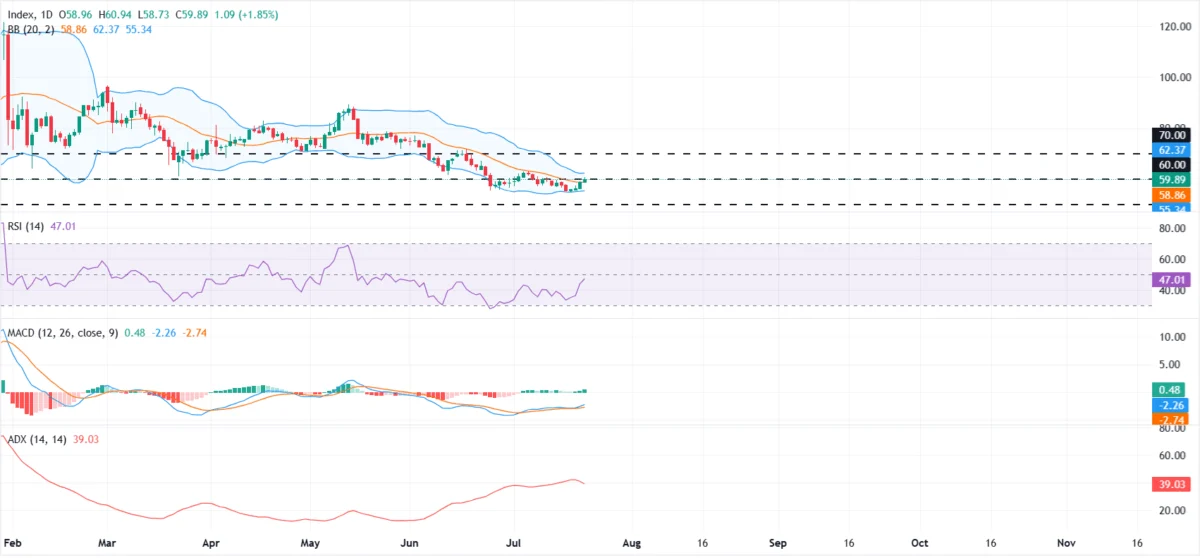
Silver (XAG/USD) is currently trading with modest gains on Wednesday, finding temporary respite from a slight pullback in the US Dollar (USD). Despite this positive momentum, the precious metal struggles to establish strong upside traction, as market participants meticulously weigh the persistent risks of energy-driven inflation and their potential ramifications for the Federal Reserve’s (Fed) interest-rate outlook. At the time of writing, XAG/USD is positioned around the $59.90 mark, having earlier in the day touched a two-week high of $60.94, illustrating the tentative nature of its recent ascent. The broader sentiment remains cautious, with the specter of restrictive monetary policy looming large over non-yielding assets.
The Federal Reserve’s Stance and Monetary Policy Outlook
The primary drag on Silver’s potential for a sustained rally stems from the prevailing market expectation that the Federal Reserve will maintain a restrictive monetary policy for an extended period. This sentiment is reinforced by the consensus pricing in at least one more interest-rate hike before the year concludes. Higher borrowing costs fundamentally increase the opportunity cost of holding non-yielding assets such as Silver, as investors can achieve more attractive returns from interest-bearing alternatives like bonds or savings accounts. The Fed’s resolute commitment to taming inflation, even at the risk of economic deceleration, has been a defining characteristic of its recent policy trajectory.
This "higher for longer" narrative from the Fed is not merely speculative; it is a direct response to persistent inflationary pressures that have proven more stubborn than initial projections suggested. Central bank officials have repeatedly underscored their data-dependent approach, emphasizing that a return to their 2% inflation target remains paramount. Recent statements from various Federal Open Market Committee (FOMC) members have consistently signaled a willingness to tighten monetary conditions further if inflation metrics do not show a clear and sustained deceleration. This hawkish rhetoric, coupled with robust labor market data and surprisingly resilient consumer spending, continues to feed market expectations for elevated rates, casting a shadow over the appeal of precious metals.
Inflationary Pressures: The Energy Nexus
A significant component of the current inflationary concern is deeply rooted in the energy sector. Global energy prices, particularly for crude oil and natural gas, have experienced notable surges in recent months, driven by a confluence of factors including geopolitical tensions, supply constraints from major producers (such as OPEC+ production cuts), and robust demand from reopening economies. For instance, benchmark crude oil prices, like Brent and WTI, have frequently climbed above key psychological thresholds, translating directly into higher fuel costs for consumers and increased operational expenses for businesses.
This "energy-driven inflation" poses a complex challenge for central banks. Unlike demand-pull inflation, which can be more directly influenced by monetary policy, cost-push inflation originating from supply-side shocks (like energy price increases) is harder to combat with interest rate hikes alone. However, the Fed’s mandate includes price stability, and sustained high energy prices risk embedding inflationary expectations into the broader economy, potentially leading to a wage-price spiral. Therefore, the Fed feels compelled to act, even if its tools are less effective against this specific type of inflation. The market’s interpretation of this dilemma is that the Fed will err on the side of caution, prioritizing inflation containment over potential growth slowdowns, thus reinforcing the outlook for higher rates.
The Dollar’s Influence: A Key Counterweight
The US Dollar’s performance plays a crucial role in the short-term price dynamics of Silver, as the metal is globally priced in dollars. An inverse relationship typically exists: a stronger USD makes dollar-denominated commodities more expensive for holders of other currencies, thereby dampening demand. Conversely, a weaker USD tends to make these commodities more affordable and attractive, often providing a fillip to their prices. Silver’s modest gains on Wednesday are directly attributed to a slight pullback in the US Dollar Index (DXY), which measures the dollar against a basket of major currencies.
Historically, periods of robust dollar strength, often propelled by widening interest rate differentials between the US and other major economies or by its safe-haven appeal during global economic uncertainty, have acted as a significant headwind for Silver. For instance, the DXY’s multi-year highs observed during various phases of the Fed’s tightening cycle have corresponded with periods of subdued performance for precious metals. While the recent dollar weakness provided some breathing room, the underlying strength of the US economy relative to others, coupled with the Fed’s hawkish stance, suggests that any sustained dollar depreciation might be fleeting, limiting the upside potential for Silver from this avenue.
Silver’s Dual Identity: Industrial Demand vs. Safe Haven Appeal
To fully understand Silver’s complex price movements, it is essential to acknowledge its dual identity: both a precious metal with safe-haven characteristics and a vital industrial commodity. While its safe-haven appeal often sees it grouped with Gold as a hedge against inflation or economic uncertainty, Silver’s industrial demand component is significantly larger than Gold’s. Approximately 50-60% of annual Silver demand comes from industrial applications, compared to around 10% for Gold.
This industrial demand is particularly strong in sectors such as electronics (due to its unparalleled electrical conductivity), solar energy (photovoltaic cells), and automotive (electrical components, catalysts). A surge in these sectors, driven by technological advancements and global sustainability initiatives, can significantly bolster Silver prices. Conversely, a slowdown in global manufacturing or a recessionary environment can depress industrial demand, acting as a downward pressure. Recent data from the Silver Institute indicates a robust demand outlook from the solar industry, with projections for continued growth as renewable energy adoption accelerates globally. However, this demand can be sensitive to overall economic health, particularly in major industrial economies like China, the US, and India, which are key consumers of industrial Silver.
In its role as a store of value, Silver often mirrors Gold’s movements, albeit with higher volatility. During periods of heightened geopolitical instability or fears of a deep recession, investors may flock to both metals. However, Silver’s "poor man’s gold" moniker also implies it can be more susceptible to speculative flows and broader market sentiment swings. The Gold/Silver ratio, which shows the number of ounces of Silver needed to equal the value of one ounce of Gold, often provides insights into their relative valuation. A high ratio might suggest Silver is undervalued relative to Gold, potentially attracting investors looking for a "catch-up" trade, while a low ratio could indicate the opposite. Currently, the ratio remains at levels that some analysts consider favorable for Silver in the long term, assuming a broader commodities rally.

Historical Context and Recent Performance: A Volatile Journey
Silver’s journey over the past year has been characterized by significant volatility, largely mirroring the broader macroeconomic landscape. Following the aggressive monetary tightening cycle initiated by the Federal Reserve in early 2022, Silver, like Gold, initially struggled as rising interest rates boosted the dollar and increased the opportunity cost of holding non-yielding assets. Prices saw significant declines from their post-pandemic highs.
However, intermittent periods of banking sector stress, such as the regional banking crisis in the US in early 2023, sparked temporary rallies as investors sought safe havens. Similarly, evolving inflation data and shifts in Fed rhetoric have frequently caused sharp price swings. For instance, a perceived dovish pivot by the Fed or a weaker-than-expected inflation print has often triggered immediate buying interest, only for gains to be pared back when hawkish statements or strong economic data reassert the "higher for longer" narrative. The current trading around $59.90, after hitting a two-week high of $60.94, reflects this ongoing tug-of-war between the dollar’s influence, inflationary concerns, and the Fed’s policy outlook. Over the past six months, Silver has largely traded within a range, consolidating previous moves, as markets await clearer signals on the trajectory of inflation and interest rates.
Technical Landscape and Price Targets
From a technical perspective, Silver bulls are currently grappling with the challenge of sustaining price action above the psychologically significant $60.00 mark. This level often acts as a pivot point, with sustained breaks above or below it signaling shifts in market sentiment. Despite this immediate struggle, XAG/USD is trading above its 20-day Simple Moving Average (SMA), which is currently positioned near $58.86, and also above the Bollinger middle band. This positioning suggests that buyers retain a degree of control in the short term, indicating underlying support.
Further technical indicators offer a nuanced view. The Moving Average Convergence Divergence (MACD) indicator is modestly positive, subtly hinting at a slight bullish tilt in short-term momentum. However, the Average Directional Index (ADX) is registering a reading of 39. This relatively high ADX value indicates that the underlying trend, whether bullish or bearish, remains fairly strong, which could limit the scope for abrupt reversals. This suggests that while there might be short-term buying interest, a dramatic shift in direction would require a more significant catalyst.
Looking ahead, initial resistance for Silver is observed at the intraday high of $60.94. A decisive break above this level would open the path towards the upper Bollinger Band, currently near $62.39. Should Silver manage a sustained break above this latter area, it could unlock a more significant rally, potentially paving the way toward the ambitious psychological barrier of $70.00. This $70.00 target would require a substantial shift in the macroeconomic environment, perhaps a clear end to the Fed’s tightening cycle or a significant escalation of safe-haven demand.
Conversely, on the downside, the 20-day SMA near $58.86 provides immediate technical support. A breach of this level could see Silver testing the lower Bollinger Band, situated around $55.34. A deeper decline, breaking below this critical support, could expose the psychological $50.00 level, a price point that has historically acted as a strong demand zone but also represents a significant psychological threshold for investors. The interplay of these technical levels will likely guide short-term trading decisions, with traders closely watching for decisive breaks that could signal the next sustained move.
Analyst Perspectives and Future Outlook
Market analysts and economists are largely divided on Silver’s immediate trajectory, reflecting the complex interplay of fundamental and technical factors. Many acknowledge the strong underlying industrial demand, particularly from the green energy transition, as a long-term bullish catalyst. However, the near-term outlook is heavily influenced by the Fed’s ongoing battle against inflation.
"The ‘higher for longer’ interest rate environment is the primary headwind for Silver and other non-yielding assets," notes one commodity strategist. "While industrial demand remains robust, especially from solar, the cost of capital and the relative attractiveness of fixed-income instruments will cap any significant upside until the Fed signals a clear end to its tightening cycle." Other analysts emphasize Silver’s historical volatility and its potential for outperformance during periods of real interest rate decline or renewed inflationary spikes that outpace central bank action. Some foresee a potential surge if geopolitical tensions intensify, pushing investors towards traditional safe havens.
The broader implications extend beyond just Silver investors. The persistent inflationary environment, exacerbated by energy price volatility, continues to challenge global economic stability. Central banks worldwide are grappling with similar dilemmas, balancing the need to control inflation with the risk of triggering recessions. Should the Fed successfully engineer a "soft landing," avoiding a severe downturn while bringing inflation under control, it could stabilize markets and create a more predictable environment for commodities. However, an economic hard landing, or a resurgence of inflation, would undoubtedly introduce renewed volatility across asset classes, including Silver.
Conclusion
Silver’s current market performance is a microcosm of the broader economic uncertainties pervading global financial markets. While a weaker US Dollar provides a fleeting tailwind, the formidable challenges posed by persistent energy-driven inflation and the Federal Reserve’s unyielding commitment to restrictive monetary policy continue to temper any sustained bullish enthusiasm. The metal’s dual identity, straddling both precious and industrial roles, adds layers of complexity, making its price highly sensitive to shifts in both economic growth forecasts and monetary policy expectations. As traders navigate the psychological $60.00 barrier and assess the technical indicators, the overarching narrative remains one of caution. Until there is a clearer resolution to the inflation-interest rate conundrum, Silver is likely to continue its volatile dance, influenced by every nuance of economic data and central bank rhetoric, with significant upside requiring a fundamental shift in the global macroeconomic landscape.
