

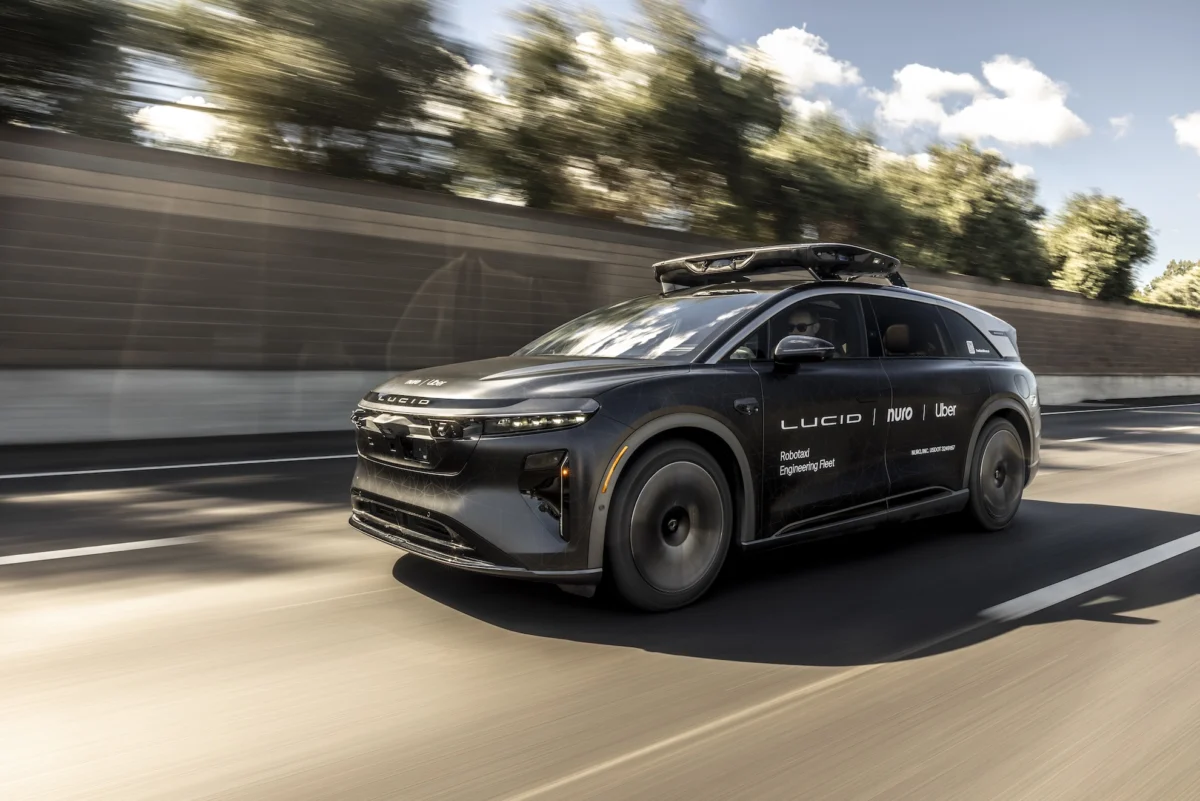
San Francisco, CA – In a significant step forward for autonomous ride-hailing, select Uber employees are now participating in test rides of Lucid Gravity SUVs equipped with Nuro’s self-driving technology through the Uber app in San Francisco. This controlled environment testing phase marks a crucial milestone in the partnership between Uber, Nuro, and Lucid, as the companies prepare for a planned public launch of the robotaxi service later this year. The vehicles, easily identifiable by their array of sensors, operate in autonomous mode with a human safety operator present behind the wheel as a precautionary measure.
This development follows the formal announcement of a multi-faceted partnership in July 2025, a collaboration that saw Uber make substantial investments in both Nuro and Lucid. Uber committed $300 million to Lucid and, in a separate agreement, pledged to procure a minimum of 20,000 of Lucid’s new Gravity SUV electric vehicles over the subsequent six years. These premium EVs are specifically modified to integrate Nuro’s advanced autonomous vehicle system, a platform that is robustly powered by Nvidia’s Drive AGX Thor computing architecture. The Lucid Gravity robotaxi, which made its public debut in January 2026, is outfitted with a sophisticated sensor suite including high-resolution cameras, solid-state lidar sensors, and radars, enabling its self-driving system to accurately perceive and navigate complex real-world environments. Beyond its investment in Lucid, Uber also injected an undisclosed "multi-hundred-million dollar" sum into Nuro, underscoring its deep commitment to the autonomous technology provider.
The Strategic Alliance: A Deep Dive into Uber’s Robotaxi Ambitions
Uber’s foray into the robotaxi space through this partnership represents a strategic pivot for the global ride-sharing giant. After years of significant investment in its own in-house autonomous vehicle development unit, Advanced Technologies Group (ATG), which it eventually divested, Uber has shifted its strategy towards collaboration with specialized AV technology developers. This partnership with Nuro and Lucid allows Uber to leverage established expertise and cutting-edge hardware without bearing the full financial and operational burden of developing foundational autonomous driving technology from scratch. The ultimate plan is for Uber to own and operate this premium robotaxi service, potentially with the assistance of a third-party fleet management provider, once it scales. Regulatory filings from last year indicated that production of these specially modified Lucid Gravity vehicles is anticipated to commence in late 2026, aligning with a phased rollout strategy.
The decision to partner with Nuro, known primarily for its autonomous goods delivery vehicles, for passenger transport signals Nuro’s expanding capabilities and ambition. Nuro’s technology, refined over years in various urban environments, is now being adapted for the more complex demands of human passengers, including the nuanced aspects of pick-up and drop-off points, which Nuro explicitly states are a key focus of the employee testing phase. For Lucid, a luxury electric vehicle manufacturer, the partnership provides a significant commercial pathway for its new Gravity SUV, diversifying its revenue streams beyond direct consumer sales and validating its platform for commercial applications.
Technological Foundations: Powering the Autonomous Journey
At the heart of the Lucid Gravity robotaxi’s intelligence lies Nuro’s autonomous vehicle system, a testament to years of research and development in self-driving technology. This system’s computational backbone is provided by Nvidia’s Drive AGX Thor, a highly integrated, high-performance compute platform designed specifically for autonomous driving. Nvidia’s role in the AV ecosystem is crucial, as its hardware provides the processing power necessary for real-time data analysis from multiple sensors, decision-making, and execution of driving commands. The Drive AGX Thor architecture, known for its ability to handle immense data throughput and complex AI algorithms, enables Nuro’s software to process environmental data with exceptional speed and accuracy.
The physical perception layer of the robotaxi is equally impressive. The Lucid Gravity SUVs are equipped with a comprehensive array of sensors designed to create a robust and redundant understanding of the vehicle’s surroundings. High-resolution cameras provide visual data, crucial for object recognition, lane keeping, and traffic light detection. Solid-state lidar sensors use laser pulses to generate precise 3D maps of the environment, essential for distance measurement, obstacle detection, and localization. Radar sensors complement these systems by providing reliable performance in adverse weather conditions like fog or heavy rain, detecting objects and their velocities. This multi-modal sensor fusion approach enhances safety and reliability, allowing the self-driving system to perceive the real-world environment comprehensively and operate within it effectively.
A Phased Approach to Public Deployment: From Closed Tracks to City Streets
The current employee test rides in San Francisco represent the culmination of an extensive, multi-stage testing and validation process. Nuro initiated this journey with rigorous closed-course testing of the autonomous Lucid Gravity SUVs, ensuring the foundational safety and functionality of the integrated system in a controlled environment. Following successful completion of these initial tests, Nuro expanded its operations to public road testing in late last year. This progressive approach is standard practice in the autonomous vehicle industry, allowing companies to gradually expose their technology to increasing levels of real-world complexity and unpredictability.
Nuro’s engineering fleet currently comprises 100 Lucid Gravity SUVs, all outfitted with its self-driving system. These vehicles are actively engaged in gathering real-world data and testing autonomous driving capabilities across multiple U.S. cities and states. This extensive data collection is vital for training and refining the artificial intelligence models that power the autonomous system, addressing edge cases, and continuously improving performance. The employee test rides serve a distinct purpose within this rigorous validation framework. According to Nuro, these rides are instrumental in allowing the team to evaluate the seamless integration of the autonomy stack, the vehicle’s performance, and the overall rider experience within a live operating environment. A particular emphasis is placed on refining the vehicle’s ability to handle rider pickups and drop-offs, a notoriously complex and critical operation in autonomous ride-hailing that often involves navigating congested areas, identifying specific locations, and interacting safely with human passengers and pedestrians.
The San Francisco Crucible: Navigating a Complex Urban Landscape
San Francisco has emerged as a prominent, albeit challenging, proving ground for autonomous vehicle technology. The city’s dense urban environment, diverse road conditions, steep hills, unique traffic patterns, and often unpredictable pedestrian and cyclist activity present a formidable test for any self-driving system. Companies like Waymo and Cruise have also extensively tested and deployed their robotaxi services in San Francisco, facing both technological hurdles and public scrutiny. For Nuro and Uber, operating in San Francisco offers invaluable data and experience, pushing the boundaries of their technology in one of the world’s most demanding urban settings.
The choice of San Francisco for these employee test rides underscores the companies’ confidence in the system’s capabilities while also acknowledging the need for real-world validation under challenging conditions. The insights gained from navigating the city’s intricate street network, managing dynamic traffic situations, and handling various weather conditions will be critical in preparing the service for a broader public launch. This environment provides a rich tapestry of scenarios that are essential for refining the system’s ability to perceive, predict, and plan in real-time.
Broader Impact and Implications: Reshaping Urban Mobility
The partnership between Uber, Nuro, and Lucid, and the ongoing progress in deploying robotaxis, carries significant implications for the future of urban mobility and the broader transportation industry.
-
For Uber: This initiative represents a potential long-term play to significantly reduce operational costs associated with human drivers, ultimately improving profitability. While the initial investment is substantial, a fully autonomous fleet could lead to lower per-mile costs, allowing Uber to offer more competitive pricing or higher margins. It also positions Uber at the forefront of the premium autonomous ride-hailing market, distinguishing its service from competitors and potentially attracting a new segment of users seeking a high-tech, reliable, and potentially more luxurious experience. This move is critical for Uber to maintain its market leadership in the evolving transportation landscape.
-
For Nuro: Expanding from autonomous goods delivery to passenger transport is a monumental step, validating its core AV technology for a broader range of applications. This partnership with a global giant like Uber provides Nuro with immense scale, market access, and a clear path to commercialization for its passenger AV stack, bolstering its position in a highly competitive industry. Success in this venture could solidify Nuro’s reputation as a versatile and robust autonomous technology provider.
-
For Lucid: The deal for 20,000+ Gravity SUVs provides a crucial commercial anchor for its new vehicle platform, demonstrating its adaptability beyond the luxury consumer market. It offers a significant, guaranteed revenue stream and establishes Lucid as a key player in the nascent commercial EV and autonomous fleet sector. This partnership strategically positions Lucid to capitalize on the growing demand for purpose-built autonomous vehicles.
-
Competitive Landscape: The entry of Uber-Nuro-Lucid into the robotaxi space intensifies competition with established players like Waymo (Alphabet) and Cruise (GM), as well as Tesla’s ongoing efforts to develop full self-driving capabilities. The market for autonomous ride-hailing is projected to grow substantially in the coming decade, with some industry analysts forecasting it to reach hundreds of billions of dollars globally. This partnership signals that the race to dominate this future market is accelerating.
-
Regulatory and Public Acceptance: While the technological advancements are impressive, the widespread adoption of robotaxis hinges on regulatory frameworks and public trust. Governments are still grappling with establishing comprehensive regulations for autonomous vehicles, and public acceptance remains a critical factor. Incidents involving autonomous vehicles, even minor ones, can significantly impact public perception and slow down deployment. Companies like Uber, Nuro, and Lucid must continue to prioritize safety, transparency, and effective communication to build and maintain public confidence.
The Road Ahead: Challenges and Opportunities
The journey from employee testing to a full public launch is fraught with challenges. Beyond the technological hurdles of perfecting autonomous driving in all conditions, companies must navigate complex regulatory landscapes that vary by jurisdiction, manage high operational costs of maintaining and monitoring autonomous fleets, and effectively address public skepticism. The ability to scale the service efficiently, ensure consistent reliability, and provide an intuitive user experience will be paramount to success.
However, the opportunities are equally vast. A successful robotaxi service could revolutionize urban transportation, offering increased safety by reducing human error, enhanced accessibility for those unable to drive, and potentially more efficient use of road space through optimized routing and fleet management. It could also contribute to reducing carbon emissions, especially with the use of electric vehicles like the Lucid Gravity.
As the Uber-Nuro-Lucid partnership progresses towards its planned public launch later this year, all eyes will be on San Francisco, watching how these advanced robotaxis navigate the intricate dance of city life, promising a glimpse into the future of transportation. The collaboration represents a powerful convergence of ride-sharing expertise, autonomous driving innovation, and premium electric vehicle manufacturing, setting the stage for a new era in urban mobility.
