

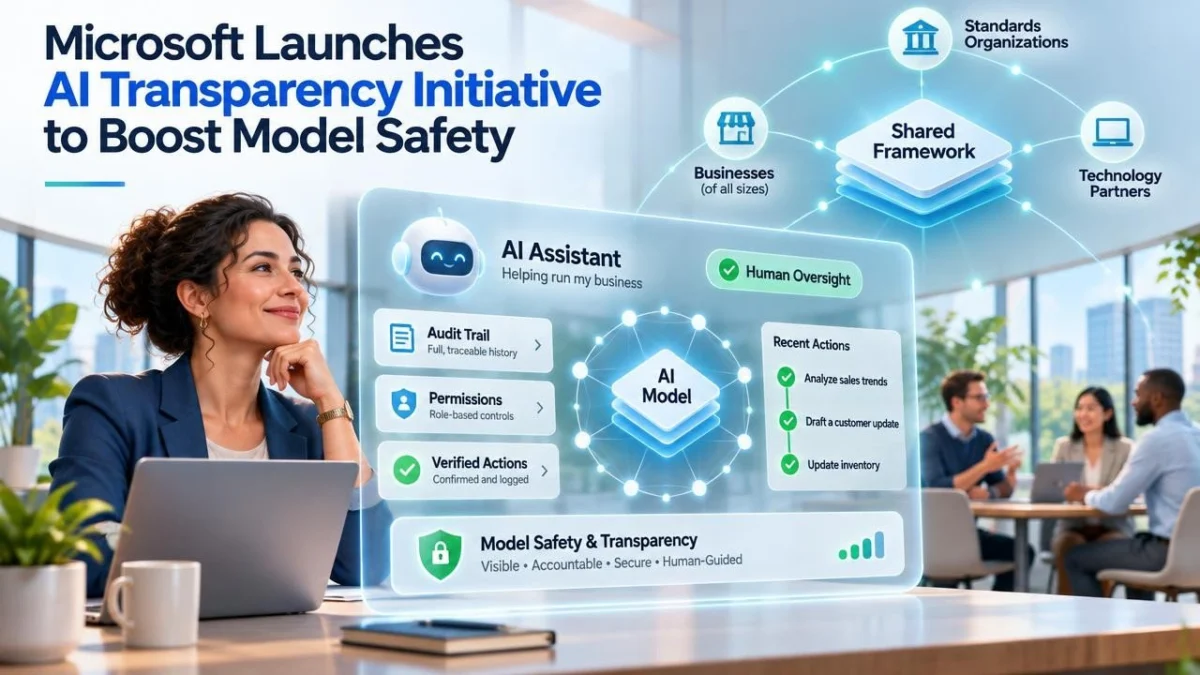
The integration of artificial intelligence into the global economic fabric has reached a critical inflection point, transitioning from experimental chatbots to autonomous agents capable of executing complex business processes. In response to the growing concerns regarding the "black box" nature of these systems, Microsoft CEO Satya Nadella utilized the platform of the annual Microsoft Ignite conference to announce the AI Transparency Initiative. This strategic program is designed to provide small and medium-sized enterprises (SMEs) with the clarity, control, and accountability frameworks necessary to deploy AI technologies without compromising institutional security or ethical standards. As AI agents begin to operate at machine speeds with access to sensitive corporate data, the initiative represents a systemic effort to build a "trust architecture" that bridges the gap between technological capability and human oversight.
During his keynote address, Nadella emphasized that the evolution of AI necessitates a parallel evolution in governance, stating that greater AI autonomy requires greater transparency. This sentiment underscores a shift in the industry’s focus from mere performance metrics to the verifiability of AI actions. For small businesses, which often lack the massive internal compliance departments of multinational corporations, the AI Transparency Initiative offers a standardized pathway to navigate an increasingly complex regulatory and security landscape. The initiative arrives at a time when the "shadow AI" phenomenon—where employees use unauthorized AI tools—poses a significant risk to data integrity and corporate compliance.
The Evolution of AI at Microsoft: A Chronological Context
The launch of the AI Transparency Initiative is the latest milestone in a rapid two-year trajectory of AI development at Microsoft. To understand the significance of this announcement, one must look at the timeline of the company’s recent technological pivots. Following the public release of ChatGPT in late 2022, Microsoft moved aggressively to integrate Large Language Models (LLMs) into its core product offerings.
In early 2023, Microsoft announced a multi-billion-dollar investment in OpenAI, signaling a long-term commitment to generative AI. This was followed by the rollout of Microsoft Copilot across Windows and Microsoft 365, which introduced millions of users to AI-assisted productivity. By mid-2024, the focus shifted toward "agentic AI"—systems that do not merely respond to prompts but can autonomously plan and execute tasks across different software environments. The Ignite conference in November 2024 served as the stage for the next logical step: ensuring these autonomous agents operate within a framework that is visible and controllable by the organizations that deploy them.
This chronological progression reflects a move from AI as a "tool" to AI as a "colleague." However, as these agents gain the ability to access databases, communicate with clients, and manage financial transactions, the risks associated with opaque decision-making have intensified. The AI Transparency Initiative is positioned as the corrective measure for this increased autonomy.
Strategic Pillars of the AI Transparency Initiative
The initiative is built upon three foundational pillars intended to create a universal standard for AI safety and visibility. These components are designed to be interoperable, ensuring that the benefits of transparency extend beyond the Microsoft ecosystem.
Collaboration with the National Institute of Standards and Technology (NIST)
The first pillar involves a deepened partnership with NIST, a non-regulatory agency of the United States Department of Commerce. Microsoft has committed to supporting open, industry-wide standards for AI transparency, security, and governance. By aligning with NIST’s AI Risk Management Framework, Microsoft aims to provide small businesses with a common language for risk assessment. This collaboration is intended to move the industry away from proprietary, fragmented safety protocols and toward a unified standard that can be audited by third parties.
The Industry Coalition for Accountable AI
The second pillar is the formation of a massive industry coalition comprising more than 40 global leaders, including Accenture, KPMG, Mastercard, and Adobe. This group is tasked with developing cross-industry standards to ensure AI systems are accountable and safe regardless of the underlying provider. The involvement of financial giants like Mastercard and consulting leaders like KPMG suggests a focus on high-stakes environments where data privacy and financial accuracy are non-negotiable. This coalition aims to create a "safety certification" of sorts, providing small business owners with the assurance that the tools they purchase meet a rigorous baseline of ethical and technical scrutiny.
Integration into the Microsoft Ecosystem
The third pillar focuses on the practical application of these standards within Microsoft’s own software suite. The newly established transparency protocols will be hard-coded into Microsoft AI, Microsoft Foundry, and Microsoft Copilot. This means that a small business using Copilot will have access to "activity logs" for AI agents, allowing administrators to see exactly what data an agent accessed, why it made a specific decision, and how that action aligns with pre-set organizational policies. This integration transforms transparency from an abstract concept into a functional dashboard for business owners.
Supporting Data and the Economic Necessity of Trust
The push for transparency is not merely an ethical choice but an economic necessity. According to Microsoft’s 2024 Work Trend Index, approximately 75% of global knowledge workers are already using AI at work. However, a significant portion of this usage occurs outside of official corporate channels. For small businesses, the stakes of an AI-related security breach are disproportionately high. Data from the IBM Cost of a Data Breach Report 2024 indicates that the average cost of a data breach for organizations with fewer than 500 employees is approximately $3.3 million—a figure that can be catastrophic for a small enterprise.
Furthermore, a recent Edelman Trust Barometer special report on AI revealed that public trust in AI companies has declined globally over the last five years, dropping from 62% to 53%. This "trust gap" represents a barrier to adoption. By implementing the AI Transparency Initiative, Microsoft is attempting to reverse this trend, betting that businesses will be more likely to invest in AI if they can prove to their customers and stakeholders that the technology is being used responsibly.
Stakeholder Perspectives and Industry Reactions
The announcement has garnered significant support from security and compliance leaders across various sectors. The consensus among these stakeholders is that visibility is the prerequisite for security.
Aanchal Gupta, Chief Security Officer at Adobe, noted that security teams require clear visibility into the actions of AI agents. She emphasized that without the ability to verify how an agent accesses data, organizations cannot effectively defend against internal or external threats. Similarly, John Israel, Global Chief Information Security Officer at KPMG, highlighted that transparency and explainability are the cornerstones of responsible oversight. For KPMG’s clients—many of whom are small to medium-sized firms—the ability to explain an AI’s decision is often a legal requirement in regulated industries like finance or healthcare.
Harpreet Sidhu, global cybersecurity lead at Accenture, reinforced the idea that a solid foundation of trust is necessary for innovation. Sidhu argued that if small businesses are afraid of the "unintended consequences" of AI, they will hesitate to adopt tools that could otherwise provide a competitive advantage. The AI Transparency Initiative is viewed by these leaders as a mechanism to "de-risk" AI adoption for the broader market.
Analysis of Implications for Small Business Operations
The long-term implications of the AI Transparency Initiative for small businesses are profound, though they come with immediate operational challenges. In the short term, business owners must prepare for a period of adjustment. Implementing these transparency standards will likely require additional training for staff and the establishment of new internal protocols. For example, a business may need to designate a "Human-in-the-Loop" (HITL) coordinator to oversee the activity logs generated by AI agents.
However, the potential benefits far outweigh the initial friction of implementation. By adopting standardized transparency protocols, small businesses can:
- Ensure Regulatory Compliance: As governments worldwide, including the European Union with its AI Act, move to regulate artificial intelligence, having transparent and auditable AI systems will simplify compliance and reduce the risk of legal penalties.
- Enhance Data Security: Clear visibility into AI behavior allows for the early detection of anomalies, preventing data leakage or unauthorized access to confidential information.
- Improve Customer Trust: Small businesses that can demonstrate their commitment to ethical AI usage will likely enjoy a competitive advantage in a market where consumers are increasingly concerned about data privacy.
- Optimize AI Performance: Transparency allows for "explainable AI," which helps business owners understand why an AI model might be producing errors, allowing for more precise calibration and better outcomes.
Potential Challenges and the Path Forward
Despite the optimistic outlook, the path to universal AI transparency is fraught with hurdles. Small businesses often operate on thin margins, and the requirement for more sophisticated compliance tools or specialized training could be viewed as a financial burden. There is also the challenge of "standard fatigue"—where businesses are overwhelmed by the constant influx of new technological requirements and certifications.
Moreover, the technical challenge of making LLMs truly "explainable" remains a subject of intense academic and industrial research. While Microsoft’s initiative provides the framework for transparency, the inherent complexity of neural networks means that providing a simple, human-readable explanation for every AI decision is a goal that is still being perfected.
The AI Transparency Initiative represents a significant step toward a more mature and responsible AI ecosystem. By prioritizing the needs of small businesses—the backbone of the global economy—Microsoft is attempting to ensure that the AI revolution does not leave behind those with the fewest resources to manage its risks. As the initiative unfolds through 2025 and 2026, its success will be measured not just by the adoption of Microsoft’s tools, but by the establishment of a global culture of accountability in the age of autonomous intelligence. Organizations are encouraged to remain engaged with these evolving standards to ensure they remain at the forefront of secure and ethical technological deployment.
