

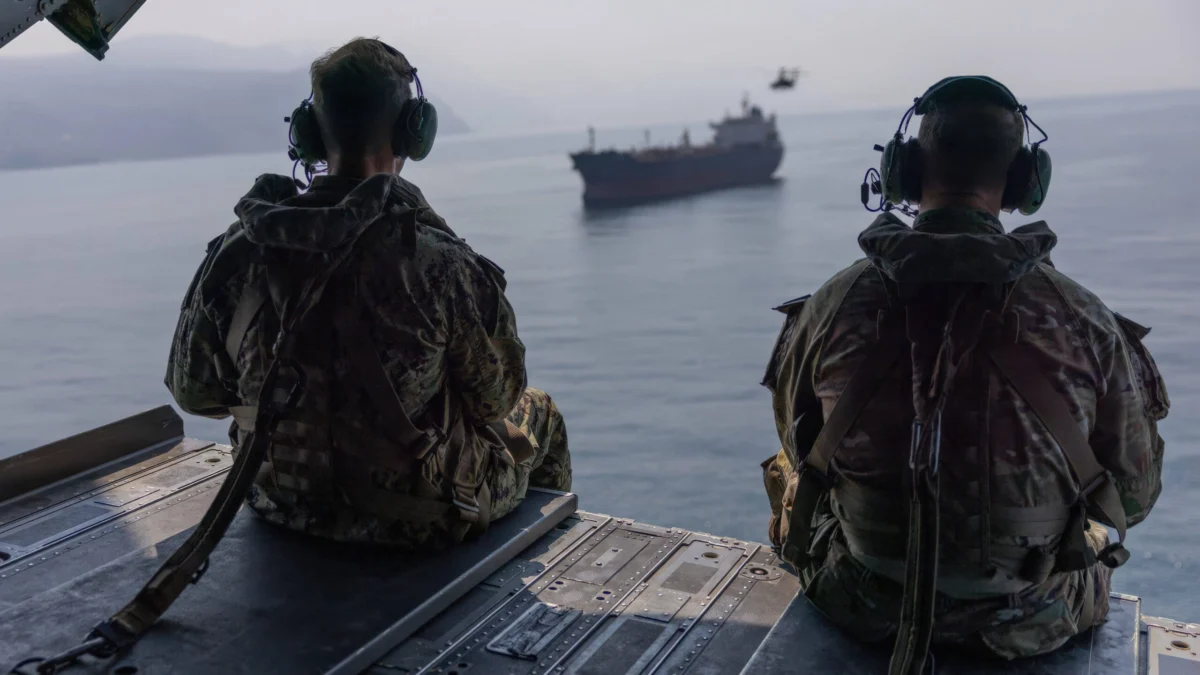
Bahrain successfully thwarted multiple Iranian aerial assaults, as confirmed by the Gulf state’s military on Sunday. The nation’s air defense systems intercepted and neutralized incoming projectiles before they could reach their intended targets. This marks the first instance of such interceptions by Bahraini air defenses since September. The incident follows earlier alerts that prompted the population to seek shelter.
Tehran, through state media, had previously claimed responsibility for an attack on a U.S. military base in Bahrain earlier that day. The Islamic Revolutionary Guard Corps (IRGC) reportedly launched six drones targeting a U.S. air defense radar at the Al-Rifaa helicopter base. This action was framed as retaliation for hostile U.S. actions, according to the Fars news agency, citing the IRGC. Bahrain hosts the U.S. Navy’s Fifth Fleet. This latest assertion contradicts an earlier claim by the IRGC on Friday, stating they had attacked a U.S. early warning radar in Bahrain. At that time, the U.S. military reported intercepting two Iranian drones without reporting any damage.
These escalating events occur against the backdrop of ongoing negotiations aimed at reviving a nuclear deal between the United States and Iran, which seeks to end nearly nine months of strained relations and potential conflict. Both Washington and Tehran have, until recently, strived to avoid direct military confrontations. However, diplomatic efforts have yet to yield a breakthrough, leaving the region in a state of heightened tension.
Escalation in the Persian Gulf: A Pattern of Provocation
The reported Iranian attacks on a U.S. military installation in Bahrain represent a significant escalation in the already volatile geopolitical landscape of the Persian Gulf. This region has been a focal point of international concern due to its strategic importance for global energy supplies and the ongoing proxy conflicts involving Iran and its regional adversaries, including Saudi Arabia and Israel.
Key Developments:

- Bahrain’s Defense: Bahrain announced the successful interception of multiple Iranian aerial attacks, asserting its air defense capabilities.
- Iranian Claims: Iran, via its Revolutionary Guard Corps (IRGC), claimed responsibility for drone strikes targeting a U.S. radar facility in Bahrain.
- U.S. Response: The U.S. military stated it intercepted Iranian drones, contradicting Tehran’s narrative of a successful strike.
- Strait of Hormuz Incidents: Three oil tankers reportedly caught fire in the Strait of Hormuz following contact with naval mines.
- Houthi Activity: A U.S.-led coalition intercepted Houthi rockets, while Bahrain issued a warning about potential threats.
- Gaza Conflict: A Hamas commander was reportedly killed in an Israeli airstrike in the Gaza Strip.
The repeated Iranian claims of targeting U.S. assets in Bahrain suggest a deliberate strategy to pressure the United States and its allies in the region. The IRGC’s assertion of retaliatory actions highlights a tit-for-tat dynamic that could easily spiral out of control. The U.S. military’s counter-narrative underscores the difficulty in verifying claims from the region and the potential for miscalculation.
Background Context: A Shadow War and Nuclear Ambitions
The current tensions are deeply rooted in decades of animosity between Iran and the United States, exacerbated by Iran’s controversial nuclear program and its support for various regional militias. The U.S. withdrawal from the Joint Comprehensive Plan of Action (JCPOA) in 2018 and the subsequent reimposition of stringent sanctions have intensified Iran’s isolation and fueled its defiance.
Iran’s nuclear program has been a persistent source of international concern. The International Atomic Energy Agency (IAEA) has repeatedly voiced worries about the lack of transparency and access to certain Iranian nuclear facilities. Specifically, a uranium enrichment facility in Isfahan, declared by Iran but not yet fully accessible for inspections, has raised significant red flags. The IAEA’s confidential reports to member states have indicated uncertainty regarding the facility’s exact location, status, and whether nuclear material is present. This ambiguity fuels fears that Iran may be pursuing a path toward nuclear weapons capability, a scenario that Israel and several Arab nations view as an existential threat.
The IRGC’s actions are also intertwined with the broader regional power struggle. Iran’s network of proxies, including the Houthi rebels in Yemen, has been instrumental in projecting its influence and challenging regional rivals like Saudi Arabia. The Houthi’s missile and drone attacks on Saudi targets, often claimed as retaliation for the ongoing conflict in Yemen, are part of this wider strategic calculus. The coalition’s interception of these projectiles demonstrates the ongoing military engagement in that theater.
Timeline of Recent Events: A Volatile Escalation
Sunday:
- Bahrain Claims Defense: Bahrain’s military announces the successful interception of Iranian aerial attacks, stating its air defense systems thwarted the projectiles.
- Iran Claims Strike: Iran’s state media, citing the IRGC, reports that six drones were launched against a U.S. air defense radar at the Al-Rifaa helicopter base in Bahrain.
- U.S. Military Reports Interception: The U.S. military claims to have intercepted two Iranian drones, contradicting Tehran’s narrative of a successful strike on the Bahraini base.
Friday:

- Previous Iranian Claim: The IRGC previously claimed to have attacked a U.S. early warning radar in Bahrain.
- U.S. Military Response: The U.S. military reports intercepting two Iranian drones at that time, with no reported damage.
Recent Past:
- Houthi Missile Interceptions: A Saudi-led coalition announces the interception of two ballistic missiles launched by Houthi rebels towards Riyadh.
- Bahraini Threat Warning: The Bahraini Ministry of Interior issues a warning about a potential threat, advising citizens and residents to remain calm and proceed to the nearest safe location.
- Hamas Commander Killed: Israel reports the death of a senior commander of Hamas’s armed wing in an airstrike in Khan Yunis, southern Gaza Strip.
- Strait of Hormuz Incidents: Iran reports three oil tankers catching fire in the Strait of Hormuz after colliding with naval mines. This incident raises concerns about maritime security in one of the world’s most critical oil transit routes.
Data and Implications: The Ripple Effect of Regional Instability
The incidents in Bahrain and the Strait of Hormuz carry significant implications beyond immediate military exchanges.
Energy Market Sensitivity: The Strait of Hormuz is a vital chokepoint for global oil supplies, through which approximately 20% of the world’s total oil consumption passes daily. Any disruption, such as the reported mine incidents, can lead to volatility in oil prices. The potential for increased oil prices on the global market, impacting everything from gasoline at the pump to industrial production costs, is a tangible economic consequence. The International Energy Agency (IEA) closely monitors such developments for their impact on global energy security.

Geopolitical Risk Premium: The heightened tensions contribute to a general increase in the geopolitical risk premium in financial markets. This can lead to reduced investment, currency fluctuations, and a general air of uncertainty that affects global economic growth. Investors and businesses often react to such escalations by increasing their caution, potentially delaying expansion plans or reallocating capital to perceived safer havens.
Humanitarian Concerns: The ongoing conflict in Gaza, highlighted by the reported death of a Hamas commander, continues to exacerbate humanitarian suffering. International bodies like the United Nations have repeatedly called for unimpeded access for humanitarian aid. The approaching winter season in the region further amplifies these concerns, as demonstrated by the joint appeal from over 50 states and organizations urging Israel to allow critical winter aid into Gaza.
Nuclear Proliferation Fears: The persistent concerns surrounding Iran’s nuclear program, coupled with its assertive regional posture, fuel fears of a potential nuclear arms race in the Middle East. Israel, in particular, has repeatedly stated that it will not allow Iran to acquire nuclear weapons. This has led to speculation about potential preemptive military actions, which could have catastrophic regional and global consequences.

Official Responses and International Reactions
The official responses to these events vary, reflecting the complex web of alliances and rivalries in the region.
Bahrain’s Stance: Bahrain’s confirmation of repelling attacks signals its alignment with U.S. and other Gulf Arab states in countering perceived Iranian aggression. The Bahraini military’s statement emphasizes its capability to defend its sovereignty.
Iran’s Position: Iran’s state media and the IRGC frame their actions as defensive measures and retaliation against perceived U.S. provocations. This narrative is consistent with Iran’s broader foreign policy of projecting strength and challenging Western influence in the region.

United States’ Role: The U.S. military’s report of intercepting drones serves to counter Iran’s claims and reinforce its commitment to regional security. The U.S. has consistently advocated for diplomatic solutions while maintaining a strong military presence in the Gulf.
International Concern: The international community, particularly major global powers and organizations like the UN and IAEA, have consistently called for de-escalation and adherence to international law. The ongoing diplomatic efforts to revive the JCPOA reflect a desire to curb Iran’s nuclear ambitions and reduce regional tensions. However, the effectiveness of these efforts remains contingent on the willingness of all parties to engage constructively.
The reported incidents in Bahrain and the Strait of Hormuz are not isolated events but rather part of a broader pattern of strategic maneuvering and brinkmanship in the Middle East. The interplay of regional rivalries, Iran’s nuclear ambitions, and the involvement of global powers like the United States creates a highly combustible environment. The long-term implications hinge on whether diplomatic channels can prevail over military confrontation and whether a sustainable framework for regional security can be established.
