

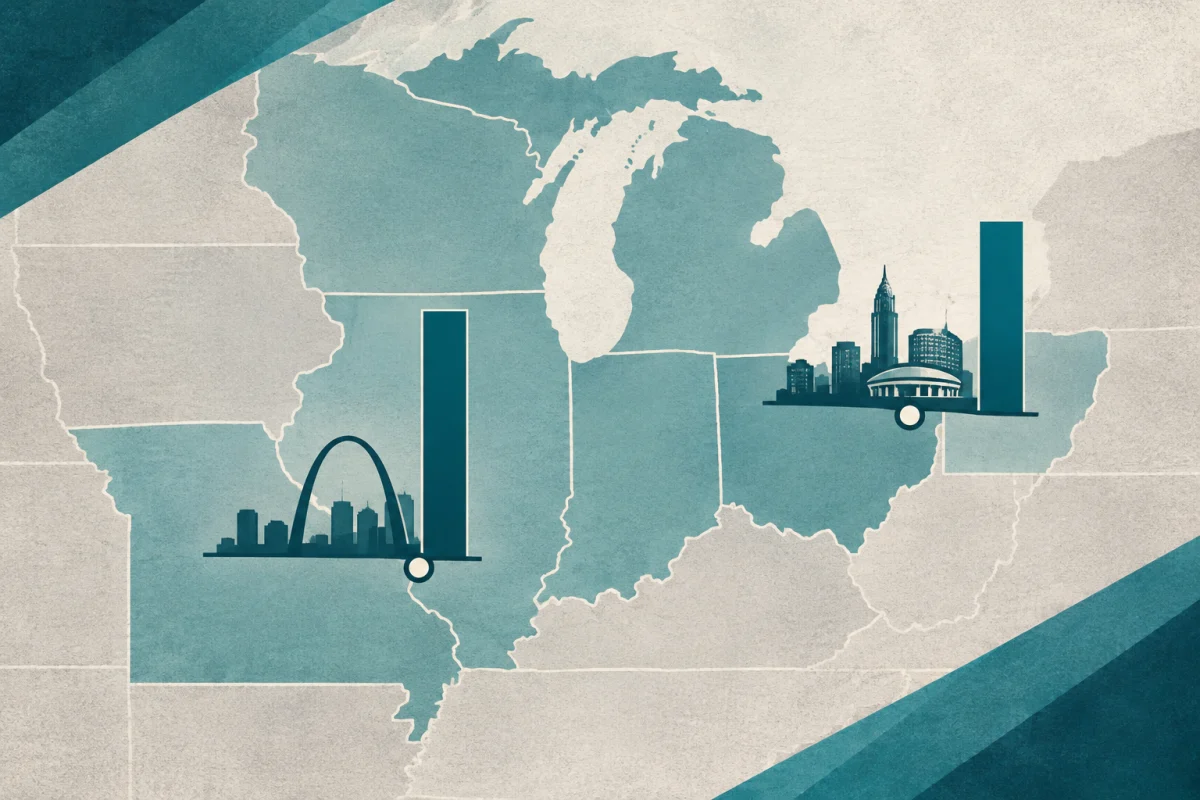
While the broader United States housing market grapples with the dual pressures of high mortgage rates and historically low inventory, several key metropolitan areas in the Midwest are emerging as beacons of resilience. Recent data indicates that markets in Ohio and Missouri are not only outperforming national averages in terms of buyer demand but are also maintaining a steady pace of transactions that defies the cooling trends seen in coastal and Sun Belt regions. This regional strength is largely attributed to a significant affordability advantage, as median home prices in these areas remain substantially lower than the national median, allowing first-time buyers and investors to remain active even as borrowing costs hover near two-decade highs.
A Comparative Analysis of Market Demand
The strength of the Midwest housing sector is most visible in the ratio of pending home sales to new listings. According to recent data from HousingWire, Columbus, Ohio, has established itself as one of the most competitive markets in the country. As of early November 2024, Columbus recorded 127 pending sales for every 100 new listings. This figure suggests a high level of market velocity where homes are being placed under contract faster than they are being replenished by new inventory.
Cincinnati followed closely behind with a ratio of 125 pending sales per 100 new listings. Both Ohio cities are performing significantly better than the national average, which currently sits at approximately 95 pending sales per 100 new listings. While Cleveland and St. Louis are performing slightly below the national benchmark—at 91 and 90, respectively—they continue to demonstrate a level of stability that mortgage professionals describe as resilient compared to high-cost markets like San Diego, Seattle, or Las Vegas.
The primary catalyst for this sustained demand is the price point. The national median list price was recently recorded at $429,000. In contrast, the Midwest hubs offer a far more accessible entry point for the average American household. Cleveland leads the affordability rankings with a median list price of $174,000, followed by St. Louis at $225,000. Columbus and Cincinnati, despite their high demand, maintain median prices of $255,000 and $300,000, respectively. These figures represent a 30% to 60% discount relative to the national average, providing a "buffer" against the impact of elevated mortgage rates.
The Impact of Elevated Mortgage Rates on Buyer Behavior
The Federal Reserve’s "higher-for-longer" interest rate policy has pushed 30-year fixed mortgage rates above the 7% threshold for much of the past year. In higher-priced markets, this has led to a "lock-in effect," where homeowners are reluctant to sell and lose their low-interest mortgages, and buyers are priced out by monthly payments that have nearly doubled since 2021. However, in the Midwest, the lower principal amounts mean that even at a 7% interest rate, the monthly mortgage payment remains manageable for a broader segment of the population.
Greg Iverson, a divisional sales manager for Neighborhood Loans in St. Louis, notes that while the market is moving toward a more balanced state, buyers remain active. He observes that the current environment is not strictly a buyer’s market, but it is shifting in that direction in specific neighborhoods where inventory has begun to accumulate. The primary obstacles for these buyers are not just the interest rates themselves, but the compounding effects of rising property taxes, homeowners insurance premiums, and the increased costs of home maintenance and repairs due to inflation in building materials.
In St. Louis, the market continues to see a mix of first-time buyers and "move-up" buyers. Because the total cost of acquisition is lower, these individuals are less likely to be entirely priced out of the market. Instead, they are becoming more deliberate, taking more time to inspect properties and negotiate terms—a luxury that was rarely available during the hyper-competitive pandemic-era bidding wars.
Chronology of Midwest Market Performance in 2024
The trajectory of the Midwest housing market throughout 2024 reflects a steady grind rather than a volatile surge.
- First Quarter 2024: Markets began the year with low inventory but high optimism as inflation appeared to be cooling. Purchase mortgage applications remained flat, but local demand in Ohio remained unseasonably high.
- Second Quarter 2024: As the Federal Reserve signaled that rate cuts might be delayed, national demand began to soften. However, Cleveland and Columbus saw a seasonal uptick in listings that was immediately met by pending contracts. Cleveland recorded a 0.9% year-over-year growth in purchase loans during the first seven months of the year, totaling 11,809 loans.
- Third Quarter 2024: September proved to be a challenging month across the region. Jason Harris, a Columbus-based branch manager at Rate, noted that contract activity slowed significantly during this period as mortgage rates spiked again. This led to a quieter October for closings.
- Fourth Quarter 2024: By late October and early November, a slight easing in mortgage rates led to a resurgence in contract activity. Buyers who had paused their searches in September returned to the market, particularly those utilizing state-backed down payment assistance programs and FHA loans.
Regional Economic Drivers and Employment Stability
The resilience of the Midwest is not solely a product of low prices; it is also anchored by a diversifying economic base. In smaller markets like Findlay, Ohio, the housing market is being supported by a robust expansion of logistics and industrial facilities. Scott Snapp, a branch manager at loanDepot in Findlay, points to the arrival of major distribution centers for companies like Amazon and planned facilities for Sheetz as primary drivers of housing demand.
These new business developments bring a steady stream of jobs, which in turn fuels the need for local housing. Snapp’s business has remained remarkably steady, with loan applications matching last year’s pace. In October 2024, his production levels were nearly identical to the previous year, with 51 loans closed totaling $11 million, compared to 57 loans totaling $12 million in the prior year. The average loan size in these smaller Ohio markets remains approximately $215,000, reinforcing the theme of affordability.
Furthermore, these regions are benefiting from "return-migration." Mortgage professionals report a consistent trend of individuals moving back to the Midwest from higher-cost states to be closer to family or to take advantage of remote work opportunities in a location where their salary stretches further. This influx of out-of-state capital often puts upward pressure on prices but also ensures a steady floor for demand.
Lending Trends and Investor Activity
Data from the mortgage platform Modex provides a granular look at the lending landscape in the Midwest. While purchase lending has not seen a uniform increase across all metros, it has remained more stable than in other parts of the country.
In Cincinnati, 14,048 purchase loans were recorded through July 2024, a modest 2.2% decline from the previous year. Columbus saw 12,820 loans (down 2.7%), and St. Louis saw 9,811 loans (down 6.8%, though this figure is subject to updates as county records are finalized). The median purchase loan amounts—ranging from $217,075 in Cleveland to $294,566 in Columbus—highlight the dominance of the "entry-level" market. In fact, more than 20% of all purchase loans in Cleveland and St. Louis were for amounts less than $150,000, a segment of the market that has virtually disappeared in coastal cities.
This price bracket also continues to attract real estate investors. While institutional investors have retreated from some markets due to high borrowing costs, smaller "mom-and-pop" investors remain active in St. Louis and Ohio. These investors are increasingly selective, seeking out markets where the rent-to-price ratio still yields a positive cash flow—a metric that is becoming harder to achieve in the South and West.
Future Outlook and Broader Implications
As the market moves toward 2025 and 2027, the outlook for the Midwest remains cautiously optimistic. Industry experts expect a seasonal slowdown in the winter months, but the underlying structural need for housing in the region remains strong.
Jason Harris of Rate anticipates that demand in Central Ohio will accelerate as the market enters 2027. He notes that the "Silicon Heartland" initiatives, including massive investments in semiconductor manufacturing in the region, are expected to create a long-term tailwind for housing demand. The reliance on Federal Housing Administration (FHA) loans and government-backed adjustable-rate mortgages (ARMs) is expected to increase as buyers seek any available edge to manage monthly costs.
The broader implication of the Midwest’s resilience is a potential shift in the national real estate narrative. For decades, the primary growth engines of the U.S. housing market were found in the "Smile States" (the West, South, and Southeast). However, as those markets reach a ceiling of affordability, the Midwest is proving that economic stability, coupled with a lower cost of living, can sustain a housing market even in a challenging interest rate environment. For policymakers and lenders, the Midwest serves as a case study in the vital importance of maintaining a supply of homes priced below the $300,000 mark to ensure the long-term health of the American dream of homeownership.
