

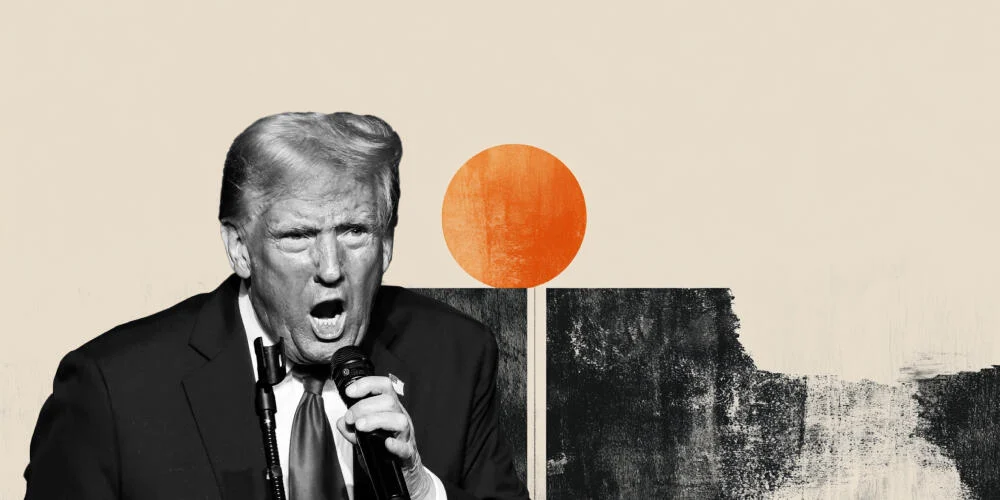
US President Donald Trump has signaled a significant shift in Washington’s posture toward Iran, stating that further military strikes would not be necessary, even as he maintained the United States remains "locked and loaded." The President’s remarks, reported by Bloomberg on Monday, suggested a pursuit of "positive momentum" towards an end to the protracted tensions with Tehran, claiming that "Iran, militarily, is effectively over." This de-escalatory rhetoric coincides with reports of a new diplomatic proposal aimed at reviving negotiations, mediated by Qatar and Pakistan, which could see Iran resume uranium enrichment at a limited level in exchange for substantial asset unfreezing by the United States.
President Trump elaborated on his assessment of Iran’s military capabilities, stating, "We’re just keeping it the status quo, and we’re doing that really at the behest of countries that are their neighbors." This assertion underscores a strategy of containment supported by key regional allies. His comments indicated a potential winding down of the conflict, a move that analysts suggest could be influenced by the deep unpopularity of prolonged military engagement, particularly following Republican midterm election losses. The President specifically named Qatar, Saudi Arabia, the UAE, Bahrain, and Kuwait as nations preferring the existing "status quo," which includes the US naval blockade and a newly referenced "Iron Gate land effort," presumably a regional security initiative designed to contain Iranian influence.
The Unraveling of a Deal: A Chronology of Escalation
To fully appreciate the current diplomatic overtures and de-escalatory rhetoric, it is crucial to revisit the trajectory of US-Iran relations, particularly since the signing of the Joint Comprehensive Plan of Action (JCPOA) in 2015. This landmark agreement, which saw Iran agree to curb its nuclear program in exchange for sanctions relief, was hailed as a triumph of diplomacy. However, the accord’s future became uncertain with the election of Donald Trump, who consistently criticized the deal as insufficient and flawed.
- May 2018: President Trump announced the unilateral withdrawal of the United States from the JCPOA, calling it "the worst deal ever." This decision marked a dramatic reversal of US policy and set the stage for renewed confrontation.
- August 2018 onwards: The Trump administration began reimposing "maximum pressure" sanctions on Iran, targeting its oil exports, banking sector, and other vital industries. The goal was to cripple the Iranian economy and force Tehran to negotiate a new, more comprehensive deal that would address its ballistic missile program and regional activities.
- May 2019: Iran announced it would gradually scale back its commitments under the JCPOA in response to the US withdrawal and the inability of European signatories to circumvent US sanctions effectively. This included exceeding limits on enriched uranium stockpiles and the level of uranium enrichment.
- June 2019: Tensions escalated sharply with a series of incidents in the Persian Gulf, including attacks on oil tankers and the downing of a US surveillance drone by Iran. These events brought the two countries to the brink of military conflict, with President Trump reportedly approving and then abruptly canceling retaliatory strikes against Iran.
- September 2019: Major drone and missile attacks on Saudi Arabian oil facilities, which the US and Saudi Arabia attributed to Iran, further heightened regional instability and underscored the vulnerability of global energy supplies. Iran denied involvement, though Houthi rebels in Yemen claimed responsibility.
These incidents illustrate a period of intense pressure and counter-pressure, with both sides engaging in brinkmanship. President Trump’s current statements, suggesting a winding down of the conflict and a search for "positive momentum," indicate a potential shift away from the purely confrontational approach that characterized much of this period, possibly acknowledging the economic and political costs of prolonged tension.
Iran’s Conditions for Dialogue and Regional Preferences
Amidst the US’s shifting stance, Iran’s Supreme National Security Council Secretary, Mohsen Rezaei, issued a stern message to Washington, urging it to "stop publishing false reports about negotiations." Rezaei reiterated that it was time for Washington to accept the "seven conditions Iran has repeatedly set out" and asserted that the ongoing conflict had inflicted "serious damage to the US government." While the specific details of these "seven conditions" are not publicly exhaustive, they are widely understood to encompass demands for comprehensive sanctions relief, verifiable security guarantees, a cessation of interference in Iran’s regional affairs, and potentially compensation for economic damages incurred under US sanctions. Iran’s consistent position has been that any new negotiation must acknowledge its sovereignty and national interests, and cannot be conducted under duress.
The regional landscape further complicates the dynamics. President Trump’s acknowledgment that Gulf states like Qatar, Saudi Arabia, the UAE, Bahrain, and Kuwait prefer the "status quo" speaks to a long-standing desire among these nations to contain Iranian influence. For these countries, the presence of US naval power, including the long-standing US naval blockade in the Persian Gulf, is a crucial deterrent against perceived Iranian aggression and maritime disruptions. The mention of a "new Iron Gate land effort" suggests a concerted regional security initiative, likely involving enhanced border security, intelligence sharing, and potentially joint military exercises aimed at bolstering defenses against land-based threats or illicit cross-border activities attributed to Iranian proxies. These nations have historically viewed Iran’s regional foreign policy, including its support for various non-state actors, as a direct threat to their stability and sovereignty. Their preference for a "status quo" of containment, therefore, reflects a desire for sustained pressure on Tehran without necessarily escalating to direct military conflict, which could destabilize the entire region.
A New Diplomatic Pathway: The Qatar-Pakistan Proposal
A significant development signaling a potential de-escalation comes in the form of a new diplomatic proposal put forth by Qatar and Pakistan. According to sources cited by Al Hadath, this initiative aims to "revive diplomatic negotiations between Washington and Tehran." The core of the proposal reportedly allows Iran to enrich uranium on its soil up to 3.67%, a limit that Tehran has reportedly accepted. This specific percentage is highly significant as it was the enrichment level permitted under the original JCPOA for peaceful energy purposes, well below the 20% enrichment level used for research reactors and vastly distant from the approximately 90% required for weapons-grade material. Iran’s reported acceptance of this limit suggests a willingness to return to a fundamental tenet of the original nuclear deal, signaling a potential desire to re-engage with the international community on its nuclear program in a verifiable manner.
In a reciprocal gesture, the United States has reportedly offered to unfreeze between $6 billion and $9 billion in Iranian assets. These assets, primarily Iranian oil revenues held in foreign banks, have been frozen under US sanctions, severely impacting Iran’s economy. The unfreezing of such a substantial sum would provide a much-needed economic lifeline to Tehran, potentially easing the severe economic hardship faced by the Iranian populace. The involvement of Qatar and Pakistan as mediators is also noteworthy. Both nations maintain diplomatic relations with both the US and Iran, positioning them as credible intermediaries capable of fostering dialogue and trust between two deeply mistrustful adversaries. Qatar, in particular, has often played a mediating role in regional disputes, leveraging its relationships across various political divides. This diplomatic channel offers a crucial avenue for de-escalation and a potential pathway towards a broader resolution of the multifaceted US-Iran standoff.
Economic Implications and the Global Oil Market
The ebb and flow of US-Iran tensions have profound implications for the global economy, particularly for the international oil market. The Persian Gulf is a critical artery for global energy supplies, with a significant portion of the world’s oil transiting through the Strait of Hormuz. Any disruption or perceived threat in this region immediately sends ripples through energy markets, affecting prices and supply chains worldwide.
West Texas Intermediate (WTI) crude oil, a key benchmark for international oil prices alongside Brent and Dubai Crude, is highly sensitive to geopolitical developments in the Middle East. WTI, known for its "light" gravity and "sweet" (low sulfur) content, is considered a high-quality oil that is easily refined. Sourced primarily in the United States and distributed via the Cushing hub—dubbed "The Pipeline Crossroads of the World"—its price is a frequent indicator of the health of the global oil market.
Several factors drive WTI oil prices, and the US-Iran situation impacts many of them:
- Supply and Demand: Political instability, wars, and sanctions, such as those imposed on Iran, can significantly disrupt oil supply. When Iranian oil exports are curtailed, it tightens global supply, pushing prices upward. Conversely, a diplomatic breakthrough that could potentially bring more Iranian oil back to the market could ease supply concerns and put downward pressure on prices. Global economic growth also drives demand; uncertainty stemming from geopolitical tensions can dampen growth and thus demand.
- OPEC Decisions: The Organization of the Petroleum Exporting Countries (OPEC), and its expanded group OPEC+ (which includes non-OPEC members like Russia), plays a pivotal role in managing global oil supply through production quotas. In times of geopolitical tension, OPEC’s decisions to either increase production to stabilize markets or decrease it to support prices become even more critical. A de-escalation between the US and Iran might influence OPEC to maintain current production levels or even consider adjustments if Iranian supply re-enters the market.
- US Dollar Value: As oil is predominantly traded in US dollars, the value of the dollar influences WTI prices. A weaker US dollar can make oil more affordable for holders of other currencies, potentially increasing demand and pushing prices up, and vice versa.
- Inventory Reports: Weekly oil inventory reports from the American Petroleum Institute (API) and the Energy Information Agency (EIA) provide crucial insights into supply and demand dynamics. A drop in inventories can signal increased demand or constrained supply, leading to higher oil prices, while higher inventories can indicate increased supply or weaker demand, pushing prices down. In a volatile geopolitical environment, these reports are closely watched for any indication of market shifts.
The prospect of Iran re-entering the global oil market with an unfreezing of assets, potentially leading to increased exports, would undoubtedly influence these dynamics. While the US sanctions have severely restricted Iran’s oil sales, a diplomatic agreement could gradually ease these restrictions, injecting more supply into the market and potentially contributing to lower global oil prices, which would be beneficial for consuming nations. Conversely, a breakdown of these diplomatic efforts and a return to escalation would likely trigger renewed market volatility and higher oil prices, posing risks to global economic recovery.
Broader Geopolitical Ramifications and Future Prospects
The current developments between the US and Iran carry significant broader geopolitical ramifications. A successful diplomatic resolution, even a partial one, could mark a turning point for regional stability. It could pave the way for reduced military confrontations, alleviate humanitarian concerns, and potentially open channels for addressing other contentious issues, such as regional proxy conflicts. For the international community, particularly the European signatories of the JCPOA (France, Germany, and the UK), a return to diplomatic engagement would be welcomed, as they have consistently advocated for the preservation of the nuclear deal and de-escalation. Such a development would reinforce the principles of nuclear non-proliferation and demonstrate the efficacy of multilateral diplomacy even in the face of profound disagreements.
However, significant challenges remain. A deep trust deficit exists between Washington and Tehran, exacerbated by years of hostile rhetoric, sanctions, and military posturing. Any new agreement would require robust verification mechanisms to ensure compliance, particularly concerning Iran’s nuclear program. Furthermore, domestic political considerations in both the US and Iran could pose obstacles. In the US, any deal might face opposition from hawkish elements in Congress or those who believe the "maximum pressure" campaign should continue. In Iran, hardliners might resist concessions, particularly if they perceive the terms as infringing on national sovereignty or failing to adequately compensate for past economic damages.
The "positive momentum" that President Trump speaks of, coupled with the Qatar-Pakistan initiative, presents a fragile but crucial opportunity. It suggests a potential recognition by both sides that an enduring state of conflict is unsustainable and detrimental to their respective interests. While the path to a comprehensive resolution is fraught with difficulties, the willingness to engage in dialogue and consider reciprocal gestures, such as asset unfreezing for nuclear restraint, represents a vital step towards de-escalating one of the world’s most enduring and dangerous geopolitical flashpoints. The coming months will be critical in determining whether this nascent diplomatic thaw can evolve into a lasting peace, reshaping the regional security architecture and impacting global energy markets for years to come.
