

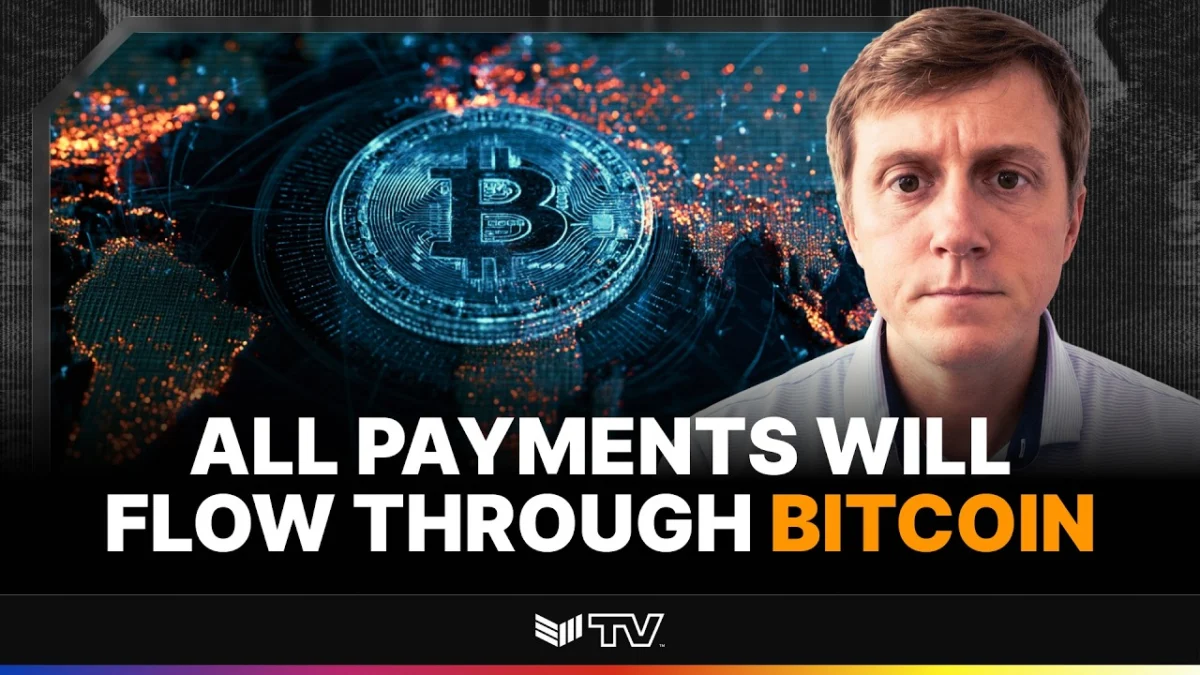
Parker Lewis, author of "Gradually, Then Suddenly," articulated a bold vision for Bitcoin’s future during a recent appearance on a podcast with Grace Remington and Sean Hagan. Lewis posits that Bitcoin is not merely a speculative asset but is destined to become the bedrock of global payment infrastructure, facilitating 100% of all transactions. This assertion is grounded in his analysis of the current financial system’s escalating debt burdens and the inherent limitations of existing credit mechanisms. The 2023 banking failures, he contends, served as a critical inflection point, illuminating the fundamental necessity of Bitcoin’s payment capabilities over its perceived role as digital capital. Lewis further elaborated on the mechanisms driving Bitcoin adoption, highlighting how merchants stand to benefit significantly by circumventing traditional credit card fees and chargeback risks, ultimately rendering the dollar price of Bitcoin a secondary concern.
On a macroeconomic level, Lewis presented a stark assessment of the Federal Reserve and the Treasury’s grip on the long end of the yield curve, citing the strain evident in 7% mortgage rates and corporate refinancing costs between 9% and 10%. He argues that this situation, exacerbated by a $107 trillion global debt stack—a dramatic increase from the $52 trillion recorded in 2007—leaves monetary authorities with little recourse but to resort to further money printing. The conversation also delved into the misalignments Lewis perceives between Bitcoin treasury companies, perpetual preferreds, and the interests of their investors.
The Catalyst: 2023 Bank Failures and the Shift to Payments
The dramatic collapse of Silicon Valley Bank (SVB) in March 2023, followed by Signature Bank and First Republic Bank, served as a pivotal moment for Parker Lewis’s perspective on Bitcoin. These failures exposed vulnerabilities within the traditional banking sector, revealing how quickly confidence could erode and liquidity could vanish. While many viewed these events through the lens of investment risk or systemic fragility, Lewis saw them as a profound validation of Bitcoin’s utility as a payments network.
"The events of 2023, particularly the bank runs and the subsequent interventions by regulators, fundamentally shifted my focus," Lewis stated. "We saw how fragile the existing payment rails are when trust breaks down. People need a way to transact reliably, securely, and without intermediaries that can fail or impose arbitrary restrictions. This is where Bitcoin, with its decentralized and censorship-resistant nature, becomes not just an alternative, but a necessity."
Prior to these events, Lewis acknowledges that the discourse around Bitcoin often centered on its potential as a store of value, a digital gold. However, the banking crisis underscored that a store of value is only truly potent if it can be readily used for exchange. The inability of depositors to access their funds during bank failures highlighted the critical importance of the "value transfer loop"—the ability to seamlessly move wealth.
Bitcoin as a Necessary Payment System: Closing the Value Transfer Loop
Lewis’s argument for Bitcoin’s dominance in global payments is built on the concept of closing the value transfer loop. He contends that Bitcoin’s inherent design, as a peer-to-peer electronic cash system, is fundamentally geared towards facilitating transactions. While its scarcity and resistance to inflation make it an attractive store of value, its true revolutionary potential lies in its ability to bypass the inefficiencies and risks of traditional financial intermediaries.
"For too long, we’ve framed Bitcoin as ‘digital capital’—something to be held, not used," Lewis explained. "This framing misses the point. Bitcoin is already money. It has all the properties of money, and its unique ability to transfer value globally, instantly, and without a trusted third party is its most compelling feature. The bank failures demonstrated that the existing system struggles with this fundamental aspect of value transfer."
The "digital capital" framing, according to Lewis, leads to misalignments, particularly within Bitcoin treasury companies. These companies often raise capital by issuing shares, which are then used to purchase Bitcoin. While this might seem like a straightforward way to gain Bitcoin exposure, it creates a situation where the company’s performance is directly tied to the price of Bitcoin, but the investors’ returns are diluted by management fees, operational costs, and the inherent risks of a publicly traded entity.
The Merchant Imperative: Driving Adoption Through Fee Reduction and Chargeback Elimination
A significant driver of Bitcoin’s eventual 100% payment adoption, as outlined by Lewis, will be the direct economic incentives for merchants. The current credit card processing system, dominated by companies like Visa and Mastercard, imposes fees that can range from 1.5% to 3.5% per transaction. For businesses operating on thin margins, these fees represent a substantial cost.
Furthermore, merchants are exposed to the risk of chargebacks, where a customer disputes a transaction and can have the funds reversed, often with little recourse for the merchant. This adds another layer of financial uncertainty and administrative burden.
"Merchants are the engine of adoption," Lewis asserted. "When they can accept payments directly in Bitcoin, they immediately eliminate those 3% fees. This is a direct increase in their bottom line. Moreover, Bitcoin transactions are final. There are no chargebacks. This provides a level of certainty and security that the current system simply cannot offer."
The adoption process, Lewis predicts, will not be driven by top-down mandates but by grassroots adoption from businesses seeking to improve their profitability and operational efficiency. As more merchants begin accepting Bitcoin, consumers will find it increasingly convenient to use it for everyday purchases. This creates a virtuous cycle.
The Irrelevance of the Dollar Price
As Bitcoin increasingly integrates into the global payment system, Lewis argues that its dollar price will become progressively less relevant. This might seem counterintuitive to many observers who focus heavily on Bitcoin’s volatility against fiat currencies. However, Lewis’s perspective is that once Bitcoin is the dominant medium of exchange, its value will be measured by its purchasing power in goods and services, rather than its exchange rate against a depreciating fiat currency.
"When you are paying for your coffee, your groceries, or your rent directly in Bitcoin, you care about how much that Bitcoin can buy, not how many dollars it’s worth at that exact moment," he explained. "The dollar price becomes a relic of a bygone era, a measure of its value relative to a failing system. In a Bitcoin-standard world, you’ll be thinking about how many Bitcoin it costs to buy a loaf of bread, or how much Bitcoin you earn for your labor."
This shift in perception is crucial. It suggests a future where Bitcoin’s value is derived from its utility and adoption as a global currency, rather than its speculative appeal against fiat. The network effects of a ubiquitous payment system would solidify its value proposition, making it the de facto unit of account for a global economy.
The Strain on the Credit System: A $107 Trillion Debt Crisis
Lewis’s macroeconomic analysis paints a concerning picture of the global financial system. He highlights the staggering $107 trillion in global debt, a figure that has more than doubled since 2007’s $52 trillion. This massive accumulation of debt, he argues, is unsustainable and is beginning to show its cracks, particularly in the long end of the yield curve.
The current environment of 7% mortgages and corporate refinancing rates hovering around 9-10% is a clear indicator of this strain. Lenders are demanding higher yields to compensate for the increased risk of default and inflation, making it increasingly expensive for individuals and businesses to borrow money.
"The Federal Reserve and the Treasury have, in essence, lost control of the long end of the curve," Lewis stated. "They can manipulate short-term rates, but the market is signaling a profound lack of confidence in the long-term value of the dollar and the solvency of borrowers. The only way out of this debt spiral, in their current framework, is to print more money. But this only exacerbates the underlying problem of inflation and devalues the currency further."
This macroeconomic backdrop provides a compelling reason for a viable alternative to the current monetary system. Bitcoin, with its fixed supply and decentralized nature, offers a stark contrast to the inflationary tendencies and inherent risks of fiat currencies and debt-laden financial structures.
Perpetual Preferreds: A Misaligned Financial Instrument
The discussion also touched upon perpetual preferreds, a type of financial instrument that Lewis views as fundamentally misaligned with investor interests. Perpetual preferreds are hybrid securities that pay a fixed dividend indefinitely. However, Lewis argues that they often function as a form of currency swap, where investors are essentially lending dollars in exchange for a yield that may not keep pace with inflation, and without the upside potential of traditional equity.
"Perpetual preferreds are often marketed as a safe, income-generating investment," Lewis observed. "But when you look at the underlying economics, especially in an inflationary environment, they are effectively a way for issuers to borrow at a fixed rate indefinitely, while investors are locked into a return that is likely to be eroded by inflation. They are not building wealth in the way that a true, scarcity-based asset like Bitcoin can."
He estimated that the market for perpetual preferreds, and similar fixed-income instruments, represents a significant amount of capital that could be better allocated towards assets that preserve and grow wealth in the long term. The $1.5 trillion reality he refers to likely points to the scale of capital tied up in these potentially suboptimal investments.
Building for the Next 10x: Lightning Network and On-Chain Capacity
Addressing the technical aspects of Bitcoin’s scalability, Lewis emphasized the importance of both on-chain and off-chain solutions. While the Bitcoin blockchain has a finite capacity for transactions, the development of the Lightning Network offers a scalable solution for everyday payments.
"The Lightning Network is crucial for enabling Bitcoin to handle the volume of global payments," Lewis explained. "It allows for near-instantaneous, low-cost transactions by creating payment channels off the main blockchain. This is how we build for the next 10x, and the 100x, in terms of transaction volume."
He stressed that the ongoing development and adoption of the Lightning Network are key to realizing Bitcoin’s potential as a global payment system. The interplay between the security and finality of on-chain transactions and the speed and efficiency of the Lightning Network creates a robust and adaptable infrastructure.
Conclusion: A Paradigm Shift in Global Finance
Parker Lewis’s analysis presents a compelling case for Bitcoin’s inevitable ascent to become the world’s primary payment system. Driven by the inherent flaws and escalating debt within the current financial paradigm, and facilitated by the economic incentives for merchants and the increasing utility of the Lightning Network, Bitcoin is positioned for a transformative role. The convergence of these factors suggests a future where the transactional capabilities of Bitcoin not only rival but ultimately surpass those of traditional financial systems, leading to a fundamental redefinition of value and a paradigm shift in global finance.
Disclaimer: The views and opinions expressed in this article are those of the interviewee, Parker Lewis, and do not necessarily reflect the official policy or position of Bitcoin Magazine or any affiliated entities. This content is provided for informational and educational purposes only and should not be construed as investment, legal, tax, or accounting advice. Nothing contained in this article constitutes a solicitation, recommendation, endorsement, or offer to buy or sell any securities or financial instruments. Viewers should consult their own advisors before making financial or business decisions.
