

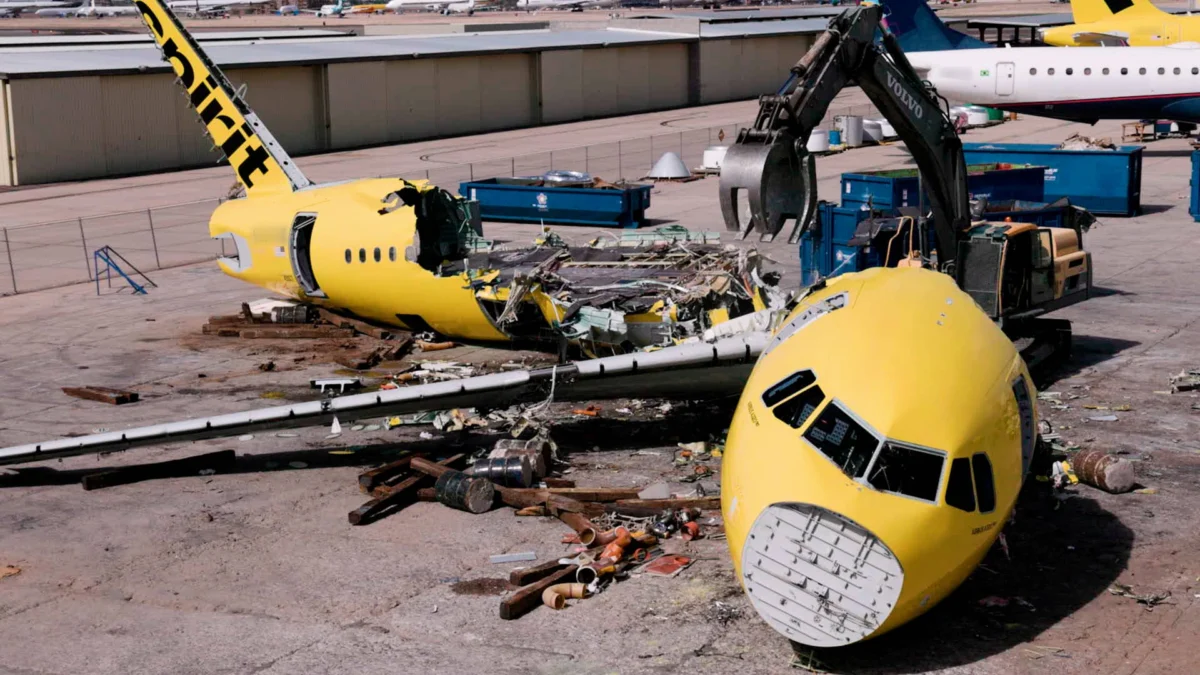
GOODYEAR, Ariz. — A striking and increasingly common sight on the arid plains of Arizona—once a graveyard for venerable aircraft reaching the end of their long service lives—is now the dismantling of jets barely out of their infancy. This alarming trend underscores profound dislocations within the global aviation industry, primarily driven by an acute shortage of critical spare parts, most notably high-tech aircraft engines. The economic calculus for airlines and leasing firms has shifted dramatically, making it more profitable to tear apart relatively new planes for their components than to endure prolonged groundings and escalating maintenance costs.
The stark reality was vividly illustrated in May, on the outskirts of Phoenix, as an Airbus A320neo, a cornerstone of modern narrow-body fleets, was systematically stripped for parts and then crushed by the unforgiving steel jaws of an excavator. This particular aircraft, built to fly for decades, had rolled off the Mobile, Alabama, factory line in July 2022, destined for Spirit Airlines. Less than four years after its initial delivery, painted in the carrier’s signature bright yellow livery, it met an untimely end. Industry executives, speaking to CNBC, confirm that this is not an isolated incident but part of a burgeoning pattern where aircraft are being retired and repurposed years, if not decades, ahead of their expected lifespan.
The Accelerating Demise of Young Jets
The conventional wisdom in aviation dictates that narrow-body aircraft, workhorses of domestic and regional routes, typically enjoy an operational life exceeding two decades, often averaging around 21.7 years before retirement, according to aviation data and advisory firm IBA Group. However, recent data paints a starkly different picture. From June 2023 through August 2024, IBA Group recorded the premature dismantling of twenty-one newest-generation aircraft. These planes, predominantly Airbus but including some Boeing models, were on average a mere 6.4 years old when they were consigned to the scrap heap. This precipitous drop in average retirement age represents an existential challenge to the long-term asset value models that underpin the aviation leasing and financing sectors.
Bill Thompson, Vice President of Aircraft and Engine Acquisition for the Americas at EirTrade Aviation, an aviation asset management and trading firm, expressed his astonishment at the trend. "It’s the first time in my career that involved purchasing an aircraft that’s less than five years since date of manufacture," Thompson stated, referring to EirTrade’s acquisition of the less-than-four-year-old Airbus A320neo. His firm paid "single-digit" millions for this plane and a similarly aged counterpart, anticipating substantial profits from the sale of over a thousand salvaged parts. From crucial landing gear and sophisticated avionics to seemingly mundane items like antennae and even coffee makers, every component is now a valuable commodity in a market starved for supply.
This shift reflects a fundamental principle articulated by industry veterans like Simon Goodson, CEO of AerFin, a company specializing in aircraft and parts trading: "We always say to our aircraft and engine traders, ‘Please don’t fall in love with the metal.’" The emotional attachment to a gleaming new airframe must yield to the harsh realities of market economics, where the aggregate value of individual components can now outstrip the worth of a grounded aircraft facing indefinite delays for repair.
The Epicenter of the Crisis: Next-Generation Engines
At the heart of this unprecedented wave of premature retirements lies a profound crisis in the supply and maintenance of advanced jet engines. Modern engines, engineered to operate at higher temperatures and with greater fuel efficiency, are proving to be less durable than anticipated. This has led to an unexpected surge in maintenance requirements, bringing engines into the repair shop far earlier than airlines and manufacturers had projected.
The impact has been catastrophic for the global Maintenance, Repair, and Overhaul (MRO) sector. Facilities owned by giants like GE Aerospace and RTX unit Pratt & Whitney, alongside smaller independent shops, are experiencing unprecedented backlogs. This logjam has created a domino effect across the industry, forcing airlines and leasing companies into a desperate hunt for spare parts and engines wherever they can be found, including the burgeoning market for salvaged components from scrapped aircraft.
A significant exacerbating factor has been the widespread recall issued by Pratt & Whitney in 2023 for its geared turbofan (GTF) engines, specifically those powering a substantial portion of the Airbus A320neo family. The recall stemmed from the discovery of contaminated powdered metal used in the manufacturing of certain engine parts, necessitating exhaustive inspections and potential replacements. This issue alone has grounded hundreds of Airbus planes worldwide, plunging numerous airlines into operational chaos.
The financial implications are staggering. The value of these affected Pratt & Whitney engines has surged, reaching close to $17 million this year at the high end—a remarkable 60% increase from 2019 levels, according to IBA. The cost to rent a replacement engine, a stopgap measure for many airlines, has soared to record highs, ranging from approximately $160,000 to $180,000 per month for the affected GTF engines. Even competing engines from CFM International (a GE Aerospace and Safran joint venture) for the A320neo family command similar rental rates, reflecting the universal scarcity.
Economic Imperatives: Parts Over Planes
For aircraft owners, the decision to dismantle a young aircraft, often still under warranty, is a purely economic one. The prolonged wait for engine repairs, which can stretch for months or even years, translates into millions of dollars in lost revenue from grounded aircraft, coupled with ongoing storage and maintenance costs. In many scenarios, the cumulative value of an aircraft’s components, sold individually in a supply-constrained market, far exceeds the potential revenue from flying the plane or the cost of holding it in storage indefinitely.
Dave Querio, CEO of Ascent Aviation Services, a company specializing in aircraft repair, modification, storage, and disassembly, noted the unprecedented volume of young aircraft being torn down. "A year might not sound that long, but does three or four years?" he questioned, highlighting the dilemma faced by owners of aircraft delivered in 2023, 2024, and 2025. This critical juncture often tips the scales in favor of disassembly.
The secondhand parts market has become extraordinarily lucrative. An engine fan blade, for instance, can fetch upwards of $50,000, potentially exceeding $100,000 for larger jets. With some A320neo engines containing 20 such blades, and a single engine disc costing between $1 million and $2 million, the incentive to salvage is clear. Mike Stengel, a partner at AeroDynamic Advisory, an aerospace consulting firm, aptly describes the situation as "playing Legos and moving engines on and off aircraft," where operational fleets are sustained by cannibalizing grounded ones.
The Ghost Fleet of Spirit Airlines
The collapse of Spirit Airlines, a major low-cost carrier, in May 2026, significantly amplified the trend of young aircraft entering the parts market. While the issues leading to premature scrapping predated Spirit’s demise, the airline’s extensive fleet of A320neo aircraft, heavily impacted by the Pratt & Whitney engine recall, became a particularly poignant example. Many of these planes had already been placed in storage due to the engine defects, awaiting repairs that never came.
CNBC’s visit to AerSale’s facility in Goodyear, Arizona, in late June, just weeks after Spirit’s shutdown, revealed dozens of idle yellow planes baking in the scorching desert sun. The scene was surreal; some jets still contained Spirit’s in-flight menus, safety cards, and even pilot manuals in the cockpit—ghosts of a recently departed airline. Former Spirit captain Glenn Zecchin, now flying corporate jets, made a pilgrimage to the desert to witness the fate of his former employer’s fleet.
While not all of Spirit’s former aircraft will be destroyed—some may find new life with other carriers, albeit often after extensive cabin reconfigurations to remove Spirit’s famously tight 28-inch seat pitch—many are destined for the salvage yard. The decision hinges on the prevailing demand for parts versus the ongoing costs of storage and the formidable delays in securing new engines or repairs. The arid desert climate of Arizona is ideal for preserving aircraft and preventing corrosion, allowing some planes to sit for decades, but others will inevitably face the smelter.
As Stengel observed, "After you get rid of all the valuable equipment and sell it back into the aftermarket, what’s really left is just a metal carcass that you will literally take a crane and crush." This metal carcass is then sold to recyclers, potentially ending up as beer cans or other non-aerospace products. Querio of Ascent Aviation Services described the process with a hint of melancholy mixed with professional thrill: "It’s a little melancholy to watch it at times… But sometimes, it’s kind of a thrill to… see how fast an aircraft can be crunched up and sent off to the smelter."
Broader Implications and the Road Ahead
The premature scrapping of young aircraft carries far-reaching implications for the entire aviation ecosystem. For passengers, this translates to reduced aircraft availability, contributing to higher airfares and potentially fewer route options as airlines struggle to maintain schedules with fewer operational planes. It also raises concerns about the environmental footprint, as less fuel-efficient older aircraft might be kept in service longer to compensate for grounded newer models, or the energy expenditure in manufacturing new planes only to scrap them prematurely.
For aircraft manufacturers like Airbus and Boeing, the crisis highlights the critical need for robust supply chains and reliable engine technology. While they continue to ramp up production of new, more fuel-efficient models, the current engine and parts shortages threaten to undermine the very benefits these new aircraft are designed to deliver. The MRO sector, while benefiting from increased demand, is grappling with unprecedented backlogs and a global shortage of skilled technicians, further exacerbating the problem.
Aircraft leasing companies, which own a significant portion of the global commercial fleet, face substantial challenges in managing their assets and mitigating financial risk. Their valuation models, typically based on decades of operational life, are being upended, forcing a reevaluation of investment strategies and residual value forecasts.
Addressing this multifaceted crisis will require a concerted effort from all stakeholders. Engine manufacturers must accelerate production, improve reliability, and streamline maintenance processes. Airlines need to diversify their engine suppliers and develop more resilient operational strategies. Governments and regulatory bodies may need to consider policies that support MRO infrastructure and address skilled labor shortages. Until these systemic issues are resolved, the image of young, vibrant aircraft being torn apart for their components will remain a stark reminder of the deep cracks in the foundations of global aviation.
Erin Black contributed to this report.
