

American Express Co., the global financial services giant renowned for its credit card and payment solutions, is embarking on a substantial global workforce reduction, signaling a pivotal shift towards increased automation and artificial intelligence integration within its operational framework. The company announced plans to eliminate approximately 5% of its worldwide employee base, a strategic move that will impact thousands of roles as the firm aims to become "leaner, more agile," and strategically positioned to leverage emerging AI capabilities. This significant restructuring comes alongside a robust third-quarter 2026 earnings report, which largely surpassed Wall Street expectations, underscoring a period of strategic repositioning even amidst strong financial health.
The Strategic Imperative: AI and Efficiency Drive
The decision to streamline its workforce was formally communicated during the company’s third-quarter 2026 earnings call, where Chairman and Chief Executive Officer Stephen Squeri detailed the comprehensive restructuring efforts. American Express, which boasted nearly 77,000 employees globally at the close of 2025, will see thousands of positions phased out. This restructuring initiative is projected to incur a substantial $336 million charge, a testament to the scale of the transformation underway.
Christophe Le Caillec, Chief Financial Officer at American Express, elaborated on the strategic underpinnings of these changes in an interview, emphasizing the dual objectives of making the company "leaner, more agile, and also to prepare for AI." Le Caillec articulated a clear vision: the company is not merely automating existing processes but rather re-engineering its operational structure to optimize for future AI integration. "You don’t want to automate processes that are not optimally structured," Le Caillec stated, outlining the strategy to "reduce layers and increase spans of controls, so that we can automate and take advantage of AI in the coming quarters and the coming years." This proactive approach suggests a fundamental redesign of workflows and organizational hierarchy, anticipating a future where AI handles a greater proportion of internal functions.
CEO Stephen Squeri further reinforced this commitment to efficiency and innovation during the analyst call. "We’ve got good momentum, but to accelerate innovation and win over the next few years, we needed to become [a] more agile and efficient organization," Squeri explained. This statement frames the layoffs not as a reaction to financial distress, but as a deliberate, forward-looking strategy to maintain and enhance competitive advantage in a rapidly evolving technological landscape. The restructuring charge, while impacting short-term profitability, is presented as an investment in the company’s long-term operational effectiveness and capacity for innovation.
A Broader Industry Trend: Financial Services Embraces Automation
American Express’s announcement is not an isolated event but rather reflects a growing, transformative trend sweeping across the financial services sector. Banks and credit card companies globally are increasingly turning to artificial intelligence and automation technologies to replace repetitive, routine, and data-intensive roles, aiming to boost efficiency, reduce costs, and enhance service delivery. Just a day prior to Amex’s disclosure, Barclays PLC confirmed its own plans to trim approximately 5,000 jobs, representing roughly 5% of its staff, in another significant tech-driven cost-reduction initiative. This parallel move by a major European bank underscores the pervasive nature of this technological shift within the industry.
Historically, the financial sector has often been at the forefront of adopting new technologies to streamline operations. From the introduction of ATMs in the 1970s that revolutionized basic banking transactions, to the advent of online banking and mobile applications that significantly reduced the need for physical branch networks and teller staff, technology has consistently reshaped the industry’s employment landscape. The current wave of AI and machine learning, however, promises a more profound impact, capable of automating not just transactional tasks but also complex analytical, decision-making, and customer interaction processes.
Experts suggest that roles involving extensive data entry, basic customer service inquiries, fraud detection, compliance monitoring, and even certain aspects of credit risk assessment are prime candidates for AI automation. While this transition is expected to displace some existing jobs, it is also anticipated to create new roles focused on AI development, deployment, maintenance, and ethical oversight, demanding a different skill set from the workforce. The strategic challenge for financial institutions lies in managing this transition effectively, ensuring a smooth integration of AI while mitigating the human cost.
American Express’s Vision for AI: Personalization with Prudence
Beyond internal operational efficiencies, Stephen Squeri dedicated a substantial 10-minute segment of his prepared remarks during the earnings call to articulate American Express’s comprehensive vision for AI, particularly its application in enhancing cardholder experiences. The CEO emphasized how AI would be leveraged to deliver highly personalized experiences and tailored offers to Amex customers, moving beyond generic marketing to truly individualized engagement. This involves sophisticated data analytics, machine learning algorithms, and predictive modeling to understand customer preferences, spending habits, and life events, enabling the company to proactively offer relevant products, services, and rewards.
However, Squeri also struck a cautious note, highlighting the critical importance of security, privacy, and control in the deployment of AI, especially when interacting with sensitive customer data. While acknowledging customers’ growing desire to utilize AI, including AI-powered agents, Squeri firmly stated that American Express would not "let assistants run rogue through our system." This declaration underscores the company’s commitment to protecting its customers and merchants from potential risks associated with unbridled AI access. He elaborated that Amex would only permit agents to access its systems if approved through secure API (Application Programming Interface) or MCP (Merchant Centric Platform) channels. These robust security protocols are designed to ensure that external platforms and AI agents interact with Amex systems in a controlled, authenticated, and secure manner, safeguarding proprietary data and maintaining the integrity of financial transactions. This balanced approach—embracing AI’s potential for personalization while rigorously managing its risks—is indicative of the complex considerations financial institutions face in the era of advanced technology.
Robust Financial Performance Underpins Strategic Shift
The significant organizational changes at American Express are being implemented against a backdrop of strong financial performance in the third quarter of 2026. The company reported adjusted earnings per share (EPS) of $4.68, comfortably surpassing the average analyst estimate of $4.48, as compiled by LSEG. This earnings beat signals a healthy underlying business despite the strategic restructuring.
Building on this positive momentum, American Express also raised its full-year earnings guidance. The revised unadjusted forecast now stands between $18.30 and $18.60 per share, an increase from its previous target range of $17.30 to $17.90. This upward revision reflects confidence in the company’s ongoing profitability and the anticipated benefits of its efficiency initiatives.
Part of this improved financial outlook was attributed to proceeds from the sale of Amex’s stake in Global Business Travel Group. CFO Christophe Le Caillec confirmed that a portion of these proceeds was allocated to fund the restructuring plan, illustrating how strategic asset management can support transformational corporate initiatives. This divestment, announced earlier, provided capital that could be reinvested into strategic priorities like AI and operational efficiency, rather than solely relying on operational cash flow to cover the restructuring costs.
Despite the strong profit figures, total revenue for the quarter, while increasing by 9% year-over-year to $20.06 billion, came in slightly below Wall Street’s LSEG forecast of $20.12 billion. Executives attributed this minor revenue drag in part to recent exits from certain small business co-brand partnerships. While the impact was marginal, it highlights the dynamic nature of the payments industry and the constant evaluation of partnership strategies.
Following the announcement, shares of American Express experienced a modest decline, falling approximately 3% in morning trading. This market reaction could be interpreted in several ways: investors might be reacting to the immediate costs associated with the restructuring charge, or perhaps a slight disappointment regarding the revenue miss. Alternatively, it could reflect a broader cautious sentiment regarding the long-term implications of significant workforce reductions and the inherent uncertainties of large-scale AI integration, despite the stated strategic benefits.
The Human Element and Future Workforce Implications
While the narrative from American Express executives focuses on strategic agility and technological advancement, the thousands of employees affected by these layoffs represent the human dimension of this corporate transformation. For those impacted, the job market presents both challenges and opportunities. The demand for skills in AI, data science, cybersecurity, and advanced analytics is rapidly growing, suggesting that individuals with adaptable skill sets may find new avenues. However, the transition can be difficult for those whose roles are directly automated, necessitating retraining and upskilling initiatives either by the company or through external programs.
From a broader workforce perspective, these developments at American Express and Barclays are indicative of a significant shift in the employment landscape within financial services. Companies are increasingly seeking a workforce that can collaborate with AI systems, interpret complex data, and engage in high-value, strategic thinking rather than routine processing. This could lead to a polarization of skills, where highly specialized technical roles and creative, strategic positions become more valuable, while middle-tier administrative and operational roles face increased pressure from automation.
Chronology of Key Events and Context
The strategic restructuring at American Express is the culmination of ongoing efforts to adapt to a rapidly changing technological and economic environment. While the specific layoff announcement came during the Q3 2026 earnings call, the groundwork has been laid over time:
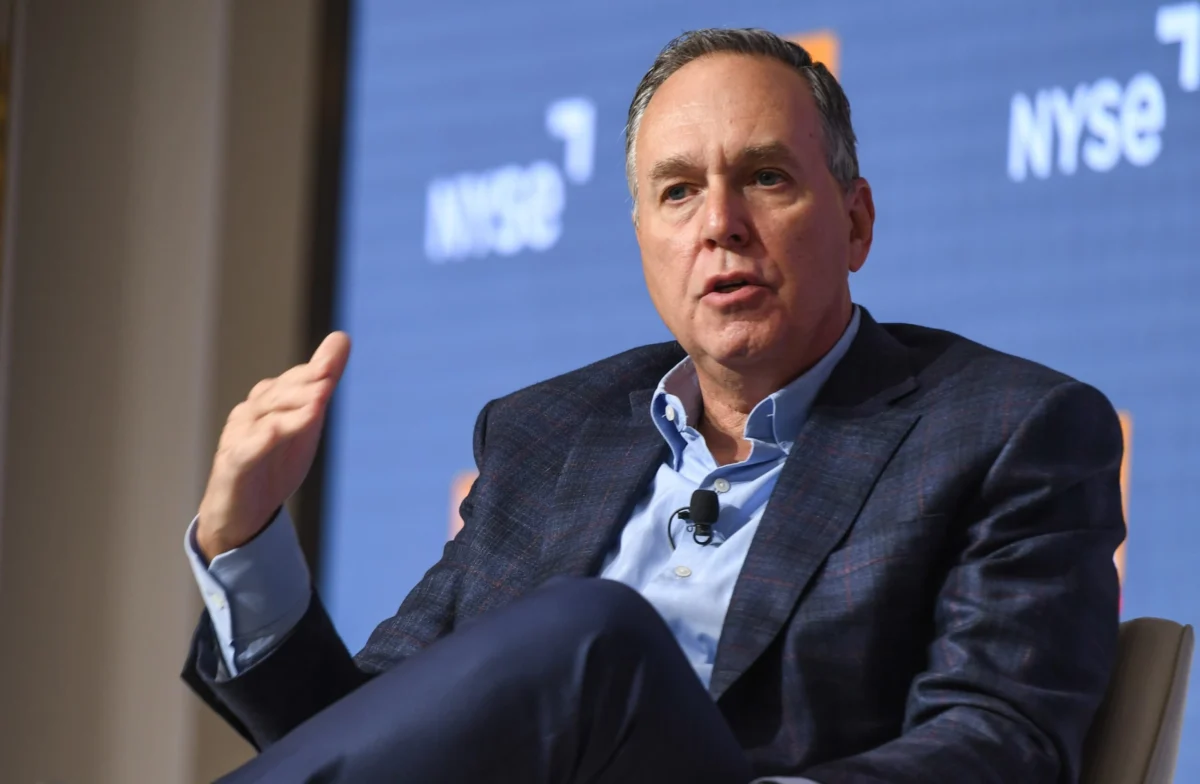
- November 10, 2022 (File Photo Context): An image of Stephen Squeri, Chairman and CEO of American Express, speaking at an Economic Club of New York event, provides a visual historical context, reminding of his long-standing leadership in shaping the company’s direction. While the photo date precedes the current news, it represents the leadership that has been steering Amex through evolving challenges.
- Late 2025: American Express reports an employee count of nearly 77,000, establishing the baseline for the subsequent workforce reduction.
- Prior to Q3 2026 Earnings Call: American Express engages in the sale of its stake in Global Business Travel Group, generating proceeds that would later help fund the restructuring. This demonstrates proactive financial management in anticipation of strategic investments.
- Third Quarter 2026 Earnings Call (Specific Date not provided, but implied as a Friday): Stephen Squeri officially announces the 5% global workforce reduction and the associated $336 million restructuring charge. Christophe Le Caillec provides further context on the AI and efficiency rationale. The company simultaneously reports robust Q3 2026 financial results, including an EPS beat and raised full-year guidance.
- Immediate Aftermath: Shares of American Express fall approximately 3% in morning trading, reflecting initial market reactions to the news. Other financial institutions, such as Barclays, have also recently announced similar, large-scale job cuts driven by technology integration, signaling a systemic shift across the sector.
Conclusion: Navigating the Future of Finance
American Express’s decision to cut thousands of jobs while simultaneously investing heavily in artificial intelligence marks a significant moment in the company’s long history and serves as a powerful indicator of the future trajectory of the financial services industry. It represents a bold strategic pivot, designed to enhance operational efficiency, accelerate innovation, and solidify its competitive position in an increasingly digitized world. The company’s nuanced approach to AI, emphasizing both its transformative potential for customer experience and the critical need for robust security and ethical controls, reflects the complex challenges and opportunities that lie ahead. As financial institutions continue to navigate this era of unprecedented technological change, the balance between leveraging cutting-edge innovations and managing the human and societal implications of these shifts will remain a central and critical challenge.
