

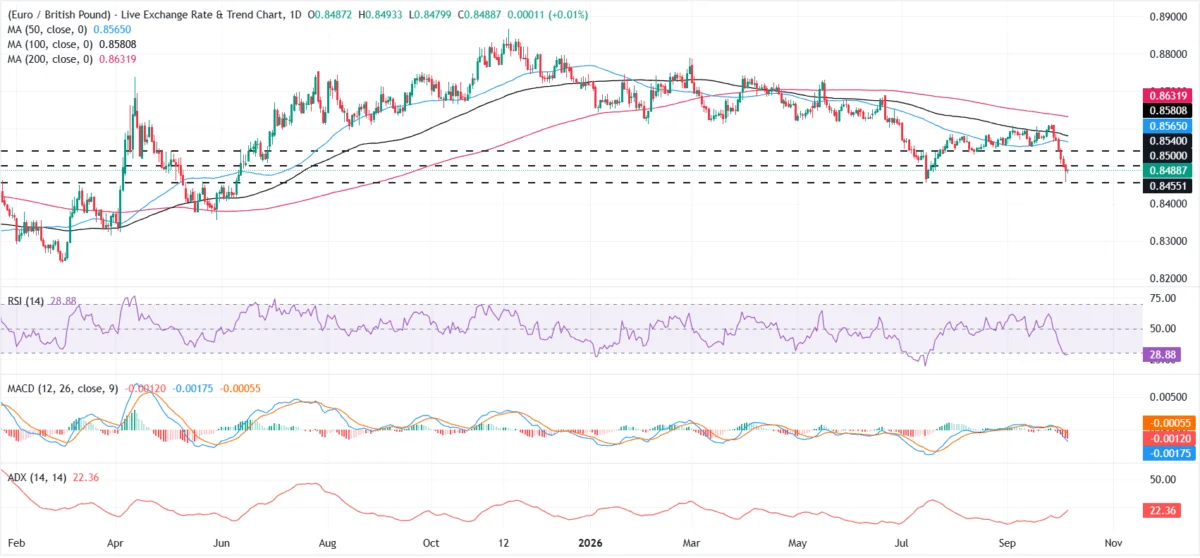
The EUR/GBP currency pair experienced fluctuations between gains and losses on Tuesday, momentarily halting a pronounced seven-day selloff. This prolonged depreciation of the Euro (EUR) has been primarily driven by escalating anxieties surrounding France’s fiscal health. At the time of reporting, the cross traded around 0.8488, showing little change for the day and maintaining a position above Monday’s low of 0.8458, a level not seen since July. The subdued price action on Tuesday was also partly attributable to a lighter economic calendar, offering little fresh impetus to market participants. However, the underlying concerns regarding French sovereign debt and political instability continue to cast a long shadow over the single currency, prompting a re-evaluation of Eurozone economic resilience and its broader implications for global markets.
A Deep Dive into France’s Fiscal Predicament and Political Instability
The recent downturn in the Euro’s value, particularly against the British Pound, is inextricably linked to the evolving political and fiscal landscape in France. President Emmanuel Macron’s unexpected decision to call a snap legislative election in early June, following a significant defeat for his centrist alliance in the European Parliament elections, ignited a firestorm of market anxiety. This move introduced a substantial layer of political uncertainty, as polls quickly indicated a strong performance by the far-right National Rally (RN) party, led by Marine Le Pen, and a resurgent left-wing coalition.
The core of the market’s apprehension lies in the potential economic policies that could be enacted should either of these anti-establishment blocs gain significant power. Both the National Rally and the New Popular Front (NFP) – the left-wing alliance – have proposed spending plans that economists and rating agencies warn could exacerbate France’s already strained public finances. The National Rally’s platform, for instance, includes proposals for tax cuts, lowering the retirement age, and increasing public sector wages, while the NFP advocates for significant social spending increases and nationalizations.
France’s fiscal position was already under considerable pressure before these political developments. The country’s debt-to-GDP ratio stood at approximately 110% at the end of 2023, well above the Eurozone average and the EU’s 60% Maastricht Treaty threshold. Its budget deficit has consistently exceeded the EU’s 3% limit, reaching 5.5% of GDP in 2023. These figures had already prompted credit rating agencies to issue warnings and, in some cases, downgrades. S&P Global Ratings, for example, downgraded France’s sovereign credit rating from AA to AA- in May, citing a deteriorating fiscal outlook. Fitch Ratings and Moody’s have also maintained negative outlooks or warnings, underscoring the precarious nature of the country’s public finances.
The prospect of a new government pursuing expansionary fiscal policies without clear funding mechanisms has triggered a sharp sell-off in French government bonds, known as OATs. The yield on France’s 10-year government bonds surged, widening the spread between French and benchmark German Bunds to levels not seen since the Eurozone debt crisis a decade ago. This widening spread is a critical indicator of perceived risk, as investors demand higher compensation for holding French debt compared to the safer German equivalent. A sustained increase in borrowing costs could severely hamper France’s ability to service its debt and fund future spending, potentially creating a domino effect across the Eurozone.
The Euro’s Broader Weakness and the Global Currency Landscape
The Euro’s struggles extend beyond the immediate concerns surrounding France. While the French situation is the primary catalyst for the recent EUR/GBP decline, the single currency has been under broader pressure due to a confluence of factors. The European Central Bank (ECB) initiated its interest rate cutting cycle in June, moving ahead of the U.S. Federal Reserve, which has maintained a more hawkish stance amidst persistent inflation. This divergence in monetary policy typically makes the currency of the central bank still hiking or holding rates (USD) more attractive, as it offers higher yields to investors.
Furthermore, economic growth within the Eurozone has been uneven and generally sluggish. While some indicators have shown signs of improvement, overall momentum lags behind other major economies. Germany, the Eurozone’s largest economy, has faced headwinds from its industrial sector and geopolitical uncertainties, impacting broader sentiment. High energy costs and geopolitical tensions, particularly the ongoing conflict in Ukraine, continue to weigh on the bloc’s economic outlook.
In this context, the US Dollar has exhibited remarkable strength against a basket of major currencies. As indicated by recent market data, the US Dollar was notably strong against the Japanese Yen, and also performed well against the Euro and British Pound on a percentage change basis. This reflects its traditional role as a safe-haven asset during times of global uncertainty, coupled with the attractiveness of higher U.S. interest rates.
| USD | EUR | GBP | JPY | CAD | AUD | NZD | CHF | |
|---|---|---|---|---|---|---|---|---|
| USD | -0.40% | -0.34% | 0.13% | -0.07% | -0.15% | -0.28% | -0.01% | |
| EUR | 0.40% | 0.01% | 0.52% | 0.33% | 0.27% | 0.11% | 0.39% | |
| GBP | 0.34% | -0.01% | 0.52% | 0.29% | 0.25% | 0.10% | 0.40% | |
| JPY | -0.13% | -0.52% | -0.52% | -0.22% | -0.29% | -0.41% | -0.13% | |
| CAD | 0.07% | -0.33% | -0.29% | 0.22% | -0.08% | -0.22% | 0.08% | |
| AUD | 0.15% | -0.27% | -0.25% | 0.29% | 0.08% | -0.16% | 0.16% | |
| NZD | 0.28% | -0.11% | -0.10% | 0.41% | 0.22% | 0.16% | 0.31% | |
| CHF | 0.01% | -0.39% | -0.40% | 0.13% | -0.08% | -0.16% | -0.31% |
The heat map illustrates percentage changes of major currencies against each other. The base currency is selected from the left column, and the quote currency from the top row. For example, the USD/JPY entry shows a 0.13% gain for the US Dollar against the Japanese Yen.
The table highlights that while the Euro gained marginally against the British Pound on the day (0.01%), it experienced losses against the US Dollar (-0.40%), reflecting the broader Euro weakness. The Pound also showed resilience against the Euro (-0.01%), underscoring the relative strength attributed to the UK’s somewhat more stable political and fiscal outlook, despite its own domestic challenges.
Expert Commentary and Outlook
Analysts at Rabobank have significantly revised their forecasts for the Euro, citing the challenging backdrop. "Last week, we revised lower our forecasts for the EUR across the board," they reported, emphasizing that while current circumstances within Europe are difficult, they cautioned against drawing direct comparisons to past crises such as the Eurozone sovereign debt crisis or the UK’s ‘mini-budget’ crisis of 2022. They judge that "France’s political and fiscal issues are arguably in a more difficult position currently than those of the UK," a critical assessment that has directly influenced their latest EUR/GBP projections.

This relative divergence in perceived risk between France and the UK has been a key factor in the Euro’s recent underperformance against the Pound. Rabobank noted that this "has allowed EUR/GBP to push lower ahead of the October 28 UK budget and should cap upside potential for the currency pair." This upcoming UK budget event will provide further clarity on the UK’s own fiscal trajectory, but for now, the spotlight remains firmly on the Eurozone. Reflecting this cautious outlook, Rabobank’s "revised 3-month forecast for EUR/GBP stands at 0.85," and they now "see EUR/GBP trading in a choppy range around current levels on a 1- to 3-month view." This suggests that while immediate sharp declines might pause, a significant recovery for the Euro against the Pound is not anticipated in the near term.
Beyond Rabobank, other market participants have voiced similar concerns. Investment banks and asset managers have highlighted the risk of "fragmentation" within the Eurozone, where widening bond yield spreads between member states could undermine the bloc’s financial stability. The European Commission and the ECB have also implicitly signaled their vigilance, with officials stressing the importance of fiscal discipline and adherence to EU budgetary rules, even as the political situation in France evolves.
Technical Analysis: A Bearish Undercurrent Persists
From a technical perspective, the EUR/GBP pair continues to exhibit a bearish near-term tone. The currency cross is currently trading below its key moving averages – the 50-day, 100-day, and 200-day Simple Moving Averages (SMAs) – which are clustered between approximately 0.8565 and 0.8632. This alignment of SMAs, with shorter-term averages below longer-term ones, typically signals a strong downtrend.
Momentum indicators further support this downside bias. The Relative Strength Index (RSI) is hovering near oversold territory around 29, suggesting that while the sell-off has been intense, there might be limited room for further immediate declines without a brief consolidation or bounce. However, the Moving Average Convergence Divergence (MACD) remains firmly below zero with a negative reading, indicating persistent selling pressure. The Average Directional Index (ADX) is subdued near 22, which suggests that while a trend is developing, its strength is not yet exceptionally robust, potentially allowing for choppy price action around current levels.
Key Technical Levels to Watch:
-
Resistance:
- Initial resistance is identified at the psychological mark of 0.8500.
- A stronger barrier lies near 0.8540.
- Further gains would bring the 50-day SMA at 0.8565 and the 100-day SMA at 0.8581 into focus, reinforcing a broader resistance zone.
- The 200-day SMA at 0.8632 represents a significant long-term resistance level.
-
Support:
- Immediate support is seen near 0.8455, which corresponds to the July low.
- A sustained break below this critical level could expose the 0.8400 psychological mark, indicating a potential for further significant declines.
Overall, the prevailing technical setup suggests that EUR/GBP remains vulnerable to further losses as long as the pair continues to trade below its stacked daily SMAs. Any significant recovery would likely require a decisive break above these moving averages, which appears challenging under the current fundamental backdrop.
Broader Impact and Implications for the Eurozone
The French fiscal and political crisis represents a significant test for the Eurozone’s stability and cohesion. Should a new French government pursue policies that lead to further deterioration of public finances, it could reignite concerns about the sustainability of sovereign debt within the bloc. This would not only impact France’s borrowing costs but also potentially spill over to other, more fiscally vulnerable Eurozone members, leading to renewed calls for stricter adherence to the EU’s fiscal rules.
The European Central Bank (ECB) finds itself in a challenging position. While its primary mandate is price stability, ensuring financial stability within the Eurozone is also a critical concern. Widening bond spreads and increased market volatility could complicate the ECB’s monetary policy decisions, potentially forcing it to balance inflation control with measures to prevent market fragmentation. Such measures, like past bond-buying programs, could be politically contentious and raise questions about moral hazard.
For global investors, the situation in France adds a layer of uncertainty to European asset markets. While some might view the Euro’s weakness as a buying opportunity, many will likely remain cautious until there is greater clarity on France’s political future and its commitment to fiscal prudence. This heightened risk aversion could lead to a continued flight to safe-haven assets, including the US Dollar and potentially even the British Pound, which appears relatively more stable in the immediate term.
The unfolding events underscore the interconnectedness of politics and economics in a monetary union. The outcome of the French snap election and the subsequent fiscal policies will not only determine France’s economic trajectory but also have profound implications for the Euro’s standing, the stability of the Eurozone, and the broader global financial landscape for months, if not years, to come.
