

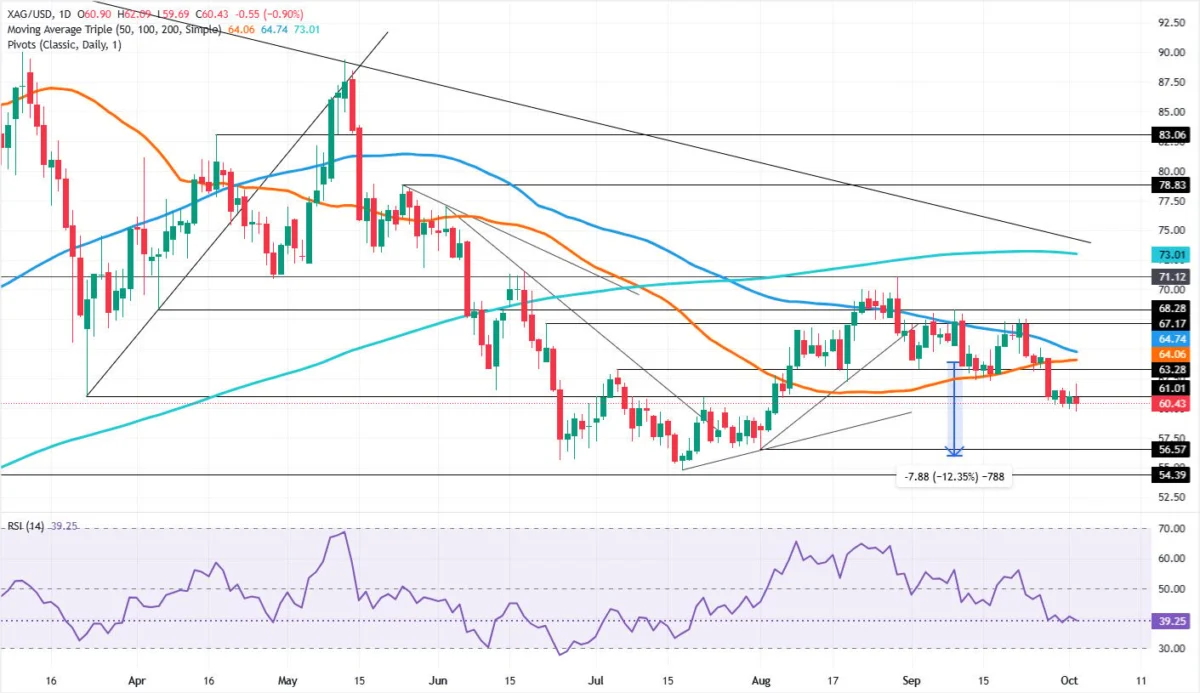
Silver price retreated on Friday, dropping approximately 0.76% to trade at $60.50, concluding a challenging week with losses exceeding 6%. This decline occurred as US Treasury yields edged higher, effectively capping the depreciation of the US Dollar, despite an earlier market reaction to a softer-than-expected US jobs report. The white metal’s significant weekly downturn places it firmly below critical technical thresholds, signaling a continued bearish outlook for the near term.
A Week of Retreat: Silver’s Steep Descent
The week’s trading saw Silver, a traditional safe-haven asset and crucial industrial metal, register its most substantial weekly loss in recent memory, shedding over 6% of its value. This sharp decline pushed the XAG/USD pair below the confluence of its 50-day and 100-day Simple Moving Averages (SMAs), located between $64.06 and $64.74. These moving averages are widely considered significant indicators of medium-term trend direction, and a decisive break below them is typically interpreted as a strong bearish signal by market participants. The consistent selling pressure throughout the week has left Silver poised to test the psychological $60.00 milestone, a level not seen consistently for several months.
The primary catalyst for Friday’s specific price action was a complex interplay between the US labor market data, Treasury yields, and the US Dollar. The US Bureau of Labor Statistics released its Non-Farm Payrolls (NFP) report, which showed a notable slowdown in job creation for the preceding month. While the exact figures are subject to change, preliminary reports indicated a significant miss compared to analyst expectations, typically leading to a weakening US Dollar and a drop in Treasury yields as investors anticipate a potentially less aggressive Federal Reserve.
Indeed, initial reactions saw the Dollar weaken and yields dip. However, this depreciation was short-lived. Treasury yields, particularly the benchmark 10-year yield, subsequently edged higher throughout the trading session. This resilience in yields, despite the softer jobs report, suggests that underlying inflationary concerns and the market’s expectation for the Federal Reserve to maintain a restrictive monetary policy stance for longer remain dominant forces. For yield-sensitive assets like Silver, which offers no dividend or interest, rising yields increase the opportunity cost of holding the metal, making it less attractive to investors.
Chronology of Friday’s Market Dynamics
Friday’s trading day began with anticipation surrounding the release of the latest US jobs data. When the Non-Farm Payrolls report was published, it immediately injected volatility into the markets. The headline figure for job additions came in below consensus estimates, indicating a potential cooling in the robust US labor market. Additionally, other components of the report, such as the unemployment rate and average hourly earnings, were closely scrutinized for signs of economic deceleration or persistent wage inflation. A softer jobs report typically implies a reduced likelihood of aggressive interest rate hikes from the Federal Reserve, which can be supportive for non-yielding assets like precious metals and detrimental to the US Dollar.
Initially, this narrative played out as expected. The US Dollar Index (DXY), which measures the Dollar against a basket of major currencies, experienced a dip, reflecting reduced expectations for an immediate hawkish shift from the Fed. Concurrently, US Treasury yields, particularly those on shorter-term bonds which are more sensitive to monetary policy expectations, also saw a modest decline. This initial environment offered a brief respite for Silver, allowing it to recover some of its earlier losses.
However, the market’s interpretation quickly evolved. As the trading session progressed, US Treasury yields began to rebound, erasing their earlier losses and pushing higher. This upward movement in yields signaled that traders might be looking beyond the single jobs report, perhaps focusing on the broader context of still-elevated inflation and the Fed’s consistent messaging about its commitment to price stability. Furthermore, some analysts suggested that while the jobs report was softer, it was not catastrophic enough to fundamentally alter the Fed’s trajectory, leading to a reassessment of interest rate expectations.
The renewed strength in Treasury yields put renewed pressure on Silver. As a dollar-denominated commodity, Silver typically has an inverse relationship with both the US Dollar and US Treasury yields. A stronger Dollar makes Silver more expensive for holders of other currencies, dampening demand. Simultaneously, higher yields on government bonds make alternative, interest-bearing investments more appealing compared to holding a non-yielding asset like Silver. This confluence of factors ultimately led to Silver’s retreat by the close of Friday’s trading, solidifying its significant weekly losses.
Technical Outlook: Bearish Momentum Dominates
From a technical perspective, the outlook for XAG/USD remains decidedly bearish. The price action on the daily chart clearly indicates that sellers are in firm control, characterized by a series of lower highs and lower lows – a classic textbook pattern for a downtrend. The breach of the 50-day and 100-day Simple Moving Averages, currently acting as dynamic resistance around the $64.06-$64.74 zone, is a critical development. This suggests that the medium-term trend has shifted to the downside, with sustained buying power required to reclaim these levels.
Adding to the bearish sentiment is the Relative Strength Index (RSI), a momentum oscillator. The RSI currently remains below its 50-neutral level and is trending closer to the oversold territory. While an oversold RSI can sometimes precede a bounce, in a strong downtrend, it can simply indicate persistent selling pressure without an immediate reversal. The fact that it is not yet deeply oversold suggests there might still be room for further declines before a significant technical bounce is triggered.
Looking ahead, the immediate critical support level for XAG/USD is the psychological $60.00 mark. This round number often acts as a significant battleground between buyers and sellers. A decisive breach of $60.00 would open the door for a potential move towards the August 3 low of the day (LOD) at $56.57. Should this level also fail to hold, the year-to-date (YTD) low of $54.77 would become the next major downside target. This YTD low represents the lowest point Silver has traded in the current calendar year, and a test of this level would underscore the severity of the current downtrend.

For a bullish reversal to take hold, Silver buyers face a formidable task. They must first push the price back above the confluence of the 50-day and 100-day SMAs, which are now acting as strong resistance. Beyond that, reclaiming the $65.00 level would be another significant hurdle. However, even if these levels are successfully navigated, the overarching bearish structure would likely remain intact. A true bullish reversal, signaling a shift in the long-term trend, would only be confirmed if the XAG/USD decisively clears the August 28 swing high of $71.12, which represents the latest cycle high and a key resistance point from the previous upward move. Until then, any rallies are likely to be viewed as corrective bounces within a broader bearish trend.
Statements and Analyst Reactions
Market analysts have been closely monitoring Silver’s recent performance. "The sustained selling pressure on Silver, particularly its failure to hold above key moving averages, reflects a broader shift in investor sentiment," stated Dr. Eleanor Vance, Head of Commodity Research at Global Insights Group. "While the softer jobs report initially offered a glimmer of hope for precious metals, the resilience of Treasury yields and the Dollar’s underlying strength indicate that the market remains fixated on the Fed’s hawkish stance and the ongoing fight against inflation."
Another perspective came from Mr. David Chen, a senior metals strategist at Quantum Capital. "Silver’s dual nature as both a safe-haven and industrial metal means it’s susceptible to multiple headwinds right now. A robust Dollar and rising real yields erode its safe-haven appeal, while concerns over global growth, particularly in key industrial economies like China, could dampen industrial demand." He added, "The technical breakdown below the $64.00-$65.00 zone suggests further downside potential, with $60.00 being the immediate test. Traders should exercise caution, as the path of least resistance appears to be lower."
These sentiments underscore the complex environment in which Silver is currently trading, where macroeconomic factors are largely outweighing any temporary relief from individual data points.
Broader Impact and Implications for the Market
The recent decline in Silver prices carries several implications for investors and the broader market. For long-term investors who view Silver as a store of value or an inflation hedge, the current downturn presents a challenge, potentially leading to reassessments of portfolio allocations. Short-term traders, on the other hand, may find opportunities in the prevailing bearish trend, utilizing technical indicators to identify entry and exit points for short positions.
The performance of Silver often mirrors that of Gold, albeit with higher volatility due to its smaller market size and greater industrial demand component. A prolonged weakness in Silver could signal broader caution among investors regarding precious metals as a whole, especially if the macroeconomic environment continues to favor higher interest rates and a stronger US Dollar. The Gold/Silver ratio, which indicates how many ounces of Silver are needed to buy one ounce of Gold, often provides insights into the relative valuation of the two metals. A rising ratio, which would occur if Silver falls faster than Gold, might suggest that Silver is becoming undervalued relative to Gold, or that Gold is overvalued. This ratio is a key metric for investors looking to diversify their precious metal holdings.
Moreover, Silver’s industrial demand component means its price movements can also reflect expectations for global economic growth. As a critical input in sectors such as electronics, solar energy, and automotive, strong industrial activity typically supports Silver prices. Conversely, fears of an economic slowdown, particularly in major industrial economies like the United States, China, and India, can depress demand and, consequently, prices. The current softness in some economic indicators, coupled with a tight monetary policy environment, contributes to this dual pressure on Silver.
The Multifaceted Nature of Silver: Beyond a Safe Haven
Silver is a highly traded precious metal with a rich history as a store of value and a medium of exchange. While often overshadowed by Gold, it remains a vital asset for portfolio diversification, intrinsic value, and as a potential hedge against inflation. Investors can acquire physical Silver in various forms, such as coins or bars, or gain exposure through financial instruments like Exchange Traded Funds (ETFs) that track its market price.
The price of Silver is influenced by a diverse array of factors. Geopolitical instability and fears of a deep recession can elevate Silver’s appeal as a safe-haven asset, although typically to a lesser extent than Gold’s. As a yieldless asset, Silver generally benefits from lower interest rates, as the opportunity cost of holding it decreases. Its valuation is also intrinsically linked to the US Dollar (USD), as XAG/USD is the primary trading pair. A stronger Dollar tends to exert downward pressure on Silver prices, while a weaker Dollar can propel them higher.
Beyond financial market dynamics, supply and demand fundamentals play a crucial role. Investment demand, mining supply (Silver is significantly more abundant than Gold), and recycling rates all contribute to price fluctuations. Major producing countries, technological advancements in mining, and global economic policies can all impact the availability and cost of Silver.
A distinctive characteristic of Silver is its extensive industrial utility. It boasts the highest electrical conductivity of all metals, surpassing even Copper and Gold, making it indispensable in sectors such as electronics, solar energy, and medical applications. For instance, the burgeoning solar power industry is a significant consumer of Silver, and global efforts towards renewable energy directly impact its demand. A surge in industrial demand can lead to price increases, while a decline often results in lower prices. The economic health of major industrial nations, notably the United States and China, directly influences industrial consumption. Furthermore, consumer demand for jewelry, particularly prominent in India, also constitutes a significant factor in global Silver pricing.
In summary, Silver’s current retreat reflects a complex interplay of macroeconomic forces, including hawkish central bank policies, resilient Treasury yields, and a strong US Dollar, compounded by underlying technical weakness. While its dual role as a safe-haven and industrial metal provides diverse avenues for demand, the prevailing market sentiment suggests that sellers will likely maintain control in the near term, with critical support levels at $60.00, $56.57, and potentially the year-to-date low of $54.77 coming into focus. A significant shift in global monetary policy or a dramatic change in economic outlook would be required to engineer a sustained bullish reversal.
