


Gold prices experienced a notable downturn on Friday, failing to sustain an earlier rally and struggling to decisively breach the significant $4,200 per ounce milestone. The precious metal, measured by XAU/USD, was trading around $4,138, marking a decline of nearly 1% from its previous close, after briefly touching a session high of $4,227. This depreciation occurred despite a less-than-stellar US employment report, primarily driven by persistently high US Treasury yields that continue to diminish the appeal of non-yielding assets like gold.
A Mixed Signal from the US Labor Market
The catalyst for much of Friday’s market movements stemmed from the release of the September US Nonfarm Payrolls (NFP) report, which presented a picture of a cooling, albeit still resilient, labor market. The US economy added a mere 29,000 jobs in September, falling significantly short of economists’ consensus estimates of 90,000. This figure also represented a sharp deceleration from August’s downwardly revised gain of 133,000 jobs, which itself was a revision from an earlier, higher estimate. The substantial miss in NFP data typically signals a weakening economy, which would ordinarily be a bullish indicator for gold, often sought as a safe haven during periods of economic uncertainty.
Accompanying the weaker job creation, the Unemployment Rate edged higher, moving from 4.1% to 4.2%. While a tenth of a percentage point increase might seem marginal, it places the rate above the Federal Reserve’s (Fed) long-term projections for 2026 and 2027. However, analysts quickly noted that this uptick in unemployment was largely attributed to an increase in the labor force participation rate. A rising participation rate suggests more individuals are entering or re-entering the workforce, which can temporarily push up the unemployment rate even if job creation is occurring, indicating a healthier underlying dynamic than a simple rise in joblessness. This nuance softened the impact of the headline unemployment figure, preventing a more pronounced risk-off reaction in equity markets that might have otherwise supported gold.
Federal Reserve’s Dovish Tones and Shifting Rate Expectations
The lukewarm jobs data arrived amidst a backdrop of increasingly dovish rhetoric from key Federal Reserve officials. New York Fed President John Williams and Vice Chair Philip Jefferson both delivered remarks indicating that the central bank is "not in a rush to raise rates." These statements, coming from influential members of the Federal Open Market Committee (FOMC), reinforced market expectations that the Fed might opt for a pause in its tightening cycle.
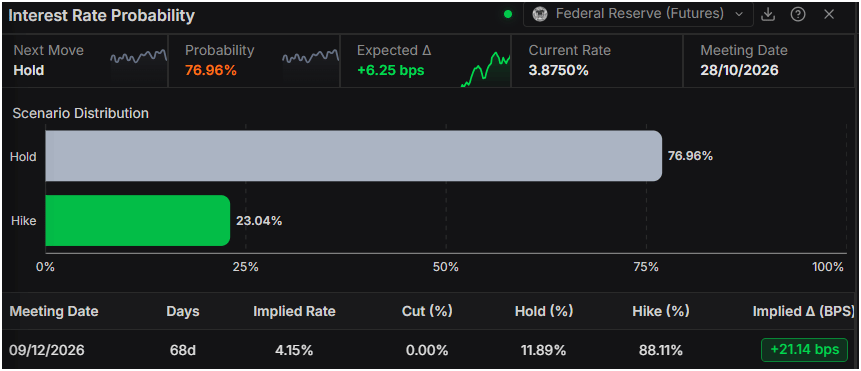
Money markets swiftly recalibrated their probabilities following the confluence of weaker jobs data and dovish Fed commentary. According to Prime Terminal data, the odds of the Fed holding interest rates steady at its upcoming October 28 meeting surged to nearly 77%. This suggests a strong consensus among investors that the central bank will likely skip a rate hike in October, prioritizing observation of incoming economic data. However, the outlook for the December meeting presented a more hawkish lean, with the chances of a rate hike increasing to 88%. This bifurcated expectation indicates that while the Fed may pause in the immediate term, the possibility of further tightening remains firmly on the table, especially if inflation proves persistent or economic activity reaccelerates. The market seems to be pricing in an "extended pause" rather than a definitive end to the hiking cycle, with December remaining a live meeting for policy adjustment.
The Persistent Pull of High Treasury Yields
Despite the perceived dovish shift in Fed sentiment and the softer employment report, gold’s ability to rally was severely hampered by the continued ascent of US Treasury yields. The yield on the benchmark US 10-year Treasury note remained notably elevated, climbing 4 basis points to 5.9%. This level represents a significant increase in the cost of borrowing for the US government and reflects a market grappling with several factors: persistent inflation concerns, the sheer volume of new Treasury debt being issued, and a general recalibration of long-term interest rate expectations.

Gold, being a non-yielding asset, typically struggles in an environment of rising bond yields. When investors can earn attractive returns from relatively safe government bonds, the opportunity cost of holding gold, which provides no interest or dividends, increases. This makes gold less appealing as an investment, diverting capital towards higher-yielding alternatives. The strength of this "yield magnet" proved to be a dominant force on Friday, overshadowing the potential tailwinds from a weaker jobs report and a slightly softer US Dollar.
The Dollar’s Diminished Safe-Haven Role
In another twist, the US Dollar Index (DXY), which measures the Greenback’s performance against a basket of six major currencies, registered a modest decline of 0.14%, trading at 101.89. A weakening dollar typically makes gold more affordable for international buyers, thereby boosting demand and price. Furthermore, during times of economic uncertainty, the dollar often acts as a safe-haven asset, much like gold. When the dollar loses some of its safe-haven appeal, as it did marginally on Friday, gold would ordinarily benefit from investors seeking alternative safe havens.
However, the slight dip in the DXY was insufficient to counteract the overwhelming pressure from elevated Treasury yields. This divergence highlights a complex market dynamic where multiple forces are at play, with the gravitational pull of bond yields currently exerting a stronger influence on gold’s trajectory than the minor fluctuations in currency markets or even the initial reaction to domestic economic data. The dollar’s overall strength over recent months, driven by robust US economic performance relative to other major economies and the Fed’s aggressive tightening cycle, has already been a significant headwind for gold.
Broader Economic and Geopolitical Context
Beyond the immediate economic data, the global landscape also played a role in shaping market sentiment. News from the Middle East, characterized by a lack of significant escalation, contributed to a more stable outlook for energy markets. Reports that Europe might consider releasing diesel and crude from its strategic reserves further eased supply concerns, pushing energy prices lower. West Texas Intermediate (WTI), the US crude benchmark, dropped by 1.6% to $91.42. Lower energy prices can be a double-edged sword: while they alleviate inflationary pressures, potentially giving central banks more flexibility, they can also signal weakening global demand, raising concerns about economic growth. For gold, lower inflation expectations reduce its appeal as an inflation hedge.
Technical Analysis Points to Downside Risks
From a technical perspective, gold’s failure to decisively clear the $4,200 mark, despite its brief foray above it, is a bearish signal. This level has proven to be a formidable psychological and technical resistance point, often referred to by some analysts as "Gold’s kryptonite." The inability to consolidate above this threshold suggests a lack of sustained buying conviction.
The Relative Strength Index (RSI), a momentum indicator, further supports the bearish sentiment, remaining below its 50-neutral level. An RSI below 50 indicates that sellers are currently in control of the market momentum.
Should the selling pressure persist, the XAU/USD’s immediate support lies at the $4,100 milestone. A decisive break below this level could open the door for a retest of the July 29 low of $3,996. Further downside targets include the July 17 low of $3,959, which would represent a more significant retracement.
Conversely, for buyers to regain control and shift the technical outlook, gold prices would need to reclaim and hold above $4,200. Successfully doing so could pave the way for a challenge of the 100-day Simple Moving Average (SMA), currently positioned at $4,279, which acts as a dynamic resistance level that often dictates the medium-term trend.
The Enduring Role of Gold in the Global Economy
Gold has historically served as a critical asset, functioning as both a store of value and a medium of exchange across civilizations. In contemporary financial markets, its allure extends beyond its ornamental uses, primarily as a safe-haven asset. During periods of geopolitical instability, economic uncertainty, or financial market turmoil, investors often flock to gold, perceiving it as a reliable hedge against risk. Its intrinsic value, independent of any specific government or issuer, also positions it as a robust hedge against inflation and the depreciation of fiat currencies.
Central banks globally are significant holders of gold, viewing it as a crucial component of their foreign exchange reserves. Their rationale is multi-faceted: gold bolsters the perceived strength and solvency of a nation’s economy and currency, providing diversification away from traditional reserve currencies like the US Dollar. The World Gold Council reported that central banks added a staggering 1,136 tonnes of gold, valued at approximately $70 billion, to their reserves in 2022—the highest annual purchase on record. Emerging economies, particularly China, India, and Turkey, have been at the forefront of this acquisition spree, underscoring a broader shift in global financial architecture.
The price of gold exhibits a complex interplay with other major financial assets. It typically shares an inverse correlation with the US Dollar and US Treasuries, both of which are also considered safe-haven assets. When the dollar strengthens or Treasury yields rise, gold tends to face headwinds as investors gravitate towards these yielding or appreciating alternatives. Conversely, a weakening dollar or declining yields often provides a tailwind for gold. Furthermore, gold often moves inversely to risk assets; a rally in stock markets might temper gold demand, whereas sell-offs in riskier markets tend to amplify its appeal.
A multitude of factors can influence gold prices. Heightened geopolitical tensions or fears of a deep economic recession can trigger rapid escalations in gold’s value due to its safe-haven status. As a yield-less asset, gold generally thrives in a low-interest-rate environment, where the opportunity cost of holding it is minimal. Conversely, higher interest rates tend to weigh down on the yellow metal. However, the most profound influence on gold’s price, given its denomination as XAU/USD, often comes from the behavior of the US Dollar. A strong dollar typically suppresses gold prices, while a weaker dollar is likely to push them higher.
Looking Ahead: Key Economic Indicators on the Horizon
The coming week promises a series of significant economic releases from the US, which will undoubtedly shape market sentiment and influence gold’s trajectory. The US economic docket includes the ISM Services PMI, which provides a crucial gauge of activity in the dominant services sector of the economy. Further jobs data will offer additional clarity on the health of the labor market following September’s mixed signals.
Crucially, the release of the Federal Open Market Committee (FOMC) Meeting Minutes from its last policy gathering will provide invaluable insights into the internal deliberations, discussions, and potential dissents among Fed policymakers. This will offer a deeper understanding of the central bank’s forward guidance. A speech by Fed Governor Bowman will present another opportunity for official commentary on monetary policy. Finally, the University of Michigan Consumer Sentiment index will shed light on consumer confidence and inflation expectations, critical components for assessing future economic growth and spending patterns. These upcoming events will be closely scrutinized by market participants seeking clearer direction for the dollar, Treasury yields, and ultimately, the price of gold.
