

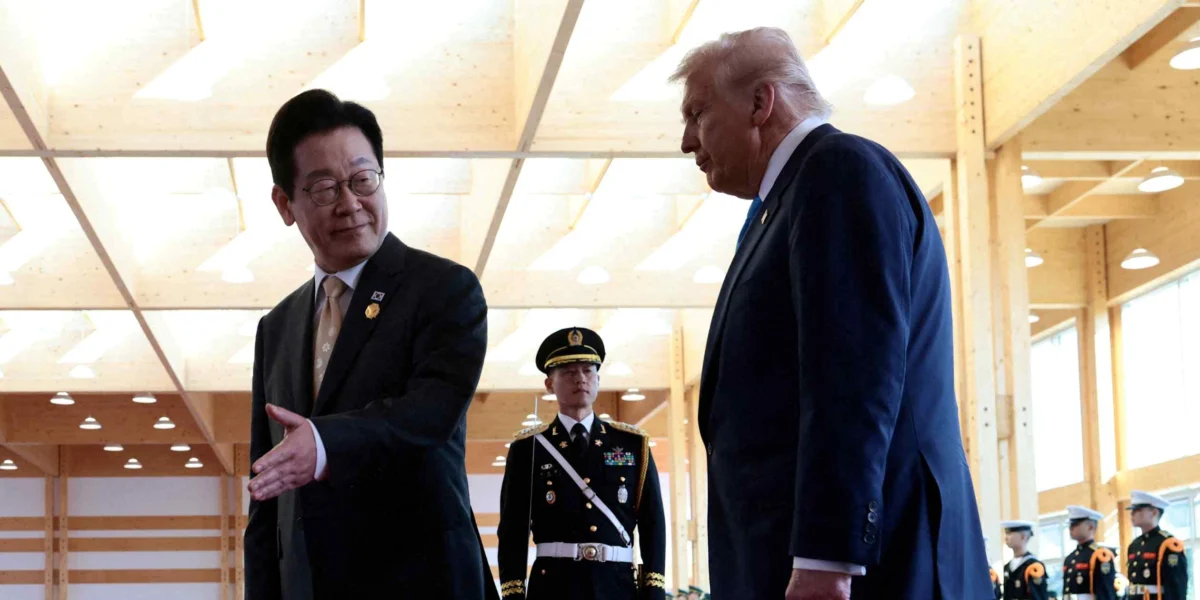
SEOUL – In a sweeping economic and strategic realignment, South Korea has pledged a monumental $120 billion investment to construct eight nuclear power plants within the United States. This ambitious undertaking forms the cornerstone of a broader $350 billion bilateral investment package, secured in exchange for significant tariff reductions on South Korean exports. The agreement, finalized amidst high-level diplomatic engagements, signals a deepening of the economic ties between Seoul and Washington, while simultaneously addressing critical energy needs and bolstering industrial capacity on both sides of the Pacific.
The announcement, made on October 29, 2025, during the Asia-Pacific Economic Cooperation (APEC) leaders’ summit in Gyeongju, South Korea, followed a series of intensive negotiations between President Lee Jae Myung of South Korea and U.S. President Donald Trump. The handshake, captured against the backdrop of international diplomacy, symbolized the culmination of months of strategic planning and delicate bargaining. This deal is not merely a financial transaction; it represents a strategic alliance aimed at fostering mutual economic growth, enhancing energy security, and solidifying geopolitical alignment in an increasingly complex global landscape.
A Deal of Unprecedented Scale
The $350 billion South Korean investment in the U.S. economy is one of the largest single foreign direct investment packages ever announced. Of this total, the $120 billion allocated to nuclear power plant construction stands out as a testament to South Korea’s advanced nuclear engineering capabilities and its commitment to a clean energy future, both domestically and internationally. This investment is expected to create thousands of high-skilled jobs in the U.S., spanning engineering, construction, and ongoing operational roles. Furthermore, it will significantly contribute to America’s energy independence and its transition towards a lower-carbon electricity grid.
The quid pro quo for this substantial investment is a reciprocal agreement for reduced tariffs on a wide array of South Korean goods entering the U.S. market. While specific tariff lines are still being finalized, preliminary reports indicate that key South Korean export sectors, including semiconductors, automobiles, and consumer electronics, will benefit from more favorable trade terms. This move is anticipated to boost South Korea’s export competitiveness, driving economic growth and job creation within the nation. The exact percentage of tariff reduction and the scope of affected products will be critical in determining the full economic impact for South Korea.
The Strategic Imperative: Energy Security and Economic Reciprocity
The genesis of this agreement can be traced back to the shared strategic interests of both nations. For the United States, the commitment to nuclear power aligns with its stated goals of increasing domestic energy production, reducing reliance on fossil fuels, and combating climate change. Nuclear energy offers a consistent, baseload power source, complementing the growth of renewable energy sources like solar and wind. The U.S. has been seeking to revitalize its domestic nuclear industry, and South Korea’s expertise and capital represent a significant catalyst.
South Korea, on the other hand, views this investment as a strategic diversification of its export markets and a means to secure favorable trade conditions. The nation’s economy is heavily reliant on exports, and securing reduced tariffs in its largest trading partner provides a crucial competitive advantage. Moreover, by exporting its renowned nuclear technology and construction capabilities, South Korea not only generates substantial revenue but also reinforces its position as a global leader in the nuclear energy sector. This also offers a potential solution to the nation’s own energy demands, as the construction and operation of these plants will undoubtedly require significant expertise and resources, potentially freeing up domestic capacity or securing future technological advancements.
A Chronology of Engagement
The path to this historic agreement was paved through a series of high-level discussions and diplomatic overtures.
- Early 2025: Initial exploratory talks between senior trade officials from both South Korea and the United States begin, focusing on potential areas of mutual economic benefit and strategic alignment. Discussions reportedly touch upon energy infrastructure and trade imbalances.
- Mid-2025: As dialogue intensifies, the concept of a large-scale South Korean investment in U.S. energy infrastructure, particularly nuclear power, emerges as a key component of a potential broader trade deal. U.S. President Trump and South Korean President Lee Jae Myung engage in direct conversations, signaling the high priority placed on the negotiations.
- August-September 2025: Technical working groups are established to delve into the specifics of the nuclear plant projects, including site selection, regulatory frameworks, safety protocols, and financing mechanisms. Simultaneously, trade negotiators engage in detailed discussions regarding tariff reductions and other trade-related concessions.
- October 29, 2025: The agreement is formally announced by Presidents Lee Jae Myung and Donald Trump on the sidelines of the APEC leaders’ summit in Gyeongju, South Korea. The joint press conference highlights the mutual benefits and the strategic importance of the deal.
Supporting Data and Economic Projections
The $120 billion allocated for nuclear power plants is not a figure plucked from thin air. South Korea’s nuclear industry has a proven track record of successful project execution and technological innovation. Korea Electric Power Corporation (KEPCO) and its subsidiaries have a history of building and operating some of the world’s most efficient and safe nuclear facilities. For instance, the Barakah Nuclear Power Plant in the United Arab Emirates, constructed by KEPCO, is a prime example of South Korea’s export capabilities in this sector.
Key Supporting Data Points:
- Global Nuclear Power Market: The global nuclear power market is projected to grow significantly in the coming decades, driven by decarbonization efforts and increasing energy demand. Projections by the World Nuclear Association indicate a potential increase in global nuclear capacity by as much as 50% by 2050.
- U.S. Nuclear Fleet: The U.S. currently operates the largest fleet of nuclear reactors globally, but many are aging. The need for new capacity and life extensions for existing plants is a persistent challenge. The average age of U.S. nuclear reactors is over 40 years.
- South Korean Nuclear Expertise: South Korea has successfully built and operated numerous nuclear reactors, demonstrating advanced capabilities in reactor design, construction, operation, and maintenance. The country’s nuclear power program is a significant contributor to its domestic energy supply, providing approximately 25-30% of its electricity.
- Economic Multipliers: Investments in large-scale infrastructure projects like nuclear power plants typically have substantial economic multipliers. Studies by the U.S. Department of Energy have shown that nuclear power construction can support hundreds of thousands of jobs and generate billions in economic output.
Official Responses and International Reactions
The announcement has been met with a mix of optimism and scrutiny from various stakeholders.
From the United States:
- White House Statement (inferred): A statement from the White House would likely praise President Trump’s "America First" trade policies, emphasizing job creation and enhanced energy security. It would highlight the deal as a victory for American workers and a testament to the strength of the U.S.-South Korea alliance. Concerns about the trade deficit might be addressed by framing this as a balanced and mutually beneficial agreement.
- Energy Sector (inferred): U.S. utility companies and energy developers would likely welcome the investment, seeing it as a crucial step towards modernizing the power grid and meeting future energy demands. The availability of foreign capital and expertise could accelerate the deployment of new nuclear capacity.
- Environmental Groups (inferred): Environmental organizations would likely express mixed reactions. While acknowledging the benefits of nuclear power in reducing carbon emissions compared to fossil fuels, concerns about nuclear waste disposal, safety, and the long-term environmental impact of uranium mining might be raised. Advocacy for robust regulatory oversight would be expected.
From South Korea:
- Presidential Office Statement (inferred): The South Korean Presidential Office would likely laud the agreement as a historic achievement for President Lee’s administration, underscoring its success in securing favorable trade terms and expanding the nation’s global economic footprint. Emphasis would be placed on the economic benefits for South Korean industries and the strengthening of the bilateral relationship.
- Industry Leaders (inferred): Leaders of South Korean conglomerates, particularly those involved in the energy and construction sectors, would express strong support, anticipating significant new business opportunities and a boost to their international competitiveness. The deal could pave the way for further South Korean technological exports.
- Economic Analysts (inferred): Economic analysts would likely point to the potential for increased export revenues and job growth in South Korea. However, they might also caution about the long-term financial implications of such a large overseas investment and the need for careful management of currency exchange rates and project risks.
International Reactions (inferred):
- Other Nuclear Exporting Nations: Countries like France, Russia, and China, which are also major players in the global nuclear market, might view this deal with a degree of concern, as it signifies a significant expansion of South Korean influence and market share.
- International Energy Agencies: Organizations like the International Atomic Energy Agency (IAEA) would likely commend the expansion of nuclear power, provided it adheres to the highest safety and security standards.
Broader Impact and Implications
The implications of this South Korea-U.S. nuclear power and trade deal extend far beyond the immediate economic benefits.
- Geopolitical Realignment: The agreement solidifies the strategic alliance between the two nations, demonstrating a shared commitment to economic cooperation and mutual security. In an era of shifting global power dynamics, such strong bilateral ties are increasingly significant.
- Energy Diplomacy: This deal sets a precedent for how major economic partnerships can be leveraged to address critical global challenges like climate change and energy security. It could inspire similar collaborations between other nations seeking to decarbonize their economies.
- Technological Advancement: The scale of the project will likely spur further innovation in nuclear reactor technology, safety systems, and waste management solutions. South Korea’s role as a builder and operator will reinforce its position at the forefront of nuclear engineering.
- Economic Resilience: For both countries, the investment enhances economic resilience. For the U.S., it diversifies its energy sources and stimulates domestic industry. For South Korea, it secures vital export markets and reduces reliance on volatile global commodity prices.
- Challenges Ahead: Despite the optimistic outlook, significant challenges remain. The construction of eight nuclear power plants is a multi-decade endeavor, requiring meticulous planning, regulatory approval, and effective project management. Potential hurdles include public perception of nuclear safety, environmental impact assessments, and the long-term management of nuclear waste. The successful implementation of the tariff reductions will also be crucial for South Korea’s export sector.
In conclusion, the $120 billion commitment by South Korea to build eight nuclear power plants in the United States, as part of a larger $350 billion investment package in exchange for lower tariffs, represents a transformative moment in bilateral relations. It is a strategic gambit that promises to reshape energy landscapes, bolster economies, and deepen the alliance between two key global players, while simultaneously presenting a complex set of challenges that will require sustained cooperation and careful navigation.
