

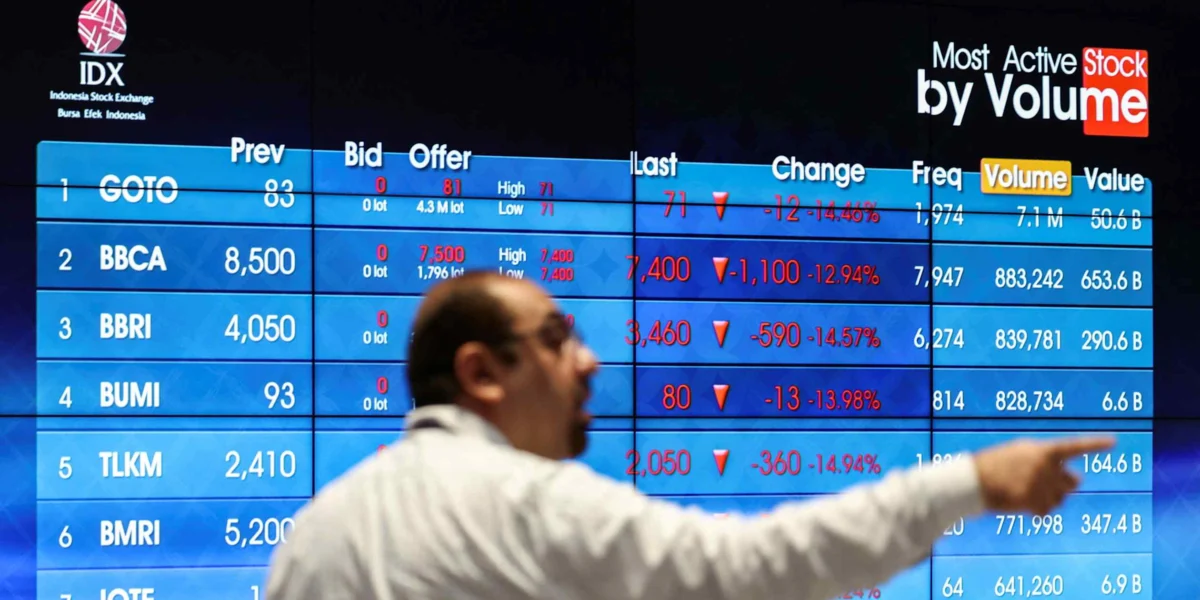
JAKARTA – The Indonesia Stock Exchange’s (IDX) benchmark composite index experienced a notable decline of 94.03 points, representing a 1.51% drop, on its first trading day without the long-standing 50 rupiah minimum share price policy. The abolition of this floor, which had been in place for years, led to significant downward pressure on a substantial number of listed companies, including prominent technology firm GoTo Gojek Tokopedia. More than 40 stocks, out of approximately 900 companies comprising the IDX composite, traded at or below the 50 rupiah threshold on Monday, signaling a dramatic repricing of previously illiquid or underperforming assets.
Background: The Rationale Behind the 50 Rupiah Minimum Share Price
The 50 rupiah minimum share price rule, implemented by the IDX in the past, aimed to curb excessive speculation in penny stocks and maintain a certain level of perceived value for listed entities. Proponents argued that it discouraged the listing of companies with fundamentally weak financial standing or those primarily driven by speculative trading rather than intrinsic value. The policy was intended to foster a more stable and mature equity market, encouraging long-term investment and discouraging the manipulation of very low-priced shares. However, critics contended that it artificially propped up the prices of fundamentally unsound companies, preventing natural price discovery and hindering the ability of investors to exit positions in struggling businesses. The policy also faced criticism for potentially limiting access for smaller retail investors who might be attracted to lower-priced stocks.
Timeline of the Policy Shift and Market Reaction
The decision to abolish the 50 rupiah minimum share price was not sudden. Discussions and consultations regarding its potential removal had been ongoing within the IDX and with market participants for an extended period. Regulatory bodies reviewed international best practices and assessed the evolving landscape of the Indonesian capital market. The IDX formally announced the policy change in the weeks preceding its implementation, providing listed companies and investors with a grace period to adjust.
Monday’s trading session represented the immediate aftermath of this significant regulatory shift. The market’s reaction was swift and, for many, severe. The composite index’s broad-based decline suggests that the impact was not confined to a few isolated cases but rather a widespread repricing of stocks that had previously been held above the 50 rupiah mark by the minimum price rule. The fact that over 40 stocks fell to or below this level underscores the extent to which the policy had masked underlying performance issues for a segment of the market.
Supporting Data: The Scale of the Decline and Sectoral Impact
The 1.51% drop in the composite index, while significant for a single day, is a symptom of a deeper repricing occurring among individual stocks. The focus on stocks trading at or below 50 rupiah reveals the true extent of the impact. These are typically companies that have struggled to generate consistent profits, faced significant operational challenges, or have seen their market capitalization erode over time. The removal of the price floor allows these stocks to reflect their current market valuation more accurately, which, in many instances, is lower than what the previous rule permitted.
Technology companies, often characterized by high growth potential but also by periods of intense competition and significant investment requirements, were among those affected. GoTo Gojek Tokopedia, a prominent example, has been navigating a complex market environment as it strives for profitability and sustainable growth. Its inclusion in the list of stocks trading at or below 50 rupiah highlights the broader challenges faced by some of the region’s most ambitious tech ventures when their valuations are subjected to a more stringent market reality.
Further analysis of the specific stocks that dropped below 50 rupiah would likely reveal a common thread of underperformance, high debt levels, declining revenues, or significant operational setbacks. The IDX’s decision is likely to lead to a period of heightened volatility as the market continues to digest the implications of this policy change.
Official Responses and Market Outlook
While specific official statements from IDX management immediately following Monday’s trading session were not detailed in the initial report, it can be inferred that the exchange would be closely monitoring market activity. The IDX’s primary objective in implementing such a change is to foster a more efficient and transparent market. It is likely that the exchange will emphasize that this move is a step towards greater market realism and that the focus will now be on the fundamental performance of listed companies.
Market analysts and participants are likely to be divided in their immediate reactions. Some may view the decline as a necessary correction, a cleansing of the market that will ultimately lead to stronger, more fundamentally sound companies attracting investment. Others may express concern about potential contagion effects and the impact on investor confidence, particularly among retail investors who may have been holding these lower-priced stocks.
The IDX will likely reiterate its commitment to investor protection and market integrity. This might involve increased surveillance of trading activities to prevent any manipulative practices that could arise from the repricing of these stocks. Furthermore, the exchange may be looking to encourage companies whose stocks have fallen to reassess their business strategies and financial performance to regain investor trust.
Broader Impact and Implications for the Indonesian Capital Market
The abolition of the 50 rupiah minimum share price has several significant implications for the Indonesian capital market:
- Enhanced Price Discovery: The most immediate impact is the restoration of more accurate price discovery. Stocks that were previously artificially held above 50 rupiah can now trade at their true market value, reflecting current investor sentiment and the underlying financial health of the companies.
- Potential for Consolidation: Companies with persistently weak fundamentals may face increased pressure. This could lead to mergers, acquisitions, or delistings as investors seek to redeploy capital into more promising ventures.
- Shift in Investor Strategy: Investors will need to be more diligent in their due diligence, focusing on company fundamentals rather than relying on the artificial support of a minimum price. This could lead to a more discerning investment landscape.
- Attracting New Listings (Long-term): While the immediate aftermath may be turbulent, in the long term, a more transparent and accurate pricing mechanism can make the IDX more attractive to quality companies seeking to list, as they will be valued based on their true potential rather than being subject to arbitrary price floors.
- Increased Volatility: In the short to medium term, the market is likely to experience increased volatility as investors adjust to the new pricing environment. Penny stocks, in particular, may see more dramatic price swings.
- Focus on Corporate Governance and Performance: The policy change places a greater onus on listed companies to demonstrate strong corporate governance and consistent financial performance. Companies that can do so will likely be rewarded with better valuations.
The IDX’s decision to remove the 50 rupiah minimum share price is a bold move that signals a commitment to aligning the Indonesian capital market with global standards. While the immediate impact has been a sharp correction for many stocks, the long-term objective is to foster a more robust, transparent, and efficient market that can better serve both issuers and investors. The coming weeks and months will be crucial in observing how the market adapts to this new reality and how companies respond to the increased pressure for performance and accountability. The success of this reform will ultimately be measured by its contribution to sustainable economic growth and the deepening of Indonesia’s capital markets. The IDX’s move is a clear indication that the era of artificially supported stock prices has ended, ushering in a new phase where intrinsic value and demonstrable performance will be the primary drivers of market valuation. This transition, though potentially challenging in the short term, is a necessary step towards building a more mature and resilient financial ecosystem in Indonesia.
