

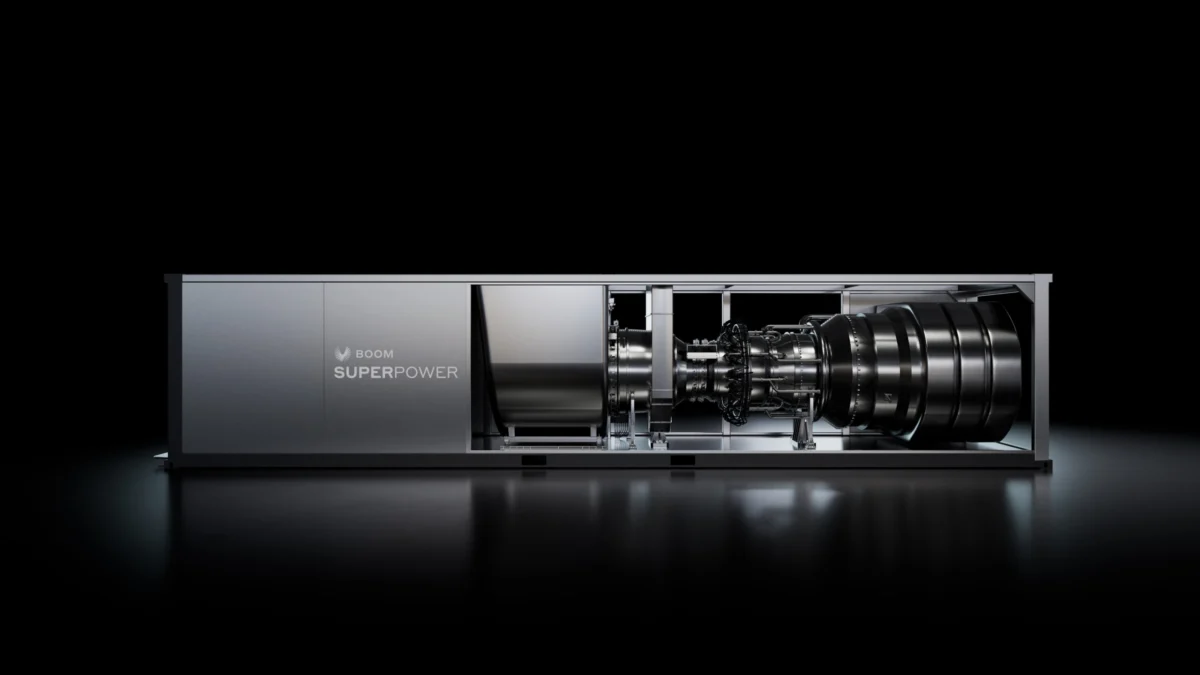
Denver-based AI data center startup Crusoe, fresh off a significant $3.9 billion funding round, has officially terminated its ambitious plans to deploy a new line of stationary power plants developed by fellow Denver company Boom Supersonic. This abrupt cessation marks a pivotal shift in Crusoe’s energy procurement strategy and represents a notable setback for Boom Supersonic’s nascent power generation division, which had envisioned these turbines as a crucial funding mechanism for its supersonic passenger jet project, Overture.
The core of the dissolved agreement involved Crusoe committing to purchase 29 of Boom’s 42-megawatt Superpower turbines, an investment valued at approximately $1.25 billion. These natural gas-fired turbines, sharing about 80% of their components with the Symphony engines designed for Boom’s Overture jet, were intended to provide substantial on-site power for Crusoe’s burgeoning AI data center operations, with initial deliveries anticipated by 2027. The partnership was publicly heralded as a strategic alliance, positioning Crusoe as the launch customer for Boom’s diversification into the energy sector.
Crusoe’s Rapid Ascent in AI Infrastructure
Crusoe, founded in 2018 by Cully Cavness and Chase Lochmiller, initially carved out its niche by leveraging excess natural gas from oil fields to power bitcoin mining operations. This innovative approach to monetizing stranded energy assets provided a unique, environmentally conscious, and economically viable model. However, recognizing the immense and escalating demand for high-performance computing, particularly for artificial intelligence, the company strategically pivoted and expanded its focus. Crusoe has since emerged as one of the preeminent builders of AI data centers, rapidly scaling its infrastructure to support the computational demands of leading AI entities.
One of Crusoe’s most significant achievements includes the development of a massive data center campus in Abilene, Texas, which currently supplies critical computing power to OpenAI, a pioneer in advanced AI research and development. This flagship facility underscores Crusoe’s capability to deploy and manage large-scale, high-density computing environments. Furthermore, the company is actively expanding its footprint, with plans for a 900-megawatt data center in Abilene dedicated to Microsoft, indicating its integral role in enabling the growth of hyperscale AI operations. The recent $3.9 billion capital infusion, announced on September 17, 2026, solidifies Crusoe’s position as a major player in the AI infrastructure landscape, providing it with substantial resources to accelerate its expansion and refine its energy strategies.
Boom Supersonic’s Ambitious Diversification
Boom Supersonic’s primary mission revolves around revolutionizing commercial air travel through the development of Overture, a supersonic passenger jet designed to make long-distance flights faster and more accessible. The creation of the Superpower turbine division last year represented a strategic pivot to generate revenue and leverage its core aerospace engineering expertise for terrestrial applications. The logic was clear: capitalize on the advanced engineering of the Symphony jet engine by adapting it for stationary power generation, thereby creating a new revenue stream to fund the capital-intensive development of Overture.
Blake Scholl, CEO of Boom Supersonic, had previously articulated this vision, noting that the profits derived from the stationary power plant business would directly contribute to the significant research, development, and certification costs associated with bringing a new supersonic jet to market. The Superpower turbines, sharing approximately 80% of their parts with the airborne Symphony engine, were presented as a testament to engineering efficiency and a pragmatic approach to cross-industry application of advanced technologies. The initial deal with Crusoe was not merely a customer acquisition but a foundational partnership, intended to validate Boom’s diversification strategy and provide critical market entry for its energy ventures.
The Ill-Fated Collaboration: A Timeline of Dissolution
The partnership between Crusoe and Boom Supersonic was initially announced with considerable optimism, highlighting the synergy between an innovative AI data center provider and a pioneering aerospace company diversifying into energy.
- Late 2025: Boom Supersonic officially launched its new business line for stationary power plants, aiming to commercialize a version of its Symphony engine. Concurrently, the company raised $300 million, largely earmarked for this new venture, with the Crusoe partnership being a cornerstone of its business plan.
- Early 2026: Crusoe signed on as the launch customer, committing to a $1.25 billion purchase of 29 Superpower turbines, totaling approximately 1,218 megawatts (1.2 GW) of generation capacity. Deliveries were projected to commence in 2027, integrating these turbines into Crusoe’s expanding data center portfolio.
- September 17, 2026: Crusoe announced a monumental $3.9 billion funding round, signaling robust investor confidence and providing significant financial flexibility.
- Shortly After (as reported on Friday, Sept 19, 2026): Blake Scholl, Boom Supersonic CEO, confirmed the dissolution of the partnership via a post on X (formerly Twitter). Scholl’s post, while congratulating Crusoe’s founders, explicitly stated that the companies were "no longer moving forward with the turbine launch partnership." Crusoe subsequently confirmed the termination to TechCrunch.
Scholl’s statement offered insight into the reasoning, remarking, "The TL/DR is that turbines are no longer part of Crusoe’s near term primary power mix at Abilene/etc., so a launch partnership just didn’t make sense." He maintained that Boom would still deliver approximately 250MW of Superpowers next year to other sites and targeted 1GW in 2028, suggesting an ongoing pipeline of customers despite the loss of its inaugural client.
Official Statements and Divergent Paths
The official communications from both companies, while professional, underscored the shift in strategic priorities that led to the partnership’s end. Blake Scholl’s X post conveyed a tone of understanding and continued goodwill, stating, "We’re grateful for the help Crusoe gave us in shaping Superpower and continue cheering for their successes. The future is long, and we look forward to potentially teaming up if/when turbines become part of their primary power mix." This indicates that while the immediate deal is off, the door remains open for future collaboration should Crusoe’s energy needs realign.
Crusoe’s spokesperson, Andrew Schmitt, provided a more detailed perspective on the company’s evolving energy strategy: "We build AI factories from the power up, and we’re bringing new campuses online across the country, powered by innovative energy sources. As our portfolio grows, we stay flexible, choosing the energy solutions that are right for each site as its needs evolve — including turbines, along with wind, solar, batteries and the grid. While Boom has been a great partner, the partnership isn’t the right fit today. We wish them well."

This statement from Crusoe highlights a dynamic and site-specific approach to energy procurement. It emphasizes flexibility and a diverse energy mix, suggesting that while turbines remain a viable option for certain applications, the specific terms or timing of the Boom deal may no longer align with Crusoe’s immediate strategic imperatives for key projects like the Abilene campus. The reference to "primary power mix" by Scholl and "right fit today" by Schmitt suggests a re-evaluation of the role of these specific natural gas turbines in Crusoe’s immediate energy infrastructure build-out, particularly in light of its significant capital raise and potentially accelerated expansion plans.
The Energy Imperative for AI Data Centers
The immense and rapidly growing power consumption of AI data centers is one of the most pressing challenges facing the technology industry. Training large language models (LLMs) and operating sophisticated AI applications demand unprecedented amounts of computational power, which translates directly into massive energy requirements. A single hyperscale AI data center can consume as much electricity as a small city, putting immense strain on existing electrical grids and raising significant environmental concerns.
As AI models become more complex and widespread, the demand for energy-efficient and reliable power solutions intensifies. Data center operators are increasingly exploring diverse energy sources, including renewable energy (solar, wind), battery storage, and on-site generation (such as natural gas turbines), to ensure power stability, reduce operational costs, and meet corporate sustainability goals. The industry is witnessing a trend towards "powering up" from the source, meaning securing or generating electricity directly rather than relying solely on traditional grid infrastructure, which can be prone to capacity limitations and price volatility.
Crusoe’s initial strategy, born from bitcoin mining, inherently understood this need for energy independence and optimization. Its existing 1.2 gigawatt data center in Abilene, which serves Oracle and OpenAI, primarily relies on the grid, augmented by a gas-turbine power plant for backup. The forthcoming 900-megawatt data center for Microsoft in Abilene, however, is planned to be powered by on-site gas turbines, indicating that while turbines are part of Crusoe’s mix, the specific type or scale of turbine solution, or perhaps the timeline for deployment, may have factored into the decision to pull back from the Boom deal. The evolving energy landscape, coupled with advancements in various power generation technologies and shifting market dynamics for natural gas, could have influenced Crusoe’s reassessment.
Implications for Crusoe: Evolving Energy Mix and Strategic Flexibility
For Crusoe, the termination of the Boom Supersonic deal, despite its significant financial commitment, appears to be a strategic decision aimed at optimizing its energy portfolio for future growth. The company’s recent $3.9 billion funding round provides it with immense financial leverage to pursue a wider array of energy solutions, potentially including more advanced or better-suited turbine technologies, enhanced renewable energy integration, or larger-scale battery storage systems. The flexibility to choose "the energy solutions that are right for each site as its needs evolve" is paramount for a company scaling as rapidly as Crusoe.
This move suggests that Crusoe may have identified alternative power generation solutions that better align with its updated timelines, cost structures, or technological preferences. It could also reflect a heightened focus on integrating more renewable energy sources or exploring hybrid power systems that offer greater resilience and sustainability. While the loss of a specific turbine supplier might require adjusting procurement plans, Crusoe’s robust financial position and stated commitment to diverse energy sources mean it is well-equipped to pivot and secure alternative power solutions without significant long-term disruption to its expansion trajectory. The company’s ability to attract such substantial investment underscores market confidence in its overall strategy, even as specific vendor relationships change.
Implications for Boom: A Strategic Setback and Refocusing
For Boom Supersonic, losing Crusoe as its launch customer for the Superpower turbine business is undeniably a significant setback. The $1.25 billion deal was not only a substantial financial commitment but also a crucial validation of its diversification strategy. The initial intent was to use the revenue and profits from Superpower sales to help fund the multi-billion-dollar development of its Overture supersonic jet. The loss of this foundational deal creates a void that Boom will now need to fill, either by securing new, comparably sized customers or by re-evaluating the scale and pace of its energy division’s growth.
While Blake Scholl’s statement indicated other customers were in the pipeline, with plans to deliver 250MW next year and target 1GW in 2028, the departure of the flagship client introduces uncertainty. It may necessitate a more aggressive sales strategy, potentially impact future fundraising efforts for the Superpower division, or even prompt a re-evaluation of the division’s long-term viability as a primary funding source for Overture. The aerospace industry itself is capital-intensive, and the ability to generate auxiliary revenue was a key part of Boom’s financial model. The market’s perception of the Superpower venture, particularly its ability to attract and retain major customers, will be closely watched.
Broader Industry Context: Powering the AI Revolution
The unfolding situation between Crusoe and Boom Supersonic offers a microcosm of the larger dynamics at play in the rapidly evolving AI and energy sectors. The "AI revolution" is fundamentally an energy revolution, requiring innovative and robust power solutions to sustain its growth. Companies like Crusoe are at the forefront of this challenge, constantly seeking the most efficient, reliable, and cost-effective ways to power their data centers. This often means exploring unconventional partnerships and technologies, and being agile enough to adapt as market conditions, energy prices, and technological advancements dictate.
The event also highlights the complexities of corporate diversification, particularly when a company like Boom attempts to bridge vastly different industries (aerospace and energy infrastructure). While the engineering principles might overlap, the market dynamics, regulatory landscapes, and customer acquisition strategies are distinct. The success of such ventures hinges on not only technological prowess but also a deep understanding of the new market’s specific demands and competitive environment. As AI continues its exponential growth, the demand for power solutions will only intensify, fostering an environment where flexibility, innovation, and strategic adaptation will be key determinants of success for both AI infrastructure providers and their energy partners.
Looking Ahead
The immediate future for Crusoe involves continuing its rapid expansion, leveraging its recent funding to solidify its position as a leader in AI data center infrastructure. Its strategy will likely continue to emphasize a diversified energy portfolio, adapting solutions to the specific needs and opportunities of each new site. For Boom Supersonic, the challenge lies in demonstrating the continued viability of its Superpower turbines to other customers and ensuring that this setback does not unduly impede the progress of its flagship Overture project. The incident underscores the dynamic nature of high-tech industries, where strategic alignments can shift quickly in response to evolving market needs, technological advancements, and financial realities.
