

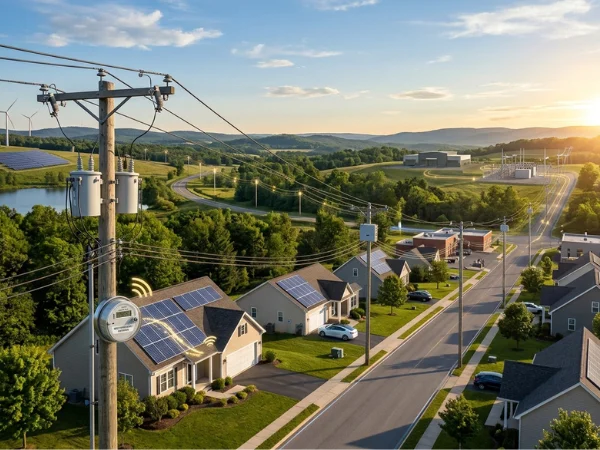
The American power sector is entering a period of unprecedented capital expenditure, driven by a confluence of aging infrastructure, the transition to renewable energy, and a surge in electricity demand from data centers and electric vehicles. For over a century, the primary strategy for ensuring grid reliability and resilience was centered on physical infrastructure investment—building more lines, larger substations, and more centralized power plants. However, the modern operating environment has shifted significantly. According to estimates from Deloitte, the U.S. power sector is projected to invest as much as $1.4 trillion between 2025 and 2030. This figure is staggering, as it roughly equals the total industry expenditure over the previous 12 years combined. As utilities move to modernize generation, transmission, and distribution systems, they face a dual challenge: the need for massive investment and an increasingly vocal demand from consumers and regulators for affordability.
This massive upside potential for industry growth is tempered by a shifting consumer landscape. Today’s electricity consumers are no longer passive recipients of power; they expect transparency, real-time visibility into their energy consumption, and the ability to control interconnected devices within their homes and businesses. The rise of "smart" technology has conditioned users to expect efficiency and affordability as standard features of any service. Consequently, utilities are under immense pressure to prove that these trillion-dollar investments will not result in unsustainable rate hikes. Infrastructure alone is no longer the solution. Instead, the industry is looking toward connected platforms and grid intelligence as the primary tools to satisfy consumer needs while simultaneously growing the utility business.
The Evolution of Grid Management: From Analog to AMI 2.0
To understand the current shift, it is necessary to examine the chronology of grid modernization. For the majority of the 20th century, the grid was a one-way system with limited visibility. Utilities only knew there was a problem when a customer called to report an outage. The first major step toward modernization was the introduction of Advanced Metering Infrastructure (AMI) 1.0. This era focused on digitizing the grid edge by connecting utilities to millions of service territory endpoints.
AMI 1.0 was a revolutionary step, providing the first real glimpse into grid operations and customer usage without requiring manual meter readings. However, while the data collection was unprecedented, the technology required to process and act upon that data in real-time was still in its infancy. For years, AMI 1.0 functioned primarily as a more efficient billing tool rather than an operational intelligence platform.
As we move into the mid-2020s, the industry is transitioning to AMI 2.0. This next phase is characterized by the maturation of supporting technologies, including advanced distribution management systems (ADMS), distributed energy resource management systems (DERMS), cloud computing, and high-speed communications networks. Unlike its predecessor, AMI 2.0 is not limited to historical data collection. It delivers real-time operational intelligence through sophisticated capabilities such as waveform analytics, advanced power quality monitoring, and enhanced fault pinpointing. This transition marks the move from "smart meters" to "grid sensors" that allow utilities to analyze and act on data at the edge of the network.
Analyzing the $1.4 Trillion Investment Landscape
The projected $1.4 trillion investment through 2030 is necessitated by several critical factors. First, the physical components of the U.S. grid are aging; many transformers and transmission lines are operating well beyond their intended 50-year lifespans. Second, the "electrification of everything"—from home heating to heavy industry—is placing a higher load on existing systems. Third, the integration of intermittent renewable sources like wind and solar requires a more flexible and responsive grid to maintain stability.
Data from the Department of Energy (DOE) suggests that weather-related power outages have increased by roughly 78% over the last decade, further emphasizing the need for resilience. However, the traditional "rate-basing" model, where utilities pass the costs of physical assets onto consumers, is hitting a ceiling. Public utility commissions (PUCs) across the country are increasingly skeptical of large-scale capital projects that do not show immediate benefits in terms of cost-efficiency. This is where grid intelligence becomes a financial necessity. By using AMI 2.0 to maximize the utility of existing assets, companies can defer or even eliminate the need for certain high-cost infrastructure upgrades, effectively "sweating" their assets more intelligently.
Strategic Case Studies: Intelligence in Action
Several global and domestic utilities have already begun to demonstrate the efficacy of grid intelligence platforms. One of the most prominent examples is the Tokyo Electric Power Company (TEPCO). TEPCO currently manages one of the world’s largest utility Internet of Things (IoT) platforms, maintaining more than 30 million connected endpoint devices. By collecting billions of data records daily, TEPCO transforms raw information into operational intelligence. This supports high-level forecasting, asset management, and grid operations across one of the most densely populated regions on Earth. The TEPCO model proves that at scale, data becomes a more valuable asset than the hardware itself.
In the United States, smaller cooperatives and municipal utilities are also finding success. Florida’s Clay Electric Cooperative utilized real-time data to navigate the 2024 hurricane season. By integrating AMI infrastructure with outage management systems, the cooperative gained visibility that allowed for faster damage assessment. Instead of sending crews to scout every line, they could pinpoint faults and deploy resources where they were most needed, significantly reducing restoration costs and improving safety for field workers.

Similarly, Central Georgia EMC has focused on the "affordability lever" of demand flexibility. By using AMI to manage appliance-level loads—such as HVAC systems, water heaters, and EV chargers—the cooperative can reduce peak demand. Lowering peak demand directly translates to lower wholesale power procurement costs, a saving that can be passed directly to the membership.
Technical Implications of AMI 2.0 and Edge Computing
The technical shift in AMI 2.0 is centered on where the "thinking" happens. In AMI 1.0, data was collected at the meter and sent to a central server for analysis, a process that could take hours or even days. AMI 2.0 utilizes edge computing, where the meter itself has the processing power to analyze electricity waveforms.
Waveform analytics allow the meter to detect the "signature" of various electrical events. For example, it can identify the specific hum of a failing transformer or the irregular draw of a malfunctioning HVAC unit before a total failure occurs. This proactive approach—shifting from reactive maintenance to predictive maintenance—drastically reduces operating costs.
Furthermore, the use of standards-based communications, such as Wi-SUN (Wireless Smart Utility Network), ensures that the grid remains flexible. National Grid’s deployment of nearly one million Revelo grid-sensing meters utilizes this open-standard approach. This allows the utility to integrate future technologies, such as new types of electric vehicle chargers or residential battery storage, without needing to overhaul their entire communications network. This "future-proofing" is essential for maintaining long-term affordability.
Official Responses and Regulatory Pressure
The push for affordability is not merely a market trend; it is a regulatory mandate. During the Edison Electric Institute (EEI) 2026 summit, industry leaders echoed the sentiment that the "triad" of reliability, resilience, and affordability can no longer be addressed in isolation. Calvin Butler, President and CEO of Exelon, noted that in every state where his company operates, governors and commissions prioritize affordability above almost all else.
Exelon’s strategy has involved shuffling capital expenditure plans to find hundreds of millions in savings, largely by leaning into digital transformation. The consensus among utility executives is that the "social license to operate" depends on the industry’s ability to modernize without creating an energy poverty crisis. Regulatory bodies are now looking for "non-wire alternatives" (NWAs)—solutions that use software and distributed energy resources to solve grid constraints instead of building new physical lines. AMI 2.0 is the foundational technology that makes NWAs viable.
Broader Impact: Empowering the Modern Consumer
The final piece of the grid intelligence puzzle is the consumer. AMI 2.0 enables real-time load disaggregation, a process where a single meter can identify the energy usage of individual appliances without requiring separate sensors on every plug. This provides customers with an unprecedented level of detail regarding their energy bills.
When consumers can see, in real-time, that their older refrigerator is consuming 30% of their daily power or that charging their EV at 6:00 PM costs four times as much as charging at midnight, they are empowered to change their behavior. This granular insight fosters a partnership between the utility and the customer. Instead of the utility simply demanding payment for a mysterious monthly total, they become a service provider helping the customer manage their budget.
Conclusion: The Path Forward for Grid Modernization
The next phase of grid modernization will be defined by the intelligent management of existing and new assets. As the U.S. power sector navigates the $1.4 trillion investment cycle, the transition from AMI 1.0 to AMI 2.0 will serve as the critical differentiator between utilities that struggle with rising costs and those that thrive.
By leveraging real-time grid intelligence, utilities can lower operating costs through predictive maintenance, reduce energy supply costs through demand flexibility, and optimize infrastructure spend by extending the life of current assets. Most importantly, they can meet the rising expectations of the modern consumer. In the words of industry leaders, reliability, resilience, and affordability are now permanently linked. Grid intelligence is the only mechanism capable of balancing all three, ensuring that the transition to a modern, electrified future remains sustainable for both the utility and the public it serves.
