

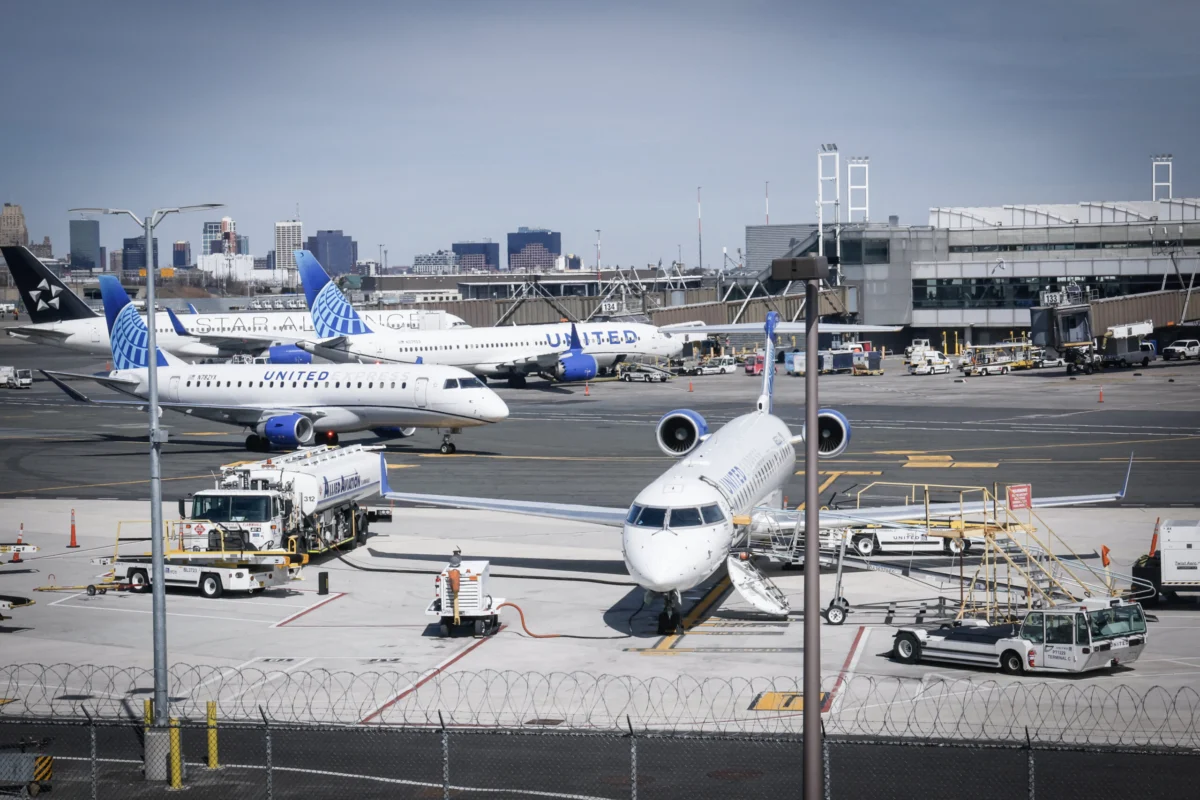
Hundreds of flights across the New York metropolitan area and Philadelphia were plunged into chaos on Monday following the accidental severance of a Verizon fiber optic cable during construction work in New Jersey. The incident, which cut off a vital backup data feed for air traffic controllers, triggered widespread cancellations, delays, and diversions, snarling travel for tens of thousands of passengers and underscoring the delicate vulnerability of the nation’s critical aviation infrastructure.
A Day of Disruption: The Immediate Aftermath
The cascading failures began when a construction crew, engaged in a rail project between New Brunswick and North Brunswick, New Jersey, inadvertently cut a Verizon fiber cable. This initial damage subsequently impacted a key data feed for the Terminal Radar Approach Control (TRACON) facility in Philadelphia, responsible for guiding aircraft into and out of Newark Liberty International Airport (EWR) and Philadelphia International Airport (PHL). While a primary circuit initially failed, the critical blow came when the system attempted to switch to its backup, only to discover that the redundant fiber line had also been severed in the same incident.
The Federal Aviation Administration (FAA) swiftly responded by implementing ground stops for flights bound for Newark and Philadelphia. The ripple effect was immediate and severe. By 6 p.m. Monday, more than 600 flights originating from or destined for Newark — representing over half of the day’s scheduled operations — were canceled, with nearly 100 additional flights experiencing significant delays. Philadelphia International Airport faced similar challenges, reporting over 200 cancellations and more than 400 delays.
The disruption extended beyond the immediate vicinity, forcing nearly 100 planes, some having already embarked on transatlantic journeys from Europe, to divert to alternative U.S. airports. Images of flight tracking maps showed a constellation of aircraft rerouting, with flights originally bound for Newark landing as far afield as Detroit, Washington D.C., and other hubs, creating logistical nightmares for airlines and immense frustration for passengers. Later in the afternoon, the FAA’s ground stops expanded to include New York City’s LaGuardia Airport (LGA) and John F. Kennedy International Airport (JFK), though these facilities saw a quicker resumption of operations, albeit with lingering residual delays.
Chronology of a Crisis: From Cut Cable to Resumed Flights
The incident unfolded throughout Monday, evolving from a localized cable cut to a regional air traffic control crisis:
- Morning (Undetermined Time): A construction crew working on an NJ Transit rail project between New Brunswick and North Brunswick, New Jersey, accidentally severs a Verizon fiber optic cable. NJ Transit later stated the crew was operating approximately 10 feet from utility markings.
- Early Morning/Mid-Morning: The severed cable causes an initial circuit failure impacting the Philadelphia TRACON facility. Critically, when the system attempts to activate its backup data feed, it fails, revealing that the redundant fiber line was also compromised in the same incident.
- Late Morning/Early Afternoon: The FAA, recognizing the severity of the data loss to the Philadelphia TRACON, issues ground stops for flights destined for Newark Liberty International Airport and Philadelphia International Airport. Flights already en route are either held in the air or diverted to other U.S. airports.
- Early Afternoon: The widespread disruptions begin to affect New York City airports, with the FAA halting flights into LaGuardia Airport and John F. Kennedy International Airport, though these restrictions are less prolonged.
- Mid-Afternoon: Airlines begin to announce widespread cancellations and delays. FlightAware data confirms hundreds of flights impacted at Newark and Philadelphia. International flights from Europe, having been in the air for hours, are forced to make unexpected landings at airports like Detroit and Washington Dulles.
- Late Afternoon: Verizon dispatches technicians to the scene to assess the damage and commence repairs. Both Verizon and NJ Transit issue statements, providing their initial accounts of the incident and raising questions about responsibility for utility markings.
- By 6 p.m. EST: Over 600 flights canceled at Newark, more than 200 at Philadelphia. The full scale of the disruption becomes clear.
- Monday Evening: Following rapid repair efforts, Transportation Secretary Sean Duffy announces via a post on X that repairs to the line have been completed and flights are resuming. However, the operational recovery is expected to be gradual, with residual delays and cancellations persisting.
The Technical Breakdown: Why a Cable Cut Led to Gridlock
At the heart of the crisis was the disruption to the Philadelphia TRACON facility. TRACONs are critical components of the national airspace system, responsible for managing air traffic within a 30- to 50-mile radius of major airports, guiding aircraft during their ascent after takeoff and descent before landing. They serve as the crucial link between tower controllers (who manage traffic on the runways and immediate airspace) and en route controllers (who manage aircraft at higher altitudes across broader regions).
FAA Administrator Bryan Bedford explained the technical failure, stating, "The problem started with an initial circuit failure and when it went to flip into the backup, we discovered the backup fiber had a break." This highlights a fundamental principle of critical infrastructure design: redundancy. Systems are built with backup components and pathways to ensure continuous operation even if a primary element fails. In this instance, both the primary and backup fiber optic feeds—essential for transmitting key radar and flight plan data to the Philadelphia TRACON—were simultaneously compromised by a single physical event, leading to a catastrophic loss of functionality. Without reliable data feeds, air traffic controllers cannot safely manage the dense volume of air traffic entering and exiting highly congested airspace like that surrounding New York and Philadelphia. This data is indispensable for tracking aircraft positions, predicting trajectories, and issuing crucial instructions to pilots.
Official Responses and the Blame Game
The immediate aftermath saw a flurry of statements from the involved parties, each providing their perspective on the incident and, in some cases, pointing to potential areas of responsibility.
Transportation Secretary Sean Duffy, in his post on X confirming the resumption of flights, also used the incident as an opportunity to reiterate a long-standing call for increased investment in infrastructure. "This incident underscores the need for additional funding to modernize aging infrastructure and prevent disruptions like this in the future," Duffy wrote. This statement connects the accidental cable cut to the broader national debate about the state of America’s infrastructure.
FAA Administrator Bryan Bedford provided the technical explanation for the failure, emphasizing the simultaneous loss of both primary and backup feeds.
Verizon, the owner of the severed fiber optic cable, issued a statement asserting its lack of responsibility for the incident. "Construction contractors working in the area dug up and cut our cable," Verizon stated. "Verizon’s facilities were fully functional up to that point. Verizon bears no responsibility for this incident." The company confirmed that it "immediately deployed our technicians to the scene" and was "actively working to repair the damaged cable and restore connectivity as quickly as possible."
NJ Transit, whose construction crew was performing the work, acknowledged that its crew "accidentally severed a fiber-optic cable while working at the site." However, NJ Transit’s statement also introduced a layer of ambiguity regarding culpability, noting that its staff was "currently on site working to determine the status of the repairs, while also determining whether it was Verizon or the contractor who made the utility markings at the site." This suggests a potential dispute over who was responsible for accurately marking underground utilities, a critical step in preventing such accidents during excavation. Proper utility markings, typically done by calling "811" before you dig, are designed precisely to prevent this type of damage.
Airline and Passenger Impact: A Cascade of Frustration
The disruption had a profound impact on airlines and their passengers. Newark Liberty International Airport, a major international hub for United Airlines, was particularly hard hit. United Airlines, recognizing the scale of the inconvenience, proactively waived flight change fees for affected travelers. To mitigate staffing issues caused by crew dislocations, the airline offered extra pay to pilots and flight attendants willing to pick up trips at Newark and confirmed space for those commuting to the New York City area. American Airlines, which operates a significant hub out of Philadelphia, also waived change fees and allowed customers the flexibility to fly out of alternative airports.
For passengers, the experience was one of frustration, uncertainty, and significant delays. Travelers reported being stranded at airports, facing hours-long waits, and enduring the stress of unexpected diversions after long international flights. Flightradar24, a flight tracking service, reported over 100 flights bound for Newark alone were forced to divert, including international flights from countries such as Iceland, Egypt, Greece, Spain, and France. A United flight from Berlin, for instance, ended up in Detroit, while an SAS flight from Stockholm bound for Newark was redirected to Washington Dulles International Airport. These diversions create immediate logistical challenges for airlines (re-routing passengers, finding new crews, fueling planes) and immense inconvenience for passengers, who then face additional travel to reach their original destinations.
Broader Context: Infrastructure Vulnerability and ATC Modernization
This incident serves as a stark reminder of the inherent vulnerabilities within complex, interconnected infrastructure systems. An accidental cut by a construction crew, seemingly a minor local event, spiraled into a regional air travel crisis due to its impact on a critical, yet unseen, data backbone. It also reignites the long-standing debate surrounding the modernization of the U.S. air traffic control (ATC) system.
Airline executives and government officials have for years lamented the challenges posed by aging ATC equipment and persistent technology issues. The current system, a patchwork of technologies, some decades old, struggles to keep pace with the increasing volume and complexity of modern air travel. While strides have been made, particularly with the implementation of some NextGen technologies, large-scale overhauls have faced funding hurdles and bureaucratic delays.
Just last year, the Trump administration announced a multibillion-dollar plan to update U.S. air traffic control equipment and resources, acknowledging the critical need for investment. Secretary Duffy’s statement on X following the Verizon cable incident directly ties into this ongoing narrative, emphasizing that such disruptions are preventable with sufficient funding for infrastructure modernization. The argument is that while physical infrastructure like fiber optic cables is essential, the systems that rely on them must also be robust, resilient, and equipped with true, geographically diverse redundancy to withstand localized failures.
Economic Repercussions and Future Implications
The economic fallout from such a widespread air traffic disruption is significant. Airlines incur substantial costs from canceled flights, passenger re-bookings, accommodating diverted passengers (hotels, meals), and paying for crew overtime or repositioning. Businesses reliant on air cargo face delays, impacting supply chains. Tourism and business travel suffer, with ripple effects across various sectors. While specific figures for this single incident were not immediately available, similar large-scale disruptions have been estimated to cost airlines and the broader economy millions of dollars per day.
The timing of the incident also added a layer of complexity. It occurred just hours before President Donald Trump and a host of international leaders were scheduled to arrive in New York for the annual United Nations General Assembly, a period when New York City’s airports already operate under heightened security and traffic demands. While it’s unclear if any high-profile arrivals were directly impacted, the additional strain on the air traffic system during such a critical period highlighted the incident’s broader significance.
Moving forward, the incident will likely prompt renewed scrutiny of utility marking protocols for construction projects, particularly those near critical infrastructure. It also reinforces the urgent need for a comprehensive assessment of the redundancy and resilience of data feeds supporting essential air traffic control facilities nationwide. The accidental severance of a single fiber cable, however critical, should ideally not have the power to bring a major air travel region to a standstill. Lessons learned from this disruption will undoubtedly feed into ongoing discussions about securing and modernizing the backbone of the nation’s transportation network.
