

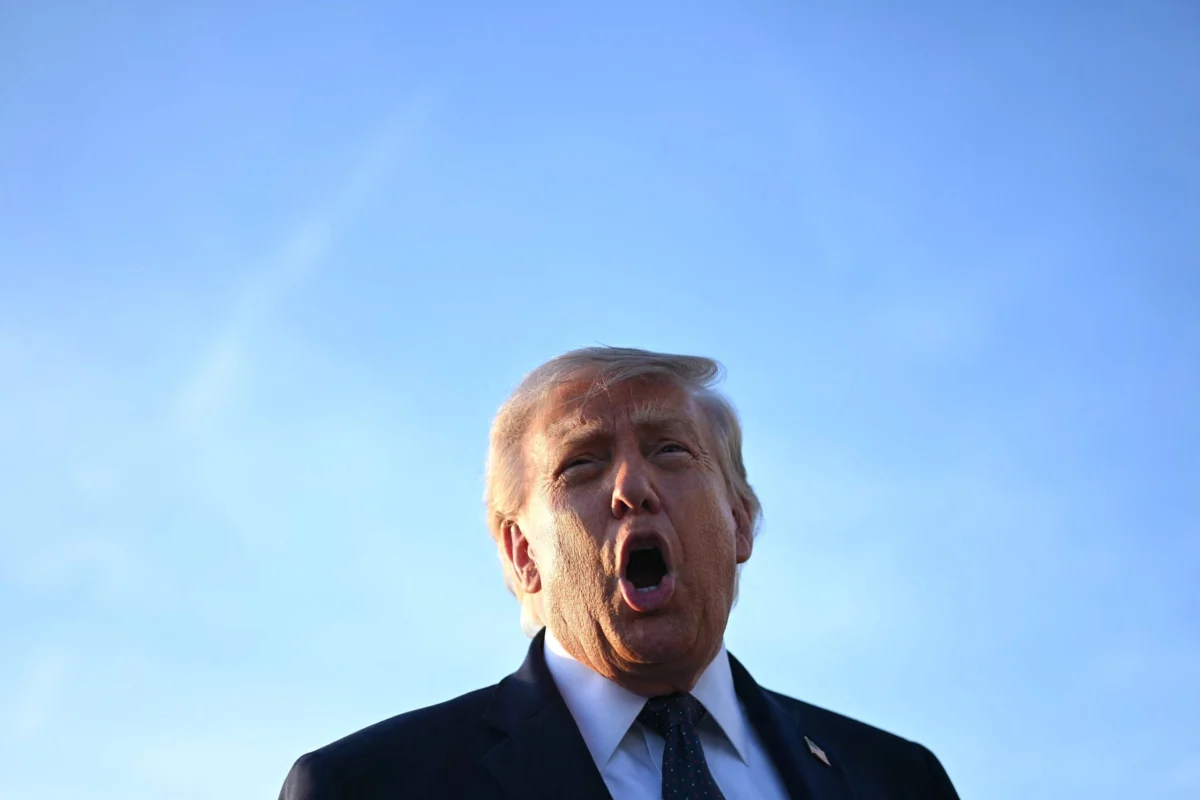
Former President Donald Trump has vehemently dismissed the escalating debate surrounding Artificial Intelligence (AI) safety, characterizing it as a fabricated concern orchestrated by "the Radical Left Dumocrats" with the explicit aim of undermining the nation. This declaration, made through a series of posts on his social network, Truth Social, on a recent Saturday, marks a significant and characteristically combative entry into a complex technological and ethical discussion.
A Chronology of Trump’s AI Stance and the Broader Debate
Trump initiated his commentary on AI with a linguistic critique, suggesting that the term "Artificial Intelligence" itself is "inaccurate, and very ineloquent." He subsequently launched a poll on Truth Social, inviting his followers to choose a more suitable moniker from options such as "Superior Intelligence," "Extreme Intelligence," or "Supreme Intelligence." This semantic diversion preceded a far more contentious pronouncement delivered just hours later.
In his follow-up post, Trump directly attacked the growing calls for AI safeguards, branding attempts at "the decimation, or destruction, of AI" as yet another in a long series of Democratic-engineered "hoaxes." He explicitly linked the AI safety debate to previous political flashpoints, citing "RUSSIA, RUSSIA, RUSSIA, UKRAINE, UKRAINE, UKRAINE, Global Warming, Impeachment Hoax #1, Impeachment Hoax #2, Men in Women’s Sports, [and] Transgender for Everyone." This rhetorical framing aligns with a recurring pattern in Trump’s political discourse, where critiques or concerns emanating from political opponents are frequently categorized as deliberate fabrications.
Trump then asserted his resolve to prevent any perceived "destruction" of AI, claiming that the current focus on AI safety follows a largely failed "crazed Data Center attack." He contended that critics initially targeted data centers until their economic value and prestige to local communities became apparent, prompting a shift in focus "straight at AI." Notably, the former president did not provide any corroborating evidence for his claims regarding the concerted "attack" on data centers or the insincerity of AI safety concerns. In reality, public and political scrutiny of both AI and data centers has been diverse and bipartisan, with concerns often stemming from environmental impact, energy consumption, and societal risks, rather than a singular partisan agenda. For instance, New York recently became the first U.S. state to impose a halt on permits for large data center projects, a move driven by environmental and energy concerns that transcend partisan lines.
These recent pronouncements echo sentiments Trump expressed at a golf tournament the preceding weekend, where he acknowledged openness to "guardrails" for AI but simultaneously attributed the heightened scrutiny to "a lot of negative forces that are bringing it up that shouldn’t be bringing it up."
The Intensifying AI Safety Debate: A Global Concern
Trump’s dismissive remarks arrive amidst a period of escalating global concern and debate over the ethical implications, societal impacts, and potential existential risks posed by advanced AI systems. The discussion gained significant traction recently when a prominent AI researcher publicly resigned from Anthropic, a leading AI development company. The researcher cited grave concerns that frontier AI firms "earnestly believe it could kill us all by the end of the decade" and are effectively "gambling with our lives." This stark warning from an insider sent ripples through the tech community and beyond.
In response to the growing alarm, Anthropic CEO Dario Amodei subsequently unveiled a plan to "pace the frontier" of AI development, emphasizing responsible innovation and safety protocols. This initiative received notable endorsements from key figures in the AI and tech industries, including OpenAI CEO Sam Altman and SpaceX CEO Elon Musk, signaling a broader acknowledgment within the industry of the need for structured approaches to AI risk management.
However, the AI safety debate itself is multifaceted. While some focus intensely on hypothetical existential threats, critics within the field of AI ethics and policy argue that the preoccupation with such distant scenarios can serve as a distraction from the more immediate and tangible harms of AI. These immediate concerns include algorithmic bias, the spread of misinformation via deepfakes, job displacement, privacy infringements through pervasive surveillance, and the potential for autonomous weapons systems. These issues are already manifesting in various forms and demand urgent regulatory and ethical frameworks.
Industry Reactions and Endorsements
Amidst this complex backdrop, Trump’s stance found a prominent ally in Nvidia CEO Jensen Huang. During an appearance at the All-In Summit, co-hosted by venture capitalist David Sacks (who previously served as Trump’s AI and crypto czar), Huang joined Trump on stage and publicly agreed with the former president’s characterization of the AI backlash as a "hoax." Huang further vowed that the industry "is not going to let" any slowdown in AI development occur, signaling a strong pro-growth, anti-regulation sentiment from one of the most influential figures in the AI hardware sector. Nvidia, a semiconductor giant, is currently a dominant force in providing the specialized chips essential for training and deploying advanced AI models, making its leadership’s perspective particularly impactful.
Trump’s Vision for AI: An "AI Force" and "AI Czar"
Beyond his critique of AI safety advocates, Trump also outlined his proactive vision for fostering the AI industry. He pledged to "cherish [the AI industry,] help it, and watch over it, as it grows." To this end, he announced his intention to establish an "AI Force," drawing a direct parallel to the Space Force, which he created during his first term in office. The Space Force, established in 2019, became the first new military service in over 70 years, tasked with organizing, training, and equipping forces to protect U.S. and allied interests in space. The proposed "AI Force" suggests a similar, dedicated governmental entity aimed at safeguarding and advancing AI capabilities, potentially with a national security dimension.
Accompanying the "AI Force" initiative, Trump also declared his forthcoming announcement of an "AI ‘Czar’" — a high-ranking official tasked with overseeing the nation’s AI strategy. In a characteristic addendum, he specified that "Only High I.Q. individuals need apply!" The precise duties and scope of authority for both the "AI Force" and the "AI Czar" remain undefined. The appointment of an AI czar is not unprecedented within the Trump administration; David Sacks previously held a similar role as Trump’s AI and crypto czar earlier in the year before stepping down to co-chair the President’s Council of Advisors on Science and Technology. This history suggests a pattern of engaging with prominent figures from the tech and venture capital sectors in advisory capacities regarding emerging technologies.
The Economic and Societal Landscape of AI and Data Centers
The debate over AI safety and the infrastructure supporting it, like data centers, unfolds against a backdrop of unprecedented technological advancement and economic transformation. The global AI market, valued at approximately $200 billion in 2023, is projected by some analyses to exceed $1.8 trillion by 2030, reflecting an astonishing rate of growth. This expansion is fueled by massive investments from venture capital and tech giants, driving innovation across various sectors from healthcare to finance to autonomous systems.
Data centers, the physical backbone of the digital economy and AI development, have also experienced a boom. The increasing demand for computing power, particularly for AI model training, has led to a proliferation of these facilities. However, their growth has not been without controversy. Data centers are enormous consumers of electricity, often drawing power equivalent to small cities, leading to significant carbon footprints and straining local energy grids. They also require vast amounts of water for cooling, posing environmental concerns in drought-prone regions. These environmental and resource-intensive aspects have generated genuine, grassroots opposition and regulatory scrutiny, as seen in New York’s moratorium on new projects. The bipartisan nature of these concerns suggests that opposition is rooted in tangible impacts rather than purely partisan motives.
Furthermore, the public’s perception of AI is complex and often ambivalent. While many recognize the potential benefits of AI in areas like medical diagnostics and scientific discovery, surveys consistently reveal widespread anxieties about job displacement, the spread of misinformation, and the ethical implications of autonomous decision-making. A 2023 Pew Research Center study, for instance, indicated that a majority of Americans express more concern than excitement about the increasing use of AI in daily life. This public sentiment often forms the basis for calls for greater regulation and safety measures, reflecting a genuine desire for responsible technological stewardship.
Implications for Policy, Industry, and Public Trust
Trump’s framing of AI safety concerns as a "hoax" carries significant implications for the future of AI policy, industry development, and public trust. By politicizing the debate, he risks further polarizing an already complex issue, potentially hindering bipartisan efforts to establish comprehensive and effective regulatory frameworks. Such rhetoric could encourage an "us vs. them" mentality, where genuine safety concerns are dismissed as partisan attacks, making it more challenging to achieve consensus on necessary safeguards.
For the AI industry, a presidential stance that champions unbridled growth while dismissing safety concerns could be seen as a green light for rapid expansion with minimal regulatory oversight. This aligns with the perspective of industry leaders like Jensen Huang, who prioritize innovation and market dominance. However, a lack of robust regulatory guardrails could also lead to unintended consequences, erode public trust, and ultimately invite more draconian interventions if major AI-related incidents occur.
The proposed "AI Force" and "AI Czar" represent a potential shift in how the U.S. government would approach AI governance under a future Trump administration. While the details are scant, the creation of a dedicated "force" suggests a national security-oriented approach, potentially prioritizing U.S. technological supremacy over other considerations. The role of an "AI Czar" could centralize policy direction, but its effectiveness would depend heavily on the appointee’s mandate, expertise, and ability to navigate the complex interplay between technological advancement, ethical considerations, and geopolitical competition.
In conclusion, Donald Trump’s unequivocal dismissal of AI safety concerns as a politically motivated "hoax" injects a highly contentious element into a critical global discussion. His proposed "AI Force" and "AI Czar" signal a distinct approach to fostering and governing this transformative technology. As AI continues its rapid advancement and integration into society, the interplay between political rhetoric, industry imperatives, and legitimate public concerns will profoundly shape its future trajectory and the frameworks designed to manage its immense power.
